


In a recent appearance on Utila's podcast, Notabene CEO Pelle Brændgaard made a point that runs against one of crypto's founding assumptions: that once a transaction settles, there is nothing anyone can do about it.
He explained why that assumption is starting to give way, and what opens up when regulated institutions can actually communicate with one another.
"For a lot of different fraud use cases, having a messaging system between trusted institutions allows you to do things that the crypto industry thought was impossible." — Pelle Brændgaard, CEO, Notabene
The missing response to fraud and error
Every payments system has to deal with fraud, theft, and honest mistakes.
Traditional finance built its answers over decades: returns, recalls, and coordinated processes between banks that trust each other enough to make them work. Crypto inherited none of that.
The moment funds land in the wrong place, whether because of a scam, a compromised account, or a payment sent in error, the sending side has had little real recourse. Recovery has often meant an email, a message to whoever might be on the other end, and hope that the counterparty cooperates.
That does not scale. And when it matters most, it leaves institutions without a consistent workflow or audit trail.
A trust layer changes the equation
The shift Pelle describes is not a change to how blockchains work. Settlement stays final, exactly as it was designed to be.
What changes is the layer above it.
When two regulated institutions speak a common language, they can do more than watch a transaction move one way. Either side of a transaction can request a return, attach the reason, and coordinate the return to a wallet address that has been verified before any funds move.
This is where the industry conversation needs to move beyond finality alone. Final settlement is important, but it is not the same as a complete payments operating model. If digital assets are going to support mainstream financial activity, institutions need the ability to manage exceptions, document decisions, and coordinate with counterparties when a transaction is technically complete but operationally unresolved.
That is the practical problem Revert is designed to address: giving institutions a way to coordinate after settlement, for the fraud and error cases where both sides of the transaction are trusted parties in a shared network.
It is a response to the the unilateral transaction problem that has defined crypto since the beginning. Not by undoing settlement on-chain, but by creating a trusted communication layer around it.
Built for the real world
Revert is not a magic recovery tool for funds that have already left the regulated perimeter. It works for fraud and error cases that move between institutions who have chosen to participate in a shared network.
And that participation is the whole point.
These flows work because the parties involved are regulated, want to be trusted, and have an interest in being trustworthy. Trust is not a nice-to-have layered on top of the technology. It is the mechanism that makes coordinated recovery possible at all.
As crypto matures into infrastructure that businesses depend on, the constructs that traditional payments take for granted are finally arriving. Not by changing the chain, but by building coordination on top of it.
Crypto settlement can stay final. But finality does not have to mean silence.
Learn more about Notabene Revert
Stack Chats Episode 4: Making Stablecoins Work Like Money with Sam Broner
Guest: Sam Broner, Founder & CEO, Better Money Company
Host: Pelle Braendgaard, CEO & Co-Founder, Notabene
Topics: Stablecoins, Payments Infrastructure, Stablecoin Clearing, Digital Money, Compliance, Interoperability
In this episode of Stack Chats, Notabene CEO Pelle Braendgaard sits down with Sam Broner, Founder and CEO of Better Money Company and former Andreessen Horowitz investor, to discuss stablecoin clearing, payment interoperability, and the infrastructure required to make stablecoins work at global scale.
Sam shares lessons from his career spanning Microsoft, MIT, the Boston Fed, and venture investing, and explains why the next phase of stablecoin adoption depends less on trading infrastructure and more on payment infrastructure.
Watch the full episode below:
Stablecoins are already faster, cheaper, and more global than traditional payment systems. Yet businesses still face operational challenges when using them for invoicing, treasury management, and cross-border payments. Pelle and Sam explore how Better Money Company is building the clearing infrastructure needed to make stablecoins behave more like traditional money while preserving the benefits of blockchain-based settlement.
📌 Topics include:
- Why stablecoins need clearing, not trading
- The hidden accounting challenges of stablecoin payments
- Stablecoin interoperability across chains and issuers
- Building payment-grade infrastructure for businesses
- The future of global stablecoin clearing networks
Pelle and Sam begin by discussing Sam's path from distributed systems engineering to stablecoin infrastructure. Their conversation quickly turns to one of the industry's biggest bottlenecks: businesses need certainty, predictability, and reconciliation tools before they can fully adopt stablecoin payments.
What follows is a look at the key themes they explored and why they matter for the future of financial infrastructure.
Key Takeaways
- Stablecoins have solved many money movement challenges but still lack payment-grade clearing infrastructure.
- Businesses require exact settlement amounts for accounting and reconciliation.
- Stablecoin interoperability is becoming increasingly important as more issuers and networks emerge.
- Clearing infrastructure can simplify payments while preserving compliance requirements.
- Better Money Company and Notabene are working to reduce friction in stablecoin payment workflows.
Stablecoins are better money, but payments are still too complicated
One of Sam's core arguments is simple: stablecoins have already solved many of the problems associated with moving money.
They are:
- Faster than traditional payment rails
- Available globally
- Programmable
- Available 24/7
- Lower cost than many existing systems
Yet despite these advantages, businesses still struggle to use stablecoins as a payment mechanism.
The reason is that moving between stablecoins often requires trading rather than payment processing.
Today, if a business wants to receive a specific stablecoin on a specific chain, the sender may need to swap assets through an exchange, liquidity provider, or trading venue. While this works for crypto-native users, it introduces unnecessary complexity for finance teams and payment operations.
As Sam explains, people do not exchange Wells Fargo dollars for Bank of America dollars before making a payment. The financial system already provides clearing infrastructure that abstracts away those differences.
Stablecoins need the same capability.
The missing layer: stablecoin clearing
Better Money Company's core product is a stablecoin clearinghouse.
Rather than forcing businesses to manage multiple chains, stablecoins, and liquidity venues, the clearinghouse allows participants to send one supported stablecoin and have the recipient receive exactly what they requested.
This creates a payment experience rather than a trading experience.
The model introduces several benefits:
- Predictable settlement
- Fixed-fee transactions
- Simplified reconciliation
- Reduced operational complexity
- Greater flexibility for senders and recipients
Instead of worrying about how funds move between assets behind the scenes, businesses can focus on the payment itself.
For finance teams, this distinction is critical.
Why finance teams care about exact amounts
One of the most practical parts of the conversation focuses on accounting and reconciliation.
Crypto-native users often focus on liquidity, swaps, and settlement speed. Finance teams care about something different: receiving the exact amount expected.
For invoicing, treasury operations, and accounting workflows, "close enough" is not good enough.
A business invoicing $789.87 needs to receive exactly $789.87.
Small variations caused by slippage, trading spreads, or liquidity fragmentation create operational headaches for finance teams that must reconcile every transaction.
This is where stablecoin clearing becomes particularly valuable.
By guaranteeing that recipients receive the exact amount specified, businesses can integrate stablecoin payments into existing accounting workflows without introducing additional reconciliation burdens.
Building the bridge between crypto and traditional finance
Sam's experience spans several worlds.
Before founding Better Money Company, he worked:
- As a distributed systems engineer at Microsoft
- On digital money research initiatives connected to the Boston Fed
- As an investor at Andreessen Horowitz focused on payments and stablecoins
Those experiences helped him identify a recurring challenge.
Crypto infrastructure often optimizes for traders, while financial institutions need systems optimized for payments, controls, and operational certainty.
The gap between those two worlds remains one of the biggest barriers to institutional adoption.
Rather than replacing existing financial processes, Better Money Company focuses on providing the payment guarantees businesses already expect.
Stablecoin interoperability will drive adoption
Another major theme is interoperability.
The stablecoin ecosystem is becoming increasingly fragmented.
New issuers, chains, and payment networks continue to emerge. While this innovation is healthy, it also creates complexity for businesses trying to accept payments.
Companies do not want to support dozens of different payment paths individually.
Instead, they want a simple way to:
- Send the stablecoin they hold
- Receive the stablecoin they prefer
- Maintain compliance requirements
- Reduce operational overhead
Sam argues that clearing infrastructure can serve as the connective tissue that enables this interoperability without requiring every participant to manage countless integrations.
Why compliance still matters
Throughout the discussion, both Pelle and Sam emphasize that stablecoin adoption requires trust.
Businesses need confidence that incoming funds originate from compliant sources and that payment flows meet regulatory expectations.
This is one reason the integration between Notabene Flow and Better Money Company is significant.
By combining:
- Better Money Company's stablecoin clearing infrastructure
- Notabene Flow's compliance and payment orchestration capabilities
businesses gain a payment experience that is both operationally simple and compliance-ready.
For regulated businesses, both pieces are necessary.
Bringing stablecoin clearing into Notabene Flow
Toward the end of the conversation, Pelle and Sam discuss the upcoming integration between Better Money Company and Notabene Flow.
The goal is straightforward:
A business can issue an invoice requesting payment in a specific stablecoin, while the payer can send a different supported stablecoin.
For example:
- An invoice requests RLUSD
- The payer holds USDC or USDG
- Better Money Company's clearing infrastructure handles the conversion and settlement
- The recipient receives the exact asset and amount requested
This reduces friction for both sides while preserving accurate reconciliation and compliance workflows.
The result is a simpler stablecoin payment experience that feels more like traditional financial infrastructure.
What comes next
As stablecoin adoption accelerates, infrastructure providers are increasingly focused on making digital asset payments easier to use rather than simply faster to settle.
The next phase of growth will depend on solving practical business challenges:
- Reconciliation
- Accounting
- Interoperability
- Compliance
- Operational efficiency
Sam believes stablecoins have already won on technology.
The next challenge is making them work seamlessly within the systems businesses already use every day.
If successful, stablecoin clearing could become one of the foundational layers that enables broader adoption across payments, treasury, fintech, and global commerce.
Episode breakdown
Here is a quick minute-by-minute guide to the conversation:
00:00 - 04:00
Sam's background from Microsoft and MIT to Andreessen Horowitz and the founding of Better Money Company.
04:00 - 08:00
Why stablecoins are already better money and the limitations of today's payment infrastructure.
08:00 - 13:00
The difference between trading and clearing and why payment flows need a new model.
13:00 - 18:00
Accounting, reconciliation, and the operational challenges businesses face when using stablecoins.
18:00 - 24:00
Interoperability across stablecoins, chains, and payment networks.
24:00 - 30:00
Building payment-grade infrastructure for financial institutions and enterprises.
30:00 - End
The Better Money Company and Notabene Flow integration and the future of stablecoin payments.
🎙️ Stack Chats is Notabene's video series for product leaders, fintech builders, and infrastructure innovators shaping the next generation of blockchain-based payments.
For the first time in OFAC's history, U.S. regulators are codifying an explicit sanctions compliance program requirement in regulation. For the first time, FinCEN is treating stablecoin issuers as a distinct financial institution category under the Bank Secrecy Act rather than as money services businesses with a crypto wrapper.
The joint proposed rule FinCEN and OFAC issued in April implementing the Permitted Payment Stablecoin Issuer (PPSI) framework under the GENIUS Act is the most consequential digital asset rulemaking the U.S. has embarked on in a decade.
Notabene filed our response to the notice of proposed rulemaking (NPRM), answering eleven substantive questions across the AML/CFT and sanctions program sections.
Three positions anchor what we filed, and the choices regulators make in finalizing this rule will shape the next decade of stablecoin payments.
Travel Rule codification has to be designed for cross-border use
The Travel Rule already applies to stablecoin transfers under existing 31 CFR 1010.410(e) and (f), as FinCEN's 2019 guidance made clear. Codifying it in a dedicated Part 1033 for PPSIs removes the ambiguity slowing U.S. implementation and gives institutions a clean foundation to build compliance programs on.
The codification has to be designed for international interoperability from day one. We recommended FinCEN endorse IVMS 101 as the data standard for transmittal-level identifying information, and require the messaging layer carrying it to operate on open and interoperable standards.
Read more about our commitment to open standards here
We also asked FinCEN to align the U.S. threshold with the FATF Recommendation 16 as Travel Rule compliance is collaborative by design. One institution's ability to comply depends on its counterparty's ability to receive and process the data, and the U.S. threshold of $3,000 is now the highest among peer jurisdictions with active enforcement. The EU and UK, for example, enforce at zero threshold.
Threshold and data-set divergence is not abstract and it causes operational headaches. When a U.S. institution sends a stablecoin transfer to an EU counterparty with only the U.S. data set, the receiving EU CASP is required by the EU Transfer of Funds Regulation and the EBA Travel Rule Guidelines to detect the missing fields and decide whether to execute, request the missing data, reject, return, or suspend the transfer. When the EU CASP requests missing data from a non-EU sender, the EBA Guidelines give the sender a five working day window to supply it. The transfer is treated as suspended in the meantime. Repeated sub-standard transmissions can show up as a counterparty-risk flag on the EU side and trigger reporting to the EU CASP's competent authority under Article 17 of the TFR.
The result is that U.S. PPSIs and their global counterparties end up at a disadvantage relative to actors operating outside regulated channels, where no such friction applies. Threshold and data-set alignment with the FATF Recommendation 16 trajectory is what closes that gap.
Block, freeze, and reject only work before settlement
Public blockchains have no built-in mechanism for evaluating a transaction before settlement. Once a transfer is initiated on-chain, it settles. A PPSI without pre-transaction authorization infrastructure is limited to reactive measures, freezing assets after they arrive rather than preventing transfers from occurring.
The GENIUS Act's block, freeze, and reject obligations under proposed 31 CFR 502.201(b)(3) are therefore architectural requirements, not just programmatic ones. Pre-transaction authorization is the mechanism that meets them.
Authorization-before-settlement models work through a private messaging layer operating alongside the blockchain. The two institutions party to a transfer exchange Travel Rule data, perform sanctions screening, assess counterparty risk, and make an explicit authorize-or-reject decision before on-chain settlement. The Transaction Authorization Protocol (TAP) is one open standard implementation of this approach.
We asked OFAC to recognize pre-transaction authorization architectures as a compliant technical implementation, without mandating any specific protocol.
The recognition matters because pre-transaction authorization pairs with, rather than replaces, the freeze, burn, and reissue capabilities GENIUS Act Section 5(a)(2) grounds. Proactive authorization at the transaction level and reactive freeze at the asset level form a complete sanctions architecture no traditional financial institution has access to.
The primary and secondary market distinction is operationally correct
FinCEN's proposed framework draws a clean line between activity where the PPSI is a direct party (primary market, where full programmatic obligations apply) and activity where the PPSI is observing smart contract operation as an issuer rather than as a transacting party (secondary market, where contract-layer interventions are narrowly scoped). We agree with how the line is drawn and think the rule should preserve it.
Any secondary market intervention authority outside lawful orders should be narrow, explicit, tied to defined triggers, and paired with an express liability safe harbor. Institutions holding the customer relationship and the Travel Rule channel are best positioned to enforce sanctions and AML controls in secondary market activity. The PPSI is best positioned to execute targeted contract-layer interventions when an objective trigger is met.
A narrow scope here protects the predictability making payment stablecoins viable as payment infrastructure. A broad or discretionary one shifts effective authorization control to an actor not party to the transfer and not participating in pre-transaction review. That breaks the architecture, and the institutions party to the transfer end up with no certainty about whether an authorized transfer will settle.
What's at stake
This rulemaking will decide whether the U.S. ends up with a stablecoin payment system designed for cross-border interoperability or one engineered around U.S.-specific architectures the rest of the world has already moved past.
The full Notabene submission can be found here, and is on regulations.gov under Docket FINCEN-2026-0100.
Additional analysis will follow over the coming weeks on OFAC sanctions architecture, the special standards of diligence framework for cross-border PPSI counterparty relationships, and the foreign payment stablecoin issuer equivalence question.
Questions? Contact our Regulatory & Compliance team here.
Any payer holding funds at an institution on the Notabene Network can now complete a Notabene Flow payment with no additional integration required
NEW YORK, June 4: Notabene, the trust layer for global money movement, today announced that customers of hundreds of regulated digital asset institutions can now complete Notabene Flow payments directly from accounts they already use. The milestone extends Notabene Flow's reach to the customers of every institution integrated on the Notabene Network — the largest global network of regulated digital asset institutions, spanning 2,000+ entities across 100+ jurisdictions and processing trillions of dollars of transaction volume annually.
The activation follows a network-wide rollout of Notabene Flow responder capabilities to Notabene's existing customer base — the exchanges, custodians, payment providers, and banks already running Travel Rule-compliant multi-party flows on the Notabene Network. Any business that issues a Notabene Flow payment link today can expect the recipient to complete the transaction directly from their hosted wallet at one of these institutions, with no separate onboarding required on their end. Payers can also complete Notabene Flow payments using a self-hosted wallet through the Notabene platform.
"The value of a payment network comes down to reach — whether the person you're trying to pay can actually receive it from wherever their funds are held," said Pelle Braendgaard, CEO of Notabene. "Hundreds of live responders means that when a business sends a Notabene Flow payment link today, the recipient can pay from their existing account at an institution already on the network. Building that kind of reach on an open network, rather than a closed one, is what makes it genuinely useful at scale."
Notabene Flow launched in September 2025 as the first open stablecoin payments network that authorizes every B2B invoice before it settles and reconciles it as it arrives — across any wallet, network, or jurisdiction. The network is built on the Transaction Authorization Protocol (TAP), an open messaging standard that any regulated institution can implement regardless of which custody or infrastructure provider, assets or blockchain they use.
Businesses can join the Notabene Flow network today to enable high-value cross-border B2B payments, using pull payments, structured invoicing, and Travel Rule-compliant multi-party payment flows at notabene.id/join-flow.
About Notabene
Notabene is the trust layer for global money movement. The Notabene network connects thousands of trusted counterparties, facilitating trillions of dollars in transaction volume annually across over 100 jurisdictions. Notabene provides industry-leading tools for stablecoin payment coordination, real-time transaction authorization, counterparty verification, and self-hosted wallet identification—helping institutions build trust into every transaction.
Learn more at notabene.id
Media Contact:
Clay Fain
VP Marketing
[email protected]
According to the Chainalysis 2026 Crypto Crime Report, in 2025, illicit crypto addresses received over $154 billion which is a 162%increase year over year. Further, 84% of all illicit volume moved through stablecoins, which is up from 63% the year before. Sanctions evasion alone grew 694%.[1] The numbers should reframe how every compliance team in the United States is reading the GENIUS Act.
Now read the GENIUS Act and ask yourself: does this law address where the risk lives?
The Architecture Is Pointed at the Wrong Thing
The GENIUS Act is a serious piece of legislation. The first federal statute to define payment stablecoins as a distinct asset class. Reserve requirements. Redemption mechanics. Issuer governance. Bank-level AML obligations for permitted issuers. All necessary.
But here is the thing nobody is saying out loud. The entire architecture of GENIUS is built around regulating the issuer. The act defines who is permitted to issue. Who must hold reserves. Who must attest monthly. Issuer, issuer, issuer.
The problem is the risk does not live with the issuer.
Risk in stablecoin payments lives in the network. Wallets. Exchanges. Intermediaries. Cross-chain flows. Counterparty institutions in jurisdictions with weak or nonexistent supervision.
Regulate a stablecoin issuer perfectly and the 84% still flows right through. Require pristine reserves, monthly attestations, full BSA compliance at the issuance point. None of these addresses what happens to the tokens once they leave the issuer's custody.
The Rulemaking to Read First
One piece of GENIUS implementation is focused on the network reality. The FinCEN/OFAC joint NPRM, released for public comment in April with a June 9 deadline, amends 31 CFR 1010.100(eee). [2] For the first time, the U.S. is codifying the Travel Rule for digital assets into federal statute.
This matters more than the headline rulemakings most teams are tracking. The Travel Rule is the only mitigating control we have before a transaction settles. No correspondent bank holding the message in a queue. No three-day window for sanctions review. The compliance work has to happen before the transaction broadcasts.
The Travel Rule pairs two BSA obligations the U.S. has had on the books since the mid-1990s for wire transfers. Recordkeeping for what you hold. Information exchange for what you pass to the next institution in the chain. FinCEN extended these obligations to crypto in 2019. [3] The April NPRM is the codification.
The international picture has moved further. According to FATF, 87% of material jurisdictions have either implemented Travel Rule for crypto or are in the process. [4] The UK has been live since September 2023. [5] The EU went live under the Transfer of Funds Regulation on December 30, 2024. [6] The U.S. is now closing the implementation gap.
What Winners Are Doing Differently
Most firms approach a new regulatory regime by reading the rule, writing a memo, running the memo through legal, building a compliance program around the memo. Six months later they realize they have a policy and no operational capability.
The teams winning this approach the work differently. They start with their transaction flows. They map their counterparty universe. They identify decision points where data has to be collected, screened, exchanged, or held. They architect for configurability because GENIUS is one regime among several.
Address screening alone is no longer sufficient. Identifying a counterparty institution at the time of every transfer is no longer optional. Real-time pre-transaction authorization is what counterparties and examiners now expect. The firms reading GENIUS as a checkbox on issuer reserves are going to be surprised when their counterparty diligence questionnaires double in length next quarter.
The Read
The act addresses issuer accountability, which is necessary. But the risk lives in the network. Miss the network framing and you have a beautifully regulated issuer base with bad actors flowing 84% of their illicit volume right through the rails.
From where we sit at Notabene, supporting Travel Rule and transaction authorization across more than 2,000 institutions in 100 plus jurisdictions, the firms moving fastest right now are treating GENIUS as a network problem from day one. They are not waiting for final rules. They are architecting for the operational reality the NPRMs already describe.
Bad compliance is a barrier to growth. Good compliance is infrastructure for growth. Compliance is now a feature of the platform, not a wrapper around the platform.
The winners here won't be the most compliant. They'll be the most operationally adaptable.
Last week at Stablecon in Amsterdam, I was on a panel called "Killing the Fiat Stablecoin Sandwich" with Simon Taylor (Tempo), Tyler Sherwin (BVNK), and Tedd Huff (Fintech Confidential).
We had a good debate about the pros and cons of the current implementation of the stablecoin sandwich. But I came away thinking the whole framing, mine included, was off.
The stablecoin sandwich isn't the real problem. The word "stablecoin" is.
The day prior to the panel I had a call with the digital assets GM at a major European bank. He said something that stuck:
"From our perspective, a stablecoin is just a settlement mechanism between fiat accounts. The enterprise instructs us to move money. Whether it goes via Swift or stablecoin rails, it lands as fiat on the other side."
That's it. He's right. And once you accept that, the whole "sandwich" debate looks different.
The "stablecoin" name is doing a lot of damage
"Stablecoin" sounds like a crypto asset that happens to be price-stable. Something exotic. Something you need to convert into and out of. That framing comes from crypto, from a world where on/off ramps are real because you're genuinely leaving fiat when you buy Bitcoin.
But USDC is just dollars. EURC is just euros. When you "on-ramp" to USDC, you never left fiat. You just changed the form factor. There is no ramp. There's no sandwich. There's just fiat sitting in a different kind of account.
It's all just money
M0, M1, and M2 are all fiat. Physical cash, checking accounts, savings accounts: different properties, different forms, same underlying asset. We don't call a savings account an "M2coin." We don't build conversion infrastructure between your checking account and your money market fund and call it a sandwich.
Tokenized money market funds are basically M2. Tokenized deposits are M1 or M2 depending on the form. Stablecoins don't fit neatly into the existing categories, but they belong in the same family. They're a new form of fiat with slightly different properties that they share with their other tokenized money cousins: programmable, blockchain-settled, 24/7. Not a foreign asset.
So why does the sandwich exist?
Because we borrowed crypto infrastructure (tokenization, blockchains, wallets) for a fiat asset, but kept the crypto mental model around it. The result is two conversion events that don't need to exist, a PSP sitting in the middle taking margin, and correspondent banking rebuilt at higher cost with extra steps.
The current batch of stablecoin orchestrators (as they came to be known) built the Wise model for stablecoins. That's useful. It works. But it's a stepping stone, not the destination. This PSP model exists because banks aren't plugged into stablecoin rails natively. Once they are, the on/off ramps dissolve.
One of the things we did discuss on stage at Stablecon is that this model, just like Wise recreates all the bad parts of correspondent banking. Not because of any specific properties of stablecoins, but because they still rely on pre-funded accounts and bilateral agreements to operate (aka correspondent banking).
The end state is simpler than the sandwich
It's account-to-account transfers on open, programmable rails. The stablecoin is the settlement layer, invisible to the enterprise, just like ACH or SWIFT is invisible today. The bank's treasury team picks the right stablecoin for the corridor. The CFO sees euros leave and euros arrive.
No sandwich. Just payments.
I argued at Stablecon that the sandwich scales badly: custody concentration, treasury risk, limited reachability. That's still true. But the deeper point is that we've been debating how to improve the sandwich when we should be asking why we're making sandwiches with fiat in the first place.
Stablecoins are just fiat. The sooner we name them that way, the better the infrastructure we'll build around them.
On 20 May 2026, the European Commission’s Directorate-General for Financial Stability, Financial Services and Capital Markets Union (DG FISMA) opened its targeted consultation on the review of the Markets in Crypto-Assets Regulation (MiCA). Responses are due by 31 August 2026 and must be submitted through the Commission’s online questionnaire.
The consultation has two tracks: a public consultation for individuals, and a targeted consultation for specialised stakeholders, covering more technical and legal questions. This article focuses on the targeted consultation.
This is the first formal step in the legislative review process anticipated under Article 140 of MiCA. The Commission is expected to report to the European Parliament and Council by 30 June 2027, on the application of MiCA and, where appropriate, accompany that report with a legislative proposal — what the market already refers to as “MiCA 2”.
Want to talk this through? Join us on 4 June, 2026, for a live webinar on From Transition to Transformation: MiCA Grandfathering Ends, the New Consultation, and What Comes Next - where we will unpack the consultation question by question and discuss what is at stake before the 31 August deadline.
Why this consultation matters
MiCA was designed before today’s stablecoin, tokenisation and DeFi markets had fully taken shape. It began applying in stages from 2024, but the market has continued to move quickly, and other jurisdictions have now put forward their own frameworks.
That is the backdrop to this consultation. The Commission is asking whether MiCA remains fit for purpose in a rapidly evolving global market, and whether the EU framework should be adjusted to reflect what has changed since the regulation was adopted.
The exercise is not limited to small technical corrections. It reopens core policy questions about Europe’s digital finance framework: whether MiCA can support globally relevant euro-denominated stablecoins, how the EU should position itself in a market increasingly shaped by USD denominated global stablecoins, where the regulatory perimeter should sit, and whether the current crypto-asset service providers (CASPs) framework is strong enough to protect the integrity of the EU market in practice.
The consultation is organised into four parts:
- Scope and definitions for crypto-assets other than asset-referenced tokens (ARTs) and e-money tokens (EMTs)
- Requirements applying to ARTs, EMTs and their issuers
- The legal framework for CASPs
- Topics outside MiCA’s original scope, including decentralised finance, prediction markets, tokenised deposits and legal certainty for natively issued on-chain assets
Below are some of the key themes to watch.
Part 1: Where does MiCA’s perimeter sit?
The first part of the consultation deals with crypto-assets that are neither ARTs nor EMTs — what MiCA calls “other crypto-assets”. It opens with the architectural question at the heart of the framework: where should the boundary between MiCA and sectoral financial services legislation sit?
Today, crypto-assets that qualify as financial instruments remain outside MiCA and are instead governed by frameworks such as MiFID II, MAR and the Prospectus Regulation. That reflects the principle of “same activity, same risk, same rules”.
The challenge is that market reality is testing that boundary in both directions. Traditional financial institutions are entering the MiCA-regulated crypto-asset space. MiCA-authorised entities are expanding into products that look closer to traditional financial instruments. Tokenised fund interests, tokenised money-market instruments, wrapped assets, governance tokens, all raise difficult classification questions.
The consultation also revisits the design of Title II, including the white paper framework, marketing rules, ex ante notification model, retail withdrawal rights, civil liability and post-issuance updates. The Commission is asking whether the current model strikes the right balance between investor protection, market integrity and innovation.
Part 2: Stablecoins take centre stage
Part 2 is the longest and arguably the most politically charged section of the consultation. The Commission structures the discussion around three themes: the future role of stablecoins in the EU, the calibration of MiCA’s existing rules, and the treatment of global stablecoins.
The future role of stablecoins
The consultation begins by asking what stablecoins should become in the EU over the next five to ten years. Are they likely to become a mainstream retail payment instrument? A wholesale settlement rail? A complement to existing payment methods for cross-border payments? Or a transitional product that will eventually be displaced by CBDCs or commercial bank money innovations?
That framing is important because the answer drives the policy choices that follow. If stablecoins are treated mainly as crypto trading instruments, the focus is likely to remain on investor protection and market integrity. If they are treated as payment infrastructure, then redemption, liquidity, reserve management, operational resilience and supervisory reporting become much more central.
The consultation also asks how beneficial stablecoins could be for concrete use cases, including international payments, retail payments, wholesale payments, settlement of tokenised financial instruments, corporate treasury management and access to programmable financial services.
A clear vision of these use cases is essential for an informed policy debate. Stablecoins’ risks depend heavily on how they are used, at what scale, by whom, and in connection with which parts of the financial system.
Reopening the debate on interest-bearing stablecoins
The consultation reopens one of the most politically sensitive questions in MiCA: whether the prohibition on interest for EMTs and ARTs remains appropriate in its current form.
Under MiCA, issuers of e-money tokens are prohibited from granting interest in relation to EMTs. The prohibition also applies to CASPs providing services related to EMTs, and “interest” is defined broadly to include any remuneration or other benefit linked to the length of time a holder holds the token.
That design reflects MiCA’s original policy choice: EMTs should function as means of payment, not as store-of-value products competing with bank deposits. But the effect is that euro EMTs are structurally non-remunerated even where the reserves backing them generate income. As the Blockchain for Europe Joint Report “Reforming MiCA for Euro Stablecoins” argues, this can weaken the competitiveness of euro-denominated stablecoins and push users either toward foreign-currency stablecoins or toward yield structures outside the regulated perimeter.
The consultation puts several questions back on the table. Should MiCA continue to prohibit all holder benefits linked to time held, even where they are funded solely from low-risk reserve income? Should the regime distinguish between issuer-paid interest, third-party rewards and regulated pass-through remuneration? And would allowing limited remuneration improve the competitiveness of euro EMTs, or would it create unacceptable risks for bank funding and monetary transmission?
Global stablecoins and multi-issuance
A key part of the stablecoin discussion concerns global stablecoins and, in particular, multi-issuance models.
There are two questions running in parallel here. The first is a legal one: does MiCA, as currently written, allow multi-issuer models? The Commission gives a clear answer in the consultation. In its view, MiCA does not currently prohibit them.
That statement matters because EU authorities have adopted divergent stances:
- The ECB, in its 10 April 2026 non-paper on EU and third country stablecoin multi-issuance, argues for a reading of MiCA that would not permit third-country multi-issuance. Its concern is that third-country issuers are not generally required to comply with protections equivalent to MiCA, and that multi-issuance could expose EU token holders — and potentially the EU financial system as a whole — to material risk.
- The European Systemic Risk Board reached a similar conclusion in its September 2025 recommendation. It flagged third-country multi-issuer schemes as amplifying financial stability risks that Union supervisors cannot adequately assess from outside the EU, and recommended that the Commission should not consider such schemes to be permitted under the current MiCAR framework.
The second question is a policy one: even if multi-issuance is not prohibited under the current text, should MiCA continue to allow it, and under what conditions?
That is the debate the Commission is now reopening. It asks whether EU users and businesses benefit from access to global stablecoins, how important it is that such access is provided through EU-licensed issuers and CASPs, and what safeguards would be needed to manage the risks of multi-issuance.
Particularly, the consultation asks whether MiCA’s existing safeguards can mitigate multi-issuance risks and, more specifically, whether the EU share of a globally fungible stablecoin can be determined with sufficient accuracy and frequency, especially where tokens circulate through self-hosted wallets.
That question sits at the intersection of MiCA’s prudential framework and the compliance infrastructure needed to make that framework operational. On-chain data may show that a transfer occurred, but it does not, by itself, tell a supervisor whether the transfer changed the person legally entitled to the token, whether the holder is located in the Union, whether the holder is retail or institutional, or whether the movement was a payment or a first-party transfer.
That information cannot be inferred with supervisory confidence from on-chain data alone. It requires identity and transaction-context data held by CASPs, issuers and other reporting infrastructures.
This is where Travel Rule architecture becomes relevant beyond its AML/CFT purpose. Originator, beneficiary and wallet-control data can help attach legal and prudential meaning to otherwise pseudonymous on-chain flows. Multi-issuance safeguards — especially any mechanism that rebalances reserves between an EU issuer and a third-country issuer based on estimated EU holdings — are only as reliable as the data used to identify those EU holdings in the first place.
Effective Travel Rule implementation is therefore instrumental to unlocking properly managed multi-issuance frameworks.
Finally, the consultation also asks whether the EU should introduce an equivalence regime for global stablecoins, and how much reliance should be placed on third-country supervision.
This debate is in direct dialogue with the emerging U.S. approach. The GENIUS Act creates a controlled access route for foreign payment stablecoin issuers whose tokens are offered into the U.S. market. The foreign issuer must operate under a comparable home regime, register with the Comptroller of the Currency, and hold reserves in a U.S. financial institution sufficient to meet the liquidity demands of U.S. customers, unless a reciprocal arrangement provides otherwise.
The EU is confronting a similar policy problem. A globally transferable stablecoin may be issued, distributed or managed across several jurisdictions, but redemption pressure, liquidity risk and consumer protection concerns materialise locally. The policy question is how to preserve access to global liquidity while ensuring that EU holders are not dependent entirely on reserves, redemption arrangements and supervisory powers located outside the Union.
Part 3: The CASP perimeter after grandfathering
Part 3 examines the legal framework for CASPs. It revisits the scope of crypto-asset services under Article 3(16), the prudential regime and minimum capital requirements for different classes of CASPs, and the interaction between MiCA and the revised payments framework for transfer services involving EMTs.
One question stands out as the EU approaches the end of MiCA’s grandfathering period: are unauthorised crypto-asset service providers continuing to serve EU users?
This question goes to the credibility of the MiCA perimeter. By the end of the transitional period, the market is expected to look materially different. Around 200 CASPs are authorised according to ESMA’s Interim MiCA register, while there is an expectation that approximately 75% of the pre-MiCA VASP population will lose its registration status as national transitional periods expire.
Against that backdrop, the relevant supervisory question is not only which firms become authorised under MiCA, but also whether firms outside the EU authorisation framework continue to serve EU residents, and what tools supervisors or enforcement authorities should have to stop unauthorised service provision.
MiCA-authorised CASPs are investing in licensing, governance, safeguarding, conduct rules, operational resilience, market abuse controls and prudential requirements. If offshore or otherwise unauthorised providers can continue to serve EU residents, the result is an uneven playing field. Consumers remain exposed to providers outside the EU supervisory framework, while authorised firms carry the cost of compliance without the benefit of a protected market.
The FATF’s 2026 report on offshore VASPs is directly relevant here. It points to the risk that regulatory or enforcement developments can shift user activity toward offshore, unregistered providers. It also highlights the need for clearer criteria on what counts as active service provision into a jurisdiction, expectations for authorised VASPs to assess exposure to unlicensed counterparties, and stronger host-jurisdiction powers against offshore providers targeting local residents without authorisation.
These points map closely onto the post-grandfathering MiCA environment. The success of MiCA will depend on making sure its perimeter is meaningful in practice.
Part 4: Revisiting what MiCA left outside
The final part of the consultation looks at activities that were left outside MiCA’s original scope and asks whether the perimeter should now be redrawn.
Decentralised finance
MiCA excludes crypto-asset services provided in a fully decentralised manner without intermediaries. While that may sound straightforward, in practice decentralisation is rarely binary.
The consultation asks how to assess whether a service is truly fully decentralised and what indicators should matter: control over the protocol, governance rights, admin keys, front-end control, revenue capture, upgradeability, or the ability of identifiable persons to influence outcomes.
It also asks what role CASPs should play when connecting users to DeFi. Options range from warnings and disclosures, to CASP liability for incidents, to limiting access to certified applications or verified pools, to whitelists, blacklists or outright restrictions on CASP facilitation of DeFi access.
Prediction markets
The consultation also asks whether DLT-enabled prediction markets create opportunities or risks for EU consumers and markets, and whether they should fall under MiFID or MiCA when facilitated through smart contracts.
In the U.S., prediction markets have become a live test case for regulatory perimeter-setting. The CFTC is pursuing a clearer federal framework for prediction markets, asserting that event contracts offered to the public may fall within the Commodity Exchange Act as swaps or futures traded on regulated venues, while several states continue to challenge certain markets as gambling or contrary to public policy.
Tokenised deposits and natively issued assets
The consultation also explores tokenised deposits, including their use cases, regulatory constraints and interaction with the CRD/CRR framework and the Deposit Guarantee Schemes Directive.
This is part of a broader question running through the consultation: how should EU law treat assets that are issued, recorded and transferred natively on-chain?
If tokenised deposits, tokenised securities, stablecoins and natively issued assets are expected to support future financial market infrastructure, participants need clarity on legal nature, transfer finality, holder rights, insolvency treatment and supervisory responsibilities.
What comes next
Responses to the consultation are due by 31 August 2026 through the online questionnaire on the Commission's website.
Notabene will be following this consultation closely and engaging in the policy conversation.
If you want to dig into what the end of the grandfathering period and the new consultation mean in practice, join us for our upcoming webinar on June 11, 2026:
— From Transition to Transformation: MiCA Grandfathering Ends, the New Consultation, and What Comes Next. We'll walk through the policy choices on the table and what they mean for the future of Europe’s digital financial infrastructure.

This week, two executive orders signed on the same day. While most coverage is treating them as separate stories, when read together, they are really one important compliance story.
The Fintech Integration EO
The Fintech Integration EO asks the Federal Reserve to evaluate direct access to Reserve Bank payment accounts for non-bank financial companies, naming digital asset firms in the text. For stablecoin issuers, custodians, and digital asset infrastructure, this is the master account fight finally landing on a federal clock.
This fight has been the most consequential unresolved piece of U.S. digital asset policy for years. Reserve Bank discretion is exercised on a case-by-case basis without a consistent standard. The result has been a payment system where digital asset firms could approach but not enter, dependent on sponsor banks willing to take on the relationship risk. This EO doesn't resolve the access question on its own, but it does force the Federal Reserve to put a transparent framework on paper within four months, and if the conclusion is that existing law permits expanded access, the 90-day application clock starts running.
The Restoring Integrity EO
The Restoring Integrity EO, signed the same day, gives Treasury 90 days to propose BSA changes that strengthen risk-based CDD and beneficial ownership identification, and 180 days to revisit CIP requirements. The mechanism reaches every covered institution.
How the two work together
A helpful way to think about these two EOs together is that one opens a door, while the other raises the bar for anyone walking through it.
For stablecoin issuers, the operational picture changes overnight if the Federal Reserve Bank concludes existing law permits expanded access. They will have access to direct settlement and real-time payment network participation with no sponsor bank in the middle. Settlement risk profiles, capital efficiency, and the operational architecture of a stablecoin business all look different the day after that determination lands.
The price of that access is becoming clearer too. The CDD and CIP changes pull domestic U.S. identity standards much closer to what FATF Recommendation 16 already demands cross-border. The gap between what a U.S. bank has been expected to collect on a domestic account opening and what a VASP has been expected to collect on a Travel Rule transfer has been wide for years. A U.S. bank could open an account with minimum FinCEN CDD compliance. A VASP sending the same customer's funds cross-border had to satisfy originator and beneficiary information requirements that went substantially further. These orders close that gap from the domestic side.
The firms already operating to FATF-aligned standards have been doing it because they had to, while the firms that built compliance programs to the higher standard absorbed the cost. That gap is what's closing.
Four Key Takeaways
Here are the four things compliance teams should be thinking about in the wake of these EOs.
- Pressure-test your CIP program documentation against a tighter BSA standard. The Treasury advisory lands in 60 days and the proposed BSA changes land in 90.
- Audit your beneficial ownership controls. If your onboarding is built to the minimum FinCEN CDD rule, the floor is moving and your program is about to look thinner than it did last week.
- Map your counterparty due diligence to FATF R.16. The standards being raised domestically are the ones FATF has expected on the originator and beneficiary side for years. Domestic and cross-border requirements are converging.
- If you are pursuing a Fed master account, get your application-readiness package together now. When the 90-day clock starts, firms with documented, examiner-ready programs move first.
In the end, most "good enough" compliance setups will not hold under these new rules. The firms treating May 19 as an inflection point will be the ones positioned when access expands.
At Stablecon 2026, Notabene CEO Pelle Brændgaard joined Simon Taylor (Tempo), Tyler Sherwin (BVNK), and moderator Tedd Huff (Fintech Confidential) for a panel on the stablecoin sandwich — the model where fiat goes in one side, stablecoins settle in the middle, and fiat comes out the other.
The conversation covers where the model works, where it breaks down, and what comes after it. Pelle makes the case that the strongest product-market fit today is the "open-face sandwich" — transactions where one side has already gone stablecoin-native — and argues that corridor-by-corridor expansion is re-implementing the worst parts of correspondent banking. Simon Taylor draws parallels to the early internet and Clayton Christensen's innovator's dilemma. Tyler Sherwin shares how BVNK approaches the operational reality of scaling across geographies without trying to own the full stack.
The panel closes with a pointed exchange about why banks treat stablecoin-based payments as high-risk remittance, and what that says about the economics of risk categorization.
Key moments
1:33 — Pelle introduces Notabene as a SWIFT-like network for crypto and explains why stablecoins on public blockchains are the first truly open-loop payment system ever built.
4:04 — Simon defines the stablecoin sandwich: fiat in, stablecoin settlement, fiat out — and why the model has been so successful for markets outside the G20.
5:46 — Pelle on the open-face sandwich: why the strongest product-market fit is where one side of the transaction has already gone native, and why the full sandwich is a temporary measure. ("I'm Danish. In Denmark we have open-face sandwiches.")
7:30 — Tyler on real-world corridors: how BVNK handles fiat on-ramps across three major currencies and lets local providers handle the last mile.
9:58 — Simon on treasury use cases: why bank holidays and weekend closures cost global PSPs real money, and how stablecoins solve the liquidity gap.
11:30 — Pelle on the corridor trap: how stablecoin companies have been forced to re-implement the worst parts of correspondent banking — prefunding, bilateral agreements, corridor-by-corridor expansion — instead of building product. ("Let's just go full keto.")
14:23 — Pelle on why banks require more KYC than regulation demands: the fiat partners on both sides treat the stablecoin sandwich as high-risk remittance, limiting the open-loop benefits that make stablecoins valuable in the first place.
15:23 — Simon Taylor: "You ever noticed how banks have high-risk categories that are also not very profitable? Just an observation."
18:22 — Simon on the innovator's dilemma: how stablecoins serve the underserved and overcharged — exactly the pattern Clayton Christensen described — and why what starts out looking uninteresting to incumbents tends to become dominant.
25:26 — The panel on going breadless: what it takes to bake trust into the network itself, why crypto needs its SSL moment, and the Dee Hock quote about Visa's founding insight — that the primary job of the network was to identify the customer with the merchant and the merchant with the customer.
Go deeper
Pelle wrote an extended analysis of the stablecoin sandwich model and why it has a shelf life: The Stablecoin Sandwich Had a Good Run.
How the 2026 Report Reshapes Crypto Compliance
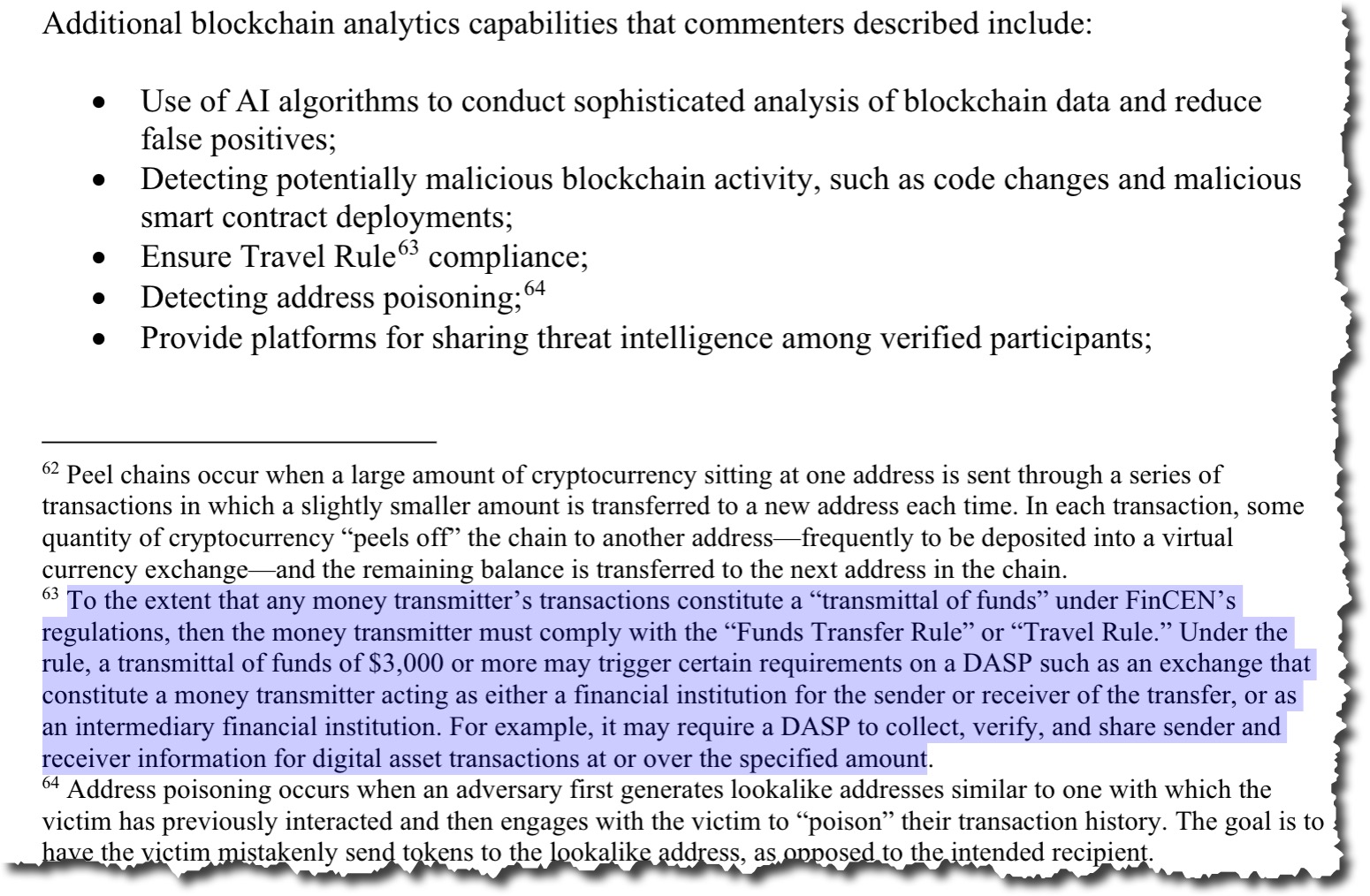
In March 2026, the US Treasury published its report on Innovative Technologies to Counter Illicit Finance Involving Digital Assets. The report frames AI, digital identity, blockchain analytics, and APIs as the four technology pillars for modern financial crime compliance. Inside sits a sharper signal for digital asset firms: Treasury explicitly references the Travel Rule, reaffirming the Funds Transfer Rule applies to crypto transactions over $3,000 and is expected to be operationalized in practice.
While the Travel Rule has long been applicable to the US crypto market, its implementation was frequently viewed more as a policy guideline than a functional necessity. The 2026 report marks a definitive transition from theoretical interpretation to mandatory implementation.
Treasury's Stance on Travel Rule Implementation
Rather than proposing new mandates, the Treasury is reinforcing established regulations. The report reiterates that digital asset transfers fall under the Funds Transfer Rule, maintaining the $3,000 threshold and requiring the collection, verification, and transmission of originator and beneficiary data.
The significance lies in the context: this directive is central to a 2026 report on illicit finance and advanced compliance tools. The industry's focus must now shift from questioning the rule's applicability to ensuring its practical effectiveness.
The Treasury's report is a major federal action signal in addition to the April 8, 2026 joint Notice of Proposed Rulemaking from FinCEN and OFAC detailed AML/CFT requirements for stablecoin issuers under the GENIUS Act. That is in additional to the FATF's March 2026 report identifies Travel Rule data gaps as a primary vulnerability in global crypto AML efforts.
All of these are moving towards the objective of closing the compliance gap.
Monitoring Is Not Travel Rule Execution
Many firms assume blockchain analytics coverage equals Travel Rule coverage. The assumption is wrong.
Blockchain analytics tools identify risk, monitor transactions, and trace flows across wallets and chains. They give institutions visibility into on-chain activity. Analytics tools do not fulfill Travel Rule obligations. They do not send originator and beneficiary data to counterparties. They do not standardize data across institutions. They do not enforce compliance workflows between counterparties.
Insight alone does not meet regulatory requirements. Insight has to be acted on, triggering workflows, exchanging required data, and enforcing decisions across counterparties. This is the distinction Treasury is pointing toward. The difference between monitoring and execution.
Obtaining insight is only the first step toward meeting regulatory mandates. Actionable workflows, data exchange, and cross-counterparty enforcement are necessary to bridge the gap between simple monitoring and true execution.
The Network Nature of Compliance
Because the Travel Rule relies on secure, real-time interactions between institutions, compliance cannot be achieved in isolation. Connectivity is the essential core of the rule.
Digital asset and stablecoin compliance is a network-wide challenge rather than an entity-specific one. While issuer compliance and counterparty controls are foundational, the system remains vulnerable if the broader network fails to exchange data reliably.
Structural exposures caused by network gaps are now a primary target for regulators, as evidenced by the alignment of the FATF offshore VASP report, the April 8 NPRM, and the Treasury Report.
How to Execute Travel Rule Compliance in Practice
This is the gap Notabene was built to solve. Notabene acts as the trust layer enabling institutions to execute Travel Rule compliance. The platform identifies and screens counterparties before a transaction, performs VASP due diligence, securely exchanges required Travel Rule data between institutions, and supports real-time decisions on whether a transaction should proceed. All of this happens before funds move.
Travel Rule compliance depends on reachability. Notabene addresses this through a global network of over 2,100 VASPs and over 260 financial institutions, custodians, and exchanges, spanning more than 100 jurisdictions and supporting 300+ assets and blockchains.
Compliance Infrastructure for the Next Phase of Digital Assets
For years, the Travel Rule was discussed primarily as a regulatory obligation. Treasury’s 2026 report signals a broader shift toward operational maturity, interoperability, and trusted digital asset infrastructure.
The shift is not about entirely new rules. It is about higher expectations for how compliance is embedded into real-time financial systems.
As digital assets and stablecoins become more integrated into global finance, institutions need infrastructure that enables secure connectivity, trusted counterparties, and seamless data exchange across networks. Monitoring and visibility remain important, but scalable growth increasingly depends on the ability to operationalize compliance in a way that supports speed, trust, and cross-border participation.
The opportunity for the industry is significant: institutions that can execute compliance efficiently will be better positioned to expand partnerships, access new markets, and participate confidently in the next generation of financial services.
The question is no longer simply whether firms understand the Travel Rule. It is how they use compliance infrastructure to unlock safer, faster, and more connected digital asset ecosystems.
Update — June 2026: On June 18, 2026, the BCB published Resolution BCB nº 574/2026, postponing the start of the FX reporting obligation from May 4 to November 3, 2026. First reports are now due by the 5th business day of December 2026, covering November's operations. The underlying obligations under Resolution 521 remain unchanged — this is a coordination move that gives SPSAVs additional preparation time alongside the October 30, 2026 authorization deadline. Everything below reflects the panel's guidance as delivered on April 28, 2026, with dates and timelines updated to reflect the new schedule.
On April 28, 2026, Notabene hosted a fireside chat with two of Brazil's most experienced voices on virtual asset regulation: Sodreia Amorim, Head of Payments & Banking Relationships at BRAZA, and Marcos Rocha, Partner at Veirano Advogados. Moderated by Catarina Veloso - Director of Regulatory & Compliance at Notabene.
The session was held in Portuguese, days before the FX reporting obligation took effect. We've recapped it in English for our global audience, to surface the subject matter and the most relevant topics for anyone navigating Brazil's regulatory build-out.
Prefer the original? The recording is available here.
The regulatory moment Brazil is in
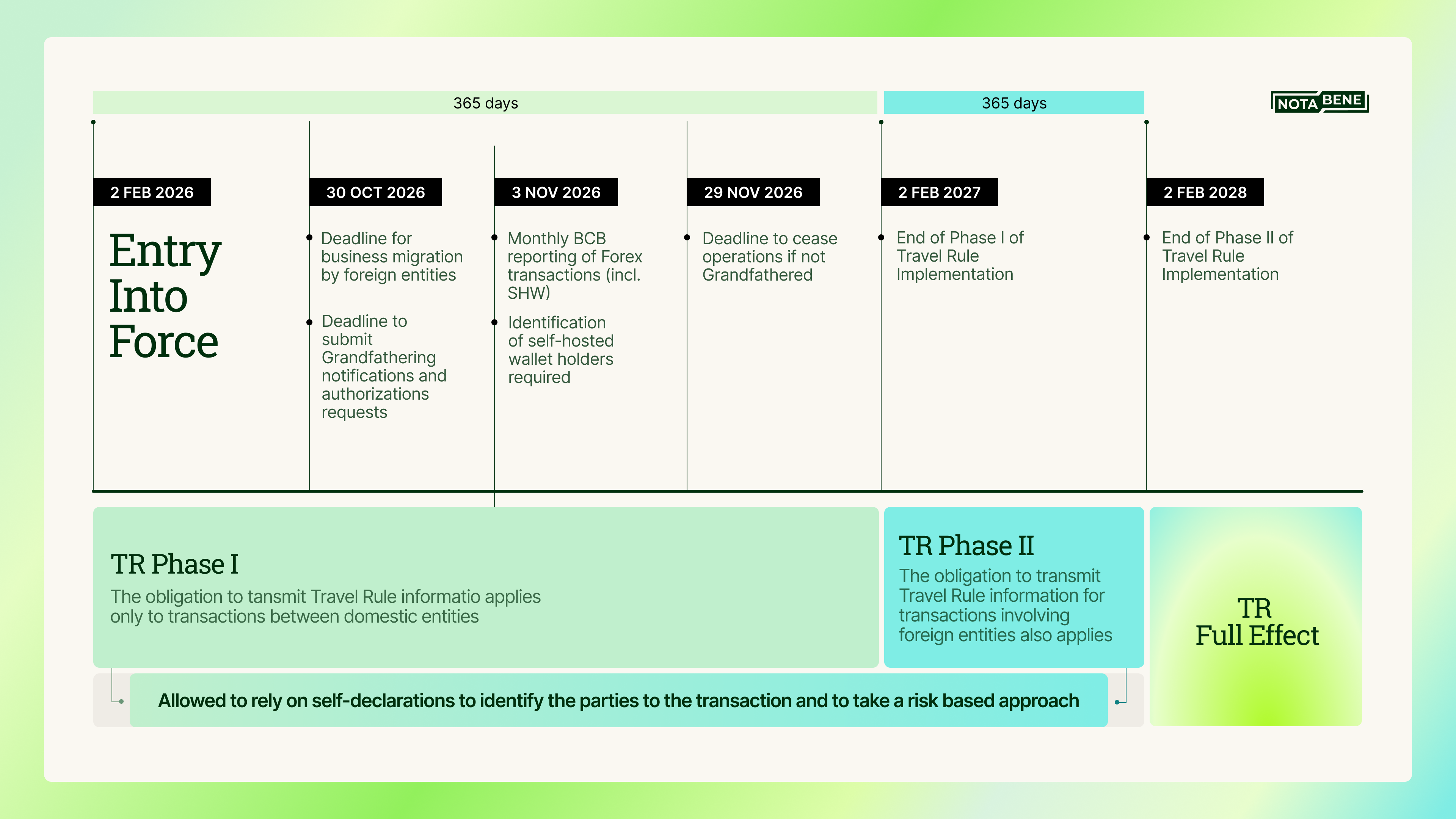
Brazil's virtual asset framework took a decisive shape in early 2026. On February 2, 2026, BCB Resolutions 519, 520, and 521 entered into force and, alongside Law 14,478, established what Catarina described as a comprehensive regulatory regime for SPSAVs (Sociedades Prestadoras de Serviços de Ativos Virtuais).
But the framework isn't being implemented all at once. The Travel Rule under Resolution 520 is being phased in through February 2028. The FX reporting obligation under Resolution 521 — the focus of this session — kicks in much sooner:
It was originally scheduled for May 2026 but has been postponed to November 3, 2026 by BCB Resolution 574/2026. First reports are now due by the 5th business day of December 2026, covering November's operations. Even with the extension, the operational picture the panel described remains intact: SPSAVs still need to build the counterparty identification and classification capabilities the reporting requires.
That sequencing matters. As Catarina put it: even though the formal Travel Rule deadlines extend to February 2028, much of the counterparty identification work it requires becomes operationally urgent far earlier — because the FX regime demands it.
Why FX? The history behind the rule
Marcos opened with the historical context, and it's worth understanding because it explains the BCB's reasoning.
Brazil's FX regulation reflects a long history of foreign reserves scarcity. Even after the 1994 Plano Real strengthened the country's external reserves and the regime liberalised through the late 1990s, the BCB retained what Marcos called "liberdade monitorada" — monitored freedom. The Central Bank cares deeply about visibility into the balance of payments, the flow of foreign currency in and out of Brazil, and the holdings of non-residents domestically and Brazilians abroad.
That posture is now being applied to virtual assets. Resolution 521 amended Resolution 277 — the foundational FX regulation — to bring four new categories of virtual asset operations into the FX market perimeter:
- International payment or transfer using virtual assets. A Brazilian resident transferring or receiving virtual assets to or from a non-resident. Because virtual assets have no geolocation, what determines location is who controls the private key.
- Virtual asset transfers to fund international card or electronic payment use. This addresses crypto-loaded credit cards used internationally — partly a pre-emptive move against IOF tax arbitrage.
- Transfers of virtual assets to or from self-hosted wallets (carteiras autocustodiadas). The BCB's logic: once an asset moves to a self-hosted wallet, it leaves the regulator's field of view, so it must be reported as if it crossed a border.
- Purchase, sale, or exchange of virtual assets referenced to fiat currency — including stablecoins, even Real-denominated ones. Marcos noted this last category surprised many in the market: a BRL-stablecoin trade arguably isn't a cross-border movement at all, yet it falls under FX market rules.
The unifying theme: the BCB wants visibility into where virtual assets go, and is treating the loss of that visibility as functionally equivalent to a cross-border movement.
What gets reported, and how
Sodreia walked through the operational mechanics. The reporting vehicle is ACAM 212, a structured data file SPSAVs submit to the BCB. The cadence is monthly, with the deadline falling on the 5th business day of the following month — though institutions can submit multiple times throughout the month.
The data fields ACAM 212 requires include:
- Customer identification (originator)
- Counterparty identification — the hardest field, by consensus
- Transaction value in BRL and in the asset
- Asset type
- Transaction date and nature
- Country of origin and destination
Sodreia made an important framing point: it would be a mistake to read the BCB's phased Travel Rule timeline as permission to defer Travel Rule readiness. The ACAM 212 obligation alone effectively requires the counterparty identification capability that the Travel Rule will demand. Companies treating February 2027 (domestic Travel Rule) or February 2028 (cross-border) as the real deadline are misreading the situation.
She also offered a pointed defence of the Travel Rule itself, against the reflexive crypto-native scepticism that often accompanies it. Tracing transactions improves AML enforcement, makes international flows auditable, and — critically — gives end users an additional layer of protection. In crypto today, a customer sending funds to the wrong wallet has no recourse. A counterparty identification layer changes that.
The hard part: identifying the counterparty
This was the throughline of the entire session. Every panelist returned to it.
The challenge is structural, not procedural. Sodreia put it cleanly: traditional financial systems were designed to identify people. Blockchains were designed to identify transactions. SWIFT — over 40 years of standardisation, accelerated in the late 1990s and now harmonised under ISO 20022 — gives institutions a BIC code that resolves counterparty identity and jurisdiction in one field. Pix and other modern payment rails inherit that design.
Crypto has nothing equivalent natively. A wallet address tells you nothing about who controls it.
Three patterns emerged from the discussion on how SPSAVs should approach this.
1. Self-declarations are accepted, but insufficient on their own.
Resolution 520 permits SPSAVs to use customer self-declarations to gather counterparty information during the Travel Rule phase-in. Sodreia acknowledged self-declarations as a starting point, but cautioned they're a weak control unless paired with blockchain analytics. Marcos agreed — for now there's no realistic alternative at scale, but the direction of travel is clear: as regulation matures globally (MiCA in Europe, FinCEN in the US, FATF's 2030 timeline), the regulatory tolerance for self-declarations alone will tighten.
2. Cryptographic proof of ownership has tradeoffs.
Methods like Satoshi tests (sending a small amount to verify control of a wallet) work, but they're expensive at volume and can make smaller transactions uneconomic. Marcos noted that some Swiss institutions use video calls to verify wallet ownership — but Brazil's market is too pulverised for that to scale. User-friendlier cryptographic signatures generated from the user's wallet are emerging as a middle path, particularly in jurisdictions like the EU where verification of control is mandatory above certain thresholds.
3. Wallet screening is the practical near-term tool.
Marcos pointed to the increasing sophistication of wallet screening providers — algorithms that can determine with high confidence whether a wallet's behaviour pattern matches a self-hosted wallet or a VASP, and even infer geolocation from on-chain activity. Catarina added that Notabene's network can already identify a significant portion of counterparty wallets and resolve their VASP and jurisdiction.
Same data, different flows: where Travel Rule and FX reporting converge
This was the conversation's organising insight, and it's worth being precise about it.
The Travel Rule and the FX reporting rule are asking for largely the same underlying data — counterparty identification, originator information, transaction details. But they ask for it through different channels:
- Travel Rule requires SPSAVs to transmit that information to the institutions they interact with (the counterparty VASP or its proxy).
- FX reporting requires SPSAVs to submit that information to the Central Bank itself.
Same data, two flow directions. One is institution-to-institution; the other is institution-to-regulator.
For SPSAVs building or buying compliance infrastructure right now, this matters operationally: investments in counterparty identification that look like Travel Rule investments are, in fact, also FX reporting investments. The reverse is true too. Catarina's recommendation to anyone implementing the Travel Rule: talk to your providers about what they can already tell you about counterparty wallets, because that capability is doing double duty.
She also flagged a common organisational hazard. The team building Travel Rule compliance and the team building ACAM 212 reporting are often different teams. The session's purpose, she said, was to get those teams talking — because the controls each is building should serve both obligations.
Settlement risk: a deeper problem the conversation surfaced
A participant question late in the session raised one of the deeper problems with applying conventional compliance to public blockchains: once a transaction is on-chain, it's settled. There's no recall, no clawback, no congelamento.
Catarina used the question to introduce a concept Notabene has been developing in other markets: shifting compliance to before settlement, not after. In traditional payment systems, settlement is preceded by an authorisation flow between the institutions involved. The same model can be applied to virtual asset transfers — the originating VASP transmits identifying information to the beneficiary VASP before executing on-chain, and the beneficiary can respond before funds move.
Notabene also announced (during the session) a new capability for VASPs to coordinate the return of unwanted transactions through its network — addressing the fact that you cannot simply send funds back to the originating address without knowing whether that address is structured to receive them.
Marcos added that permissioned networks have a structural advantage here: they support clawback and freezing natively, which has become a meaningful topic in international regulatory forums. The asset-recovery question — what happens when a high-value transaction goes to the wrong place — is one regulators globally are watching.
A post-webinar update: Resolution 561 and what it actually does
Two days after the webinar, on April 30, 2026, the BCB published Resolution 561, amending the eFX framework. International headlines almost immediately declared that Brazil had "banned stablecoin settlement in cross-border payments."
In fact, Resolution 561 targets one specific channel: eFX, Brazil's simplified electronic FX route for retail digital cross-border flows — such as international online card purchases and digital remittances handled by payment institutions, e-money issuers, and acquirers. Inside that channel, settlement between an eFX provider and its overseas counterparty must now occur through traditional FX operations or non-resident BRL accounts. Stablecoins and other virtual assets can no longer be used as the settlement leg. The change takes effect October 1, 2026.
What Resolution 561 does not do is ban stablecoin cross-border settlement across the board. Licensed SPSAVs — and banks operating under the SPSAV framework — can still use stablecoins for international transfers, because that activity sits inside the FX market regime established by Resolution 521 (mentioned above). Cross-border stablecoin movement remains entirely possible: it just has to flow through an authorised institution, under FX-market rules, with the reporting and counterparty obligations that come with that perimeter.
Put together with Resolution 521, the BCB's direction is now unambiguous:
- The lighter, retail-oriented eFX route is being closed to virtual assets.
- The supervised SPSAV/FX-market route is being expanded and reinforced, with ACAM 212 reporting, Travel Rule obligations, and FX market authorisation as the price of entry.
For the audience of this article, the practical implication is straightforward. Resolution 561 doesn't change the operational picture for SPSAVs building toward May 2026 reporting and 2027–2028 Travel Rule compliance. If anything, it raises the stakes: cross-border stablecoin activity that previously sat in the lighter eFX channel will increasingly flow through SPSAVs, which means the supervised route can absorb more volume. The institutions that have built robust Travel Rule, and counterparty resolution capabilities will be the ones positioned to capture that flow.
June 2026 update: Resolution 574 postpones the reporting start date
On June 18, 2026, the BCB published Resolution BCB nº 574/2026, postponing the FX reporting start date from May 4 to November 3, 2026. First reports are now due by the 5th business day of December 2026.
Practically, this means SPSAVs now have roughly six additional months to build counterparty identification, classification logic, and reporting infrastructure. The extension is not permission to defer preparation; it's a chance to reach the deadline with more mature controls in place.
What SPSAVs should do now: the panel's recommendations
The panel closed with practical guidance. Compressed:
Sodreia (operational priorities):
- Map your flows. Understand which transaction types your business runs and which qualify for ACAM 212 reporting.
- Classify operations. Build a clean classification logic for the four FX-scoped categories.
- Choose your counterparty identification model deliberately. Don't default to manual collection from customers — they often don't know the answer either. Look at where automation, blockchain analytics, and network-resolved counterparty data can take friction out of the customer experience.
- Don't defer Travel Rule preparation. The phased timeline isn't permission to wait.
Marcos (legal priorities):
- Comply with all obligations now, even ahead of authorisation. SPSAV authorisation applications will assess prior compliance posture. Falling short on obligations already in force can compromise the authorisation outcome.
- Assume FX market authorisation is required. Marcos was direct: realistically, almost no SPSAV will be able to operate without FX market authorisation, because even buying a BRL-denominated stablecoin now falls within the FX market.
- Structure for partnerships. SPSAVs facing the operational limits — including the USD 100,000 per transaction cap for SPSAVs without full FX dealer authorisation — should be looking at partnerships with authorised institutions early. Sodreia confirmed this is exactly where many in the market are heading, with institutions like BRAZA positioned to absorb operations that exceed SPSAV limits.
The bigger picture
Catarina closed on a structural point that's worth flagging. Crypto's native architecture wasn't designed to fit within regulatory perimeters. Bringing virtual asset infrastructure into a regulated regime means building something that doesn't yet exist: a coordination layer between institutions that can carry the kind of contextual information traditional payment rails carry natively.
That layer matters beyond compliance. As Catarina noted — drawing on Notabene's own experience with finance teams — one of the reasons crypto and stablecoin payments haven't yet penetrated business operations at scale is that payments arrive without context. Reconciliation against invoices, contracts, and customer records is genuinely hard. The same infrastructure that makes Travel Rule compliance and FX reporting possible is the infrastructure that makes crypto and stablecoins viable as actual payment rails.
November 2026 is one milestone. Even with the extension, it remains a forcing function for building the right thing.
Want to go deeper?
For a comprehensive view of the regulatory landscape, see Notabene's Brazil Virtual Asset Regulatory Playbook, produced in partnership with Veirano Advogados and ABToken.
The full webinar recording is available on demand, and the recording is available here.
This article summarises a fireside chat held in Portuguese, hosted by Notabene in collaboration with AB Token on April 28, 2026, with Catarina Veloso (Notabene), Sodreia Amorim (BRAZA), and Marcos Rocha (Veirano Advogados). All quotes and references have been translated from the original Portuguese.
Something shifted in cross-border payments over the last few years, and it happened faster than most people expected. The stablecoin layer - once an experiment at the margins - is now a real part of how money moves globally. You can see it in the deal flow, customer conversations, in where regulatory attention is going. Digital assets have crossed the chasm.
But having crossed the chasm doesn't mean you've arrived. It means the question has changed. And the question the industry is now dealing with - mostly implicitly, sometimes explicitly - is whether the architecture that got us this far is the architecture that takes us to the next stage.
The dominant architecture is what people started calling the stablecoin sandwich a year or two back. Fiat converts to stablecoin at one end, value moves across the chain, stablecoin converts back to fiat at the other end. It works. It has unlocked real use cases: hard-currency corridors where someone on one side urgently wants dollars, corporate treasury moving funds across borders at hours that SWIFT can't touch, situations where you can bundle the off-ramp problem into one partner relationship and move on.
I spent time at a very large GSIB early in my career, building systems reconciling trade feeds to SWIFT feeds, sitting inside correspondent banking. Something I learned - and that I keep thinking about now - is that correspondent banking works. It is expensive, slow, and remarkably opaque, but it reliably moves money. The model is: bilateral relationships, pre-funded positions, corridor-by-corridor expansion. You add a corridor when the economics justify it. You maintain the relationships because the alternative is reduced volume.
What I find genuinely interesting about the stablecoin sandwich is that it has reproduced this model almost exactly. Different settlement rails, same underlying structure. If you peel back the UX improvements and the faster settlement times, the correspondent banking architecture is still there. You still need pre-funded positions on both sides of each corridor. You still build out one corridor at a time. Conversion costs don't disappear - they shift around, sometimes to your benefit, sometimes not - but they stay in the system.
The payment CEOs I talk to who have been running stablecoin sandwich operations for a few years are starting to feel this. Three or four corridors looks great on the unit economics. Twenty corridors - which you need if you're serious about global reach - starts to look like a different business. Many stablecoin orchestrators product roadmaps are filled with integrations to support more corridors to increase volume rather than building better products.
The operational overhead, the compliance exposure per corridor, the working capital tied up in pre-funded positions: it compounds. And margins that looked healthy early on start to come under pressure. Many of the largest banks globally have secretly been removing expensive and risky to operate long tail corridors from their correspondence bank offerings by outsourcing this volume to PSPs and stablecoin orchestrators.
The industry is already sensing this, and you can see it in where the interesting product work is happening. What's emerged is a kind of open-faced stablecoin sandwich: one-way fiat conversion instead of two-way. Stablecoin cards are the clearest example - the cardholder's account is stablecoin-native, the conversion only happens at the point of spend into fiat. You've cut the conversion problem in half. One side of the transaction has gone native; the other side is still touching the legacy rails. It's real progress. But it's still a transitional architecture, not the destination.
This isn't a criticism of the people who built this way. The stablecoin sandwich, and its open-faced variant, were the correct call for the environments in which they emerged. When you're trying to get from zero to adoption, you build for backward compatibility. You operate within the systems where the money already lives.
Every technology does this phase. Remember Vonage or paying for a phone number in Skype? VoIP spent years routing calls between traditional phone endpoints before Skype and WhatsApp came along and made those endpoints superfluous for general use. The stablecoin sandwich is how you get a foothold, not how you achieve the end state.
As more issuers enter the market - across banking consortia, fintechs, and sovereign-backed initiatives - the question stops being which stablecoin you're holding and becomes what you can do with it natively. A network of institutions that can settle with each other directly, without rebuilding bilateral corridors for each relationship, compounds differently than a network of corridors does. That's the transition worth building toward.
There's a difference between a transitional architecture and a destination, and the industry is at the point where that distinction matters for the decisions you're making now. The companies worth watching are the ones that ran the stablecoin sandwich where they needed to, understand exactly what it costs them to operate, and are building deliberately toward something different. The regulatory framework is falling into place. The infrastructure question is the one that deserves more honest attention.
What is the Financial Action Task Force (FATF) and what does it do?
Virtual Assets and VASPs (Virtual Asset Service Providers): What are they?
What is the Crypto Travel Rule?
What Is Anti-Money-Laundering (AML) and How Does It Apply to Crypto?
What is Counter-Terrorism Financing (CTF), and how does it apply to Crypto?
What is KYC in Crypto, and why do crypto exchanges require it?
FATF's Final Guidance for Virtual Assets and VASPs
What is the Sunrise Issue?
Travel Rule compliance challenges and opportunities for VASPs
What Are Travel Rule Messaging Protocols?
How Can VASPs Ensure Travel Rule Compliance During Transactions With Unhosted Wallets?
How Decentralized Identifiers (DIDs) are Shaping the Crypto Travel Rule Infrastructure
What Is Counterparty Crypto Wallet Identification & How Does It Work?
VASP Due Diligence: Establishing Trust in Counterparty Sanctions Screening
Six Reasons VASPs Are Investing in Travel Rule Solutions Right Now
Ten Interoperability Tips for VASPs
Travel Rule Implementation by jurisdiction
The Current State of Crypto Travel Rule Enforcement [April 2023]
Which VASPs are Currently Travel Rule compliant?

Guia Prático sobre a Travel Rule para Prestadores de Serviços de Ativos Virtuais no Brasil
Travel Rule Regulation in Taiwan

Notabene's Response to the Joint Notice of Proposed Rulemaking

Notabene Responds to Draft Guidance on Implementation of FATF Recommendation 16

Travel Rule Requirements in Peru
.png)
Notabene Response to PPSI AML/CFT and Sanctions NPRM

Notabene Response to FinCEN AML/CFT Program NPRM

The US stablecoin payments playbook

How Hata Accelerated Their Growth with Notabene

Brazil Virtual Asset Regulatory Playbook
.png)
Travel Rule Requirements in Hong Kong
.png)
Crypto Travel Rule Regulations in Australia

Response to Guiding and Establishing National Innovation for U.S. Stablecoins Act Implementation Act Implementation
Response to Treasury Request for Comment on Innovative Methods to Detect Illicit Activity Involving Digital Assets

Notabene Flow: The first open stablecoin payments platform for businesses

Travel Rule Compliance in the European Union: An In-Depth Analysis of the Transfer of Funds Regulation (TFR) and the EBA’s Travel Rule Guidelines

Notabene vs. FATF's Travel Rule Compliance Tool Criteria

Travel Rule Compliance in the European Union: Summary

FATF Travel Rule Requirements in the European Union

FATF Travel Rule Requirements in Singapore

The State of Crypto Travel Rule Compliance Report 2024

The Crypto Pre-Transaction Decision-Making Guide

FATF Travel Rule Requirements in Canada

FATF Travel Rule Requirements in the Philippines

FATF Travel Rule Requirements in Malaysia

Notabene vs. Hong Kong SFC’s Compliance Criteria

The State of Crypto Travel Rule Compliance Report 2023

FATF Travel Rule Requirements in Gibraltar
.png)
FATF Travel Rule Requirements in Dubai
.png)
FATF Travel Rule Requirements in Japan

FATF Travel Rule Requirements in the United Kingdom

Crypto Travel Rule 101 Guide

FATF Travel Rule Requirements in Switzerland

FATF Travel Rule Requirements in Estonia

How Luno Singapore met Travel Rule Regulations using Notabene

Crypto Compliance: Unique Cases and State of Regulatory Landscape in 2022

The State of Crypto Travel Rule Compliance Report 2022

Clarity on Clarity: An exclusive chat with Summer Mersinger, CEO of Blockchain Association
Summer Mersinger, CEO of Blockchain Association, will be hosted by Notabene's Lana Schwartzman in a virtual fireside chat covering:
- What impact a Sept. 15th Senate vote on the Clarity Act has for operators and compliance professionals at regulated institutions
- What Blockchain Association is hearing from it's members that have been able to successfully navigate the unclear market structure rules
- What US companies should be working on today to get a head start in 2027
Register to join Summer and Lana on Wednesday September 23rd at 2pm ET.
Notabene x AMINA Bank: Bringing Institutional Trust to Digital Assets
Watch on-demand
What does it actually take for regulated financial institutions to deliver digital asset services safely, compliantly, and at scale?
Join AMINA Bank and Notabene for a discussion on the operational realities of institutional digital assets.
Hosting this session:
🎙️ Giuseppe Nicola Spinillo, Executive Director, Head of Operations, AMINA Bank
🎙️ Daniel Nicolas, Vice President, Sales, Notabene
This session covers:
🔐 Building confidence in counterparties before transactions happen
⚡ Why the industry is moving toward pre-transaction authorisation
🌍 Navigating FINMA, MiCA, FSRA, and SFC requirements
💵 The role of stablecoins in institutional strategy
🔭 What's next for regulated institutions following the end of MiCA's grandfathering period
From Transition to Transformation: MiCA Grandfathering Ends
A new consultation opens, and what comes next?
Watch on-demand
As the EU’s MiCA grandfathering period comes to an end, crypto firms are entering a critical new phase of regulatory supervision and operational readiness.
At the same time, the European Commission has opened a targeted consultation on the future of MiCA, raising important questions around stablecoins, DeFi access, offshore CASPs, and whether the regulation remains fit for purpose as the market evolves.
Join Notabene’s Director of Regulatory & Compliance, Catarina Veloso, and a panel of industry experts for a timely discussion on what the end of the transition period means for crypto firms operating in Europe.
Speaker lineup:
- Michał Truszczyński, Senior Specialist, Public Affairs, Bitpanda
- Neil Samtani, Chief Executive Officer, VASPnet
- Matthias Bauer-Langgartner, Head of Policy Europe, Chainalysis
- Dea Markova, Director of Policy, Fireblocks
- Moderated by: Catarina Veloso, Director of Regulatory & Compliance, Notabene
The panel will discuss:
- Lessons learned from MiCA implementation so far
- What happens after the 1 July 2026 grandfathering deadline
- Expectations for CASPs entering full MiCA supervision
- The operational impact of TFR requirements
- The European Commission’s new consultation and emerging policy priorities
- Stablecoins, DeFi, offshore CASPs, and the future direction of EU crypto regulation
Whether you’re already authorised, awaiting approval, or preparing for MiCA compliance at scale, this session will help you understand what matters now and what comes next.
Notabene x Fireblocks: Preparing for Australia's Travel Rule Requirements
Australia’s Travel Rule deadline is approaching, and Fireblocks customers operating in Australia need a clear path to compliance. This webinar explains what the new obligations mean for Australian VASPs, including the need to collect, verify, and transmit required originator and beneficiary information for virtual asset transfers.
Learn how Fireblocks customers can simplify readiness using the existing Notabene and Fireblocks integration. The session shows how to automate Travel Rule checks, identify counterparties, exchange required data, and use Fireblocks policies to help ensure transactions only move forward once compliance requirements are met.
Takeaways:
- What Australia’s Travel Rule means VASPs
- Key compliance obligations ahead of the 1 July 2026 deadline
- How to manage Travel Rule data collection, verification, and transmission
- How Notabene integrates with Fireblocks transaction workflows
- How Fireblocks policies can support compliant transaction approvals
- Practical steps Australian VASPs can take now to prepare
Câmbio e Travel Rule no Brasil: o que passa a ser exigido em maio de 2026
A regulamentação de serviços de ativos virtuais passou a incluir, no âmbito do mercado de câmbio, determinadas operações com ativos virtuais, em especial, transações envolvendo carteiras autocustodiadas e transferências internacionais. Nesse sentido, as SPSAVs brasileiras deverão iniciar, em maio, os reportes exigidos pelo Banco Central sobre as operações enquadradas nesse perímetro regulatório.
Detalhes do evento
⏱️ 45 minutos, incluindo perguntas ao vivo
🎙️ Sessão em português
💻 Online e gratuita
A partir de maio de 2026, as SPSAVs brasileiras passarão a ter obrigação de prestar informações mensais ao Banco Central sobre operações com ativos virtuais incluídas no mercado de câmbio – e as transferências envolvendo carteiras autocustodiadas e contrapartes internacionais agora entram nesse escopo.
Na prática, parte dos dados exigidos pelo BCB coincide com aqueles que a Travel Rule exige que as SPSAVs armazenem. Há, contudo, uma diferença relevante de natureza: enquanto a Travel Rule impõe a transmissão dessas informações às instituições com as quais a SPSAV interage, o reporte cambial consiste em uma obrigação de envio de informações ao Banco Central. O prazo para a implementação dos reportes é também mais curto, e o processo de coleta das
informações sobre operações com carteiras autocustodiadas traz desafios operacionais que merecem atenção.
Esta sessão reúne especialistas do setor para uma conversa sobre o que as normas do Banco Central realmente exigem e como se preparar nas semanas que restam.
Palestrantes
- Catarina Veloso — Diretora de Regulatório e Compliance, Notabene
- Sodreia Amorim — Braza UK
- Marcos Medeiros Coelho da Rocha — Sócio, Veirano Advogados
O que esperar desta sessão
- Uma leitura clara do perímetro cambial atual no Brasil e as operações com ativos virtuais abrangidas
- A lógica por trás do enquadramento das transferências com carteiras autocustodiadas como operações de câmbio
- Uma abordagem prática para o requisito mais desafiante: identificação da contraparte
Para quem é esta sessão
Líderes de compliance, jurídico e operações em SPSAVs, exchanges, custodiantes e PSPs brasileiros — e qualquer pessoa que esteja construindo no Brasil e precise entender, na prática, as novas obrigações de reporte cambial.
See Notabene Flow in Action: Live Product Demo
We've been putting Notabene Flow in front of some of the largest financial institutions and stablecoin-native businesses in the world. The reaction has been consistent: once people see what an end-to-end compliant stablecoin payment flow actually looks like, something clicks.
On April 30, we opened that same walkthrough up to a wider audience. Our CEO and co-founder Pelle Braendgaard will demo a crypto-native invoicing flow initiated by a custodial wallet provider and paid by the payer in their asset of choice, on any stablecoin rail — all with a fully Travel Rule-compliant, address-less workflow that solves the coordination challenge facing today's stablecoin payment solutions.
This session goes beyond the invoicing demo you may have already seen. We walk through additional use cases including subscription payments, metered billing, and other B2B payment scenarios where Flow is unlocking new revenue for network participants.
You'll also learn how, as a member of the Notabene network, you can earn fees off any stablecoin payment flow where you serve as a responding agent — with no integration lift required to be listed as a payment option.
Who should watch: Compliance leaders, product teams, revenue owners, custodial wallet providers, PSPs, and anyone responsible for payments strategy at a crypto or stablecoin-native business.
What we cover:
- A live end-to-end demo of Notabene Flow, including invoicing, subscription, and metered billing use cases
- How responding agents earn fees from payments flowing across the Notabene network
- What the address-less, Travel Rule-compliant workflow means for your compliance and product teams
- How to activate Flow with virtually zero additional integration effort
Event details:
Notabene Flow Live Product Demo
Fill in the form to watch on-demand.
How to Prepare for Australia’s New Crypto Regulatory Framework
Presented by Notabene <> TRM Labs
🎥 Format: On-demand Webinar
Australia’s Crypto Travel Rule Countdown is on
Australia’s crypto AML/CTF regime is entering a new phase. From 31 March 2026, the reformed framework takes effect, expanding AUSTRAC oversight across virtual asset services. Mandatory Travel Rule compliance—no thresholds, no exceptions—follows from 1 July 2026, requiring both existing and newly regulated VASPs to have controls in place by that date.
TRM Labs and Notabene are bringing together industry leaders and experts for a practical walkthrough of what Australia’s new crypto regulatory framework means for your business, and how to prepare before enforcement begins. This webinar will explore the real-world implications of Australia’s Travel Rule requirements for VASPs and financial institutions operating in or servicing Australia.
The session is designed to bridge regulatory expectations and operational reality, covering:
- What’s changing under Australia’s AML/CTF reforms
- How the Crypto Travel Rule works in Australia
- Key compliance obligations for VASPs
- Practical implementation guidance
Speakers:
- Angela Ang – Head of Policy & Strategic Partnerships APAC, TRM Labs
- Lana Schwartzman – VP, Global Regulatory & Compliance Strategy, Notabene
- Dianah N. Igati – Regional Head of Compliance, Pepperstone
- Antonio Alvarez Lorenzo - Chief Compliance Officer, Crypto.com
- Liam Hennessy - Partner, Thomas Geer
Australia’s 2024 AML/CTF reforms modernize how value transfers are regulated—bringing crypto firmly in line with FATF Recommendations 15 and 16. The changes significantly expand the scope of regulated activity and introduce Travel Rule obligations for both domestic and cross-border virtual asset transfers.
If you operate a crypto exchange, custodial wallet, transfer service, or token-related business, these changes apply to you.
This webinar is designed to help you move from awareness to execution—before the compliance deadline.
Navigating Hong Kong’s Stablecoin Regulatory Framework
Watch on-demand
Hong Kong is moving to establish a clear regulatory framework for stablecoin issuers. For firms operating in, entering, or servicing the market, understanding these requirements — particularly Travel Rule obligations — is no longer optional.
This webinar brings together industry specialists for a practical, forward-looking discussion on what the new framework means in real terms, how compliance expectations are likely to be enforced, and how firms can prepare effectively.
Speakers
- Christopher Liu — Chief Compliance Officer & Head of Regulatory, Matrixport
- Arnaud Wenger — General Counsel & Chief Compliance Officer, Tazapay
- Nathan Simmons — Chief Compliance Officer, VDX
- Catarina Veloso — Director, Regulatory & Compliance, Notabene
The panel explores
- Key elements of Hong Kong’s regulatory framework for stablecoin issuers
- Travel Rule implementation: regulatory expectations and operational realities
- Common compliance challenges and practical steps to address them
- What issuers should be doing now to stay ahead of regulatory change
- Time for live audience Q&A
This session is designed for stablecoin issuers, digital asset service providers, compliance and legal teams, fintech leaders, and anyone responsible for navigating regulatory risk in Hong Kong.
Monetize Your Notabene Integration with Notabene Flow
See Notabene Flow in Action
Notabene Flow is unlocking a new revenue stream for crypto businesses-and many of our existing customers are already closer than they realize.
In this session, Notabene CEO, Pelle Braendgaard, and VP of Market Engineering, Ralph King, will walk through how Notabene Flow turns the payment activity already happening on the Notabene Network into a compliant, scalable, and monetizable stablecoin payments rail for your organization.
You’ll learn why Flow was built, how it aligns with a compliance-first approach to stablecoin payments, and how your team can activate it with virtually zero additional integration effort. We’ll also demo the end-to-end experience and share how your product, revenue, and compliance teams can benefit.
Who should attend: Compliance leaders, product teams, revenue owners, and anyone responsible for payments strategy.
Key takeaways:
• How Notabene Flow transforms existing network volume into revenue
• Why Flow is the compliant path to enterprise-scale stablecoin payments
• A live demo of how Flow works today
• How to join Flow and bring the right internal teams into the process
Event details:
Notabene Customer Exclusive Webinar - Monetize Your Notabene Integration
Dec 17, 2025
9:30 AM ET / 2:30 PM GMT
How to Prepare for Brazil’s New Crypto Regulatory Framework
Catch up on this expert panel discussion to understand how the new framework will reshape licensing, AML, and Travel Rule requirements for VASPs.
Brazil is entering a pivotal moment for crypto oversight. With new BCB Resolutions now shaping how Virtual Asset Service Providers (VASPs) must operate, the next phase of implementation is about to begin. And with Brazil ranking among the top five countries globally for crypto adoption and transaction volume, these changes matter.
Featuring:
🌟 Pedro Henrique Nascimento Silva, Coordenador no Departamento de Regulação de Sistema Financeiro - Banco Central do Brasil
🌟 Marcos Coelho da Rocha, Partner - Veirano Advogados
🌟 Nicole Dyskant, Co-Founder & CEO - RegDoor
🌟 Bruno Antoniolli, Director of Risk, Controls & AML - Mercado Bitcoin
🌟 Hosted by the Notabene Regulatory & Compliance team
What this on-demand webinar to unpack:
- How the transition process will work
- SPSAV categories and what they mean in practice
- How the Travel Rule will be implemented
- Treatment of stablecoins and self-hosted wallets
If you operate in Brazil or support customers who do, this session will help you understand what’s changing and what comes next. Fill in the form today to register.
The Notabene Virtual Summit
By popular demand — watch the Notabene Summit on-demand!
This year’s Notabene Summit brought together the people shaping the trust layer for global stablecoin payments. Institutions. Product builders. Policy makers. All aligning around what is needed for stablecoins to power the $120T B2B payments market.
And it is where we introduced Notabene Flow for the first time — live on stage. We’re excited to announce that now, you can experience it for yourself. This on-demand edition gives you full access to:
🎤 All Summit panels and speakers
Hear what leaders across payments, banking and digital assets — including Mastercard, Robinhood, Apollo, Anchorage Digital, Copper and other global innovators are doing to shape the future of compliance and digital value transfer.
🚀 Notabene Flow Showcase
See how businesses can begin using stablecoins for B2B payments today, including:
• Pull payments and invoicing
• Authorization workflows
• Multi-party payment flows
• Counterparty trust at scale
⚙️ Notabene Platform Spotlight
A closer look at new capabilities across our compliance and network coordination suite, led by the product experts building them.
Inside the 2025 State of Crypto Travel Rule Report
Unlock Key Insights from the 2025 State of Crypto Travel Rule Report
Join Notabene’s Regulatory & Compliance Team - co-authors of the 2025 State of Crypto Travel Rule Compliance Report - along with expert guest speakers for a fast-paced and insightful session.
We’ll dive into the latest global trends, based on survey data from 90+ VASPs and 10 regulators, and share how leading crypto companies are overcoming implementation hurdles, bridging enforcement gaps, and staying ahead of evolving regulatory expectations.
What you’ll learn:
🌍 The latest global Travel Rule adoption trends
🧩 How top VASPs are addressing real-world implementation challenges
🔄 Solutions to interoperability issues, counterparty due diligence, and more
🔮 Why pre-transaction risk mitigation and real-time compliance are becoming essential
Notabene Customer Workshop - EU Travel Rule (Session 2)
Following the success of our first EU Travel Rule Workshop, we will be hosting a followup session, exclusively for customers preparing to comply with the upcoming TFR requirements. This session will bring together CASPs from across the industry alongside the Notabene Regulatory and Compliance team for a collaborative workshop.
The workshop offers CASPs a valuable opportunity to explore common challenges, address frequently asked questions, and learn how other counterparties are navigating various aspects of the regulation.
Designed as a closed-door workshop, the format ensures a safe space for candid discussions and the exchange of insights among participants.
Key topics of discussion will include:
- Managing missing information
- Reporting non-compliance
- Meeting obligations related to self-hosted wallets
- Clarifying authorization requirements
🗓️ This event has now passed.
Please note that this was a live, customer-only session and was not recorded.
Interested in exploring these topics further? Get in touch with our team today — we’d be happy to walk you through the key insights and help you deep dive into the content.
Notabene Customer Workshop - EU Travel Rule
Following the success of our pre deadline workshops for Estonian and UK clients, we are thrilled to invite all customers preparing to comply with the upcoming TFR requirements to join us for an open discussion and workshop on all things TFR requirements. This session will bring together CASPs from across the industry alongside the Notabene Regulatory and Compliance team for a collaborative workshop.
The workshop offers CASPs a valuable opportunity to explore common challenges, address frequently asked questions, and learn how other counterparties are navigating various aspects of the regulation.
Designed as a closed-door workshop, the format ensures a safe space for candid discussions and the exchange of insights among participants.
Key topics of discussion will include:
- Managing missing information
- Reporting non-compliance
- Meeting obligations related to self-hosted wallets
- Clarifying authorization requirements
🗓️ This event has now passed.
Please note that this was a live, customer-only session and was not recorded.
Interested in exploring these topics further? Get in touch with our team today — we’d be happy to walk you through the key insights and help you deep dive into the content.
Introducing SafeConnect Components: Seamless end-to-end TFR Compliance
On October 29th, we debuted our game-changing solutions for self-hosted wallet compliance, built to meet the latest EU Transfer of Funds Regulation (TFR) requirements.
We'll also showcased our brand-new SafeConnect Components, a powerful embedded UX suite designed to streamline Travel Rule workflows, solve the new TFR requirements, and empower businesses to offer their users a seamless, secure, and fully compliant crypto transaction experience – with just five lines of code ✨
We covered:
- Live demo of the self-hosted wallet solution
- Overview of the product architecture and capabilities
- In-depth exploration of the value that VASPs can capture
- A preview of our upcoming product roadmap
Miss the live event? No worries, we recorded it for you!
Just submit the form on the right to watch the video on-demand.
Become an Expert on Travel Rule in the EU
Do you have customers in the EU?
The European Union's Transfer of Funds Regulation, complemented by the European Banking Authority (EBA)'s Travel Rule Guidelines, sets new benchmarks for financial transparency and security requirements for any Virtual/Crypto Asset Service Provider (VASP/CASP) that has customers in the EU.
How does this your company? The answer depends greatly on the unique needs of your business. It's critical that you educate yourself on the specifics of TFR regulation before implementing your Travel Rule program for the EU.
Take the first step by completing our in-depth certification course that will clarify all of the new rules and transform you into a true expert on Travel Rule in the EU.
Course Coming Soon - Sign up to be notified when our comprehensive course on TFR regulation is ready for enrollment.
Notabene Launch Event: SafeTransact for Networks Live Demo
In an era marked by a thriving bull market and increasingly complex regulatory environments, achieving maximum reachability with your transaction authorization solution is more critical than ever. Walled gardens and competing closed networks not only slow your entry into new jurisdictions but can also significantly impact your revenues.
Introducing: SafeTransact for Networks 🌐
SafeTransact for Networks instantly increases reachability for all our customers. It enables existing networks, such as custodial services, settlement, and liquidity providers, to seamlessly integrate multi-party transaction authorizations within their current operations. No more joining multiple Travel Rule protocols or worrying about interoperability. With SafeTransact, businesses gain instant access to all its active members, fostering trust and connectivity across different crypto ecosystems.
We are thrilled to announce that Fireblocks will join us for this event. As a leader in digital asset custody and security, Fireblocks will share insights from our partnership and their perspective on the future of custody infrastructure and payments. Discover how integrating compliance into their network has benefited them and how SafeTransact for Networks can further enhance your operations.
Live Demonstration Highlights
- SafeTransact for Networks: Extend the power of SafeTransact to your entire network, boosting reachability and transaction volumes while staying compliant with international regulations.
- New Capabilities: Enjoy enhanced support for multiple counterparties, expanded use cases beyond the Travel Rule, and leverage our innovative decentralized Transaction Authorization Protocol (TAP).
- 2024 Travel Rule Milestones: Learn how these updates align with the December 30th deadline for TFR compliance in the EU.
This live event was held on June 27, 2024. To watch the recording, fill out the form on this page and you will be redirected to the video.
Insights From the State of Crypto Travel Rule Compliance Report 2024 — APAC
Register for this on-demand webinar to dive into the latest crypto compliance challenges and insights, featuring key findings from Notabene's "State of Crypto Travel Rule Compliance Report 2024."
Our in-depth exploration will highlight the current compliance landscape, drawing on a comprehensive industry survey to share exclusive proprietary knowledge.
Topics include:
Principal insights from the industry survey
Overview of key regulatory developments in 2023 crypto
Analysis of prevalent compliance challenges
Evaluation of stakeholders poised to address these challenges
Global compliance metrics and due diligence protocols among VASPs
Strategies by VASPs for managing non-compliant transactions
Join us to gain a thorough understanding of the Travel Rule adoption in crypto and prepare your organization for success in 2024.
Insights From the State of Crypto Travel Rule Compliance Report 2024 — EMEA / Americas
Dive into an in-depth exploration of the latest compliance challenges and insights in crypto Travel Rule adoption, featuring key findings from Notabene's "State of Crypto Travel Rule Compliance Report 2024."
Drawing on a comprehensive industry survey, we will provide an extensive overview of the current compliance landscape and share exclusive proprietary knowledge.
This webinar covers:
Principal insights from the industry survey
Synopsis of significant regulatory developments in crypto for 2023
Analysis of prevalent compliance challenges
Evaluation of stakeholders poised to tackle these challenges
Global compliance metrics and due diligence protocols among virtual asset service providers (VASPs).
Approaches adopted by VASPs for managing non-compliant transactions, and much more.
and much more.
Enter your information to watch this webinar on demand.
Notabene Launch Event: Preparing Your Business for Mass Travel Rule Adoption in 2024
Join us for the Notabene Launch Event, where we're unveiling pioneering solutions to tackle compliance complexities, and prepare your business for mass Travel Rule adoption in 2024.
As Travel Rule adoption reaches its inflection point, navigating its implementation across various jurisdictions, or meeting the rigorous demands of handling unhosted wallets presents a formidable challenge for companies of all sizes.
This virtual event showcases pressing compliance issues in 2024 with insights and strategies to keep your organization ahead of the curve.
Here's what you can expect:
Unlock exclusive insights from Notabene’s report on the State of Crypto Travel Rule Compliance, revealing the urgency of adoption this year. 🔒
Discover how Notabene is the only solution on the market that allows you to maintain your global reach while complying with local regulation anywhere in the world.
How Notabene supports over 300 wallets to address growing regulatory requirements for unhosted wallets.
Dive into handling compliance and Travel Rule for all real-world transactions and counterparty types. Addressing the fallacy of existing Travel Rule protocols.
Don't miss this exclusive Launch Event where Notabene provides invaluable guidance and pragmatic solutions to navigate the compliance landscape of 2024.
Pre-Transaction Decision-Making in Crypto: Preventing Illicit Activity Before Transaction Settlement
Empower Your Crypto Transactions: Understanding Pre-Transaction Obligations
Join the Notabene team, as we explore the pivotal topic of pre-transaction decision-making in crypto transactions. In this insightful webinar, we will dive into the essential strategies that can help you prevent illicit activity before it occurs in the world of cryptocurrency transactions.
This on-demand webinar covers:
- Strategies to Mitigate Illicit Activities: Learn how to prevent illicit activities before crypto transactions are finalized.
- Crypto vs. Fiat Travel Rules: Understand the critical differences and why early risk management is essential.
- Regulatory Landscape: Explore pre-transaction regulatory obligations with examples from UK guidelines.
- Benefits of Pre-Transaction Decision-Making: Discover how it can enhance your compliance efforts in the crypto space.
- Operational Challenges: Address challenges such as returning funds
- Key Features: Integrations and blockchain authorization flows.
And much more.
Watch on-demand by filling in the form above.
Everything Intermediary VASPs Need to Know About The Travel Rule
Travel Rule flows often involve Intermediary VASPs. It is important to understand what your obligations look like if you qualify as an Intermediary or when you interact with one. In this webinar we examine the definition of Intermediary VASP under different jurisdictions and investigate obligations that apply to these stakeholders.
Spoiler alert: if you are a custodian, this webinar is for you!
Speakers:
Moderator: Lana Schwartzman, Head of Regulatory and Compliance at Notabene
Andrew Price, Chief Compliance Officer at Zodia Markets
Laurent Girouille, General Manage at Komainu
Catarina Veloso, Regulatory and Compliance, Senior Associate at Notabene
Why Travel Rule & Counterparty Risk Management Is Required To Get Your VARA License
Learn how the Travel Rule fits into your Compliance Stack
In January 2023, Dubai’s Virtual Asset Regulation Authority (VARA), provided a detailed framework for regulation with a focus on Travel Rule.
During this webinar, Lana Schwartzman, Notabene’s Head of Regulatory & Compliance, will host compliance experts, as they discuss where Travel Rule sits in the VARA Rulebook and why it is important.
Panelists:
Amardeep Thandi, Compliance & Regulation EMEA, Chainalysis
Tracy Ellen Angulo, J.D., CFE, CAMS, Director, Guidehouse
Laurent Girouille, General Manager, Komainu
Watch on-demand today to find out:
How Travel Rule is required to get your VARA license
How Travel Rule is part of the Compliance/AML stack
What is the global picture for travel rule
What are the main requirements and challenges VASPs should be aware of?
A comparative look at Travel Rule in the USA and Canada
When? 🗓 Dec 7 @ 3pm GMT / 10am ET
When transacting cross-borders, it’s important that VASPs consider any jurisdictional differences in Travel Rule requirements and best practices.
During this Compliance Deep Dive, Notabene’s Lana Schwartzma, Head of Regulatory & Compliance, and Catarina Veloso, Legal Engineer, will compare the approaches to Travel Rule in the USA and Canada.
Our hosts will deep dive into several components of Travel Rule requirements and discuss the key differences in these two regions that all compliance professionals should be aware of.
Travel Rule in Crypto: What all Compliance Officers should Know
Join Catarina Veloso, Notabene's Legal Engineer (and Travel Rule expert), and Tung Li Lim, Elliptic’s Senior Policy Advisor, APAC, as they dive into the real world challenges and opportunities of Travel Rule implementation.
When? 19th October 9am BST / 4pm SGT
This webinar will cover:
The Travel Rule explained
Regulatory Landscape review
FATF’s Targeted Update
Travel Rule implementation
The Pitfalls of Travel Rule compliance
There will be time saved at the end of the webinar for Q&A.
How to Solve the Crypto Travel Rule's Sunrise Issue Today
The Travel Rule, like the sun, rises at different times worldwide. Therefore, the "sunrise period" in crypto compliance refers to the period during which the Travel Rule is not in full effect across jurisdictions, which causes additional challenges for VASPs that are already required to comply. - coining the term Sunrise Issue within crypto Travel Rule compliance.
A growing number of VASPs are receiving requests for travel rule data transfers before they have Travel Rule solutions in place but are still expected to respond. FATF's Travel Rule guidelines stipulate that VASPs should limit or completely restrict transactions with counterparty VASPs that do not reply to their Travel Rule data transfers.
Notabene's Legal Engineer - Catarina Veloso, will host a webinar to help break down what the Sunrise issue actually means, the hindrances that the sunrise period brings, as well as practical solutions that allow compliance teams to overcome these challenges without needing technical resources or budget approvals.
Register today to find out more about:
What is the Sunrise Issue
Operating during the 'Sunrise'
Dealing with the Sunrise Issue - practical solutions
VASPs subject to travel rule requirements
VASPs that are not yet subject to Travel Rule requirements
What Does the FATF Targeted Update on Implementation Mean For You?
Watch on-demand
Three years have passed since the Financial Action Task Force (FATF) extended its anti-money laundering and counter-terrorist financing (AML/CFT) Standards to financial activities involving Virtual Assets (VAs) and Virtual Asset Service Providers (VASPs) to respond to the threat of criminal and terrorist misuse.
On June 30th 2022, the FATF released its' Targeted Update on Implementation of FATF’s Standards on VAs and VASPs’, which provides an overview of areas of progress that countries and the industry have made and continued implementation gaps and concerns.
Join Notabene’s CEO, Pelle Braendgaard and FATF Virtual Asset Contact Group (VACG) Co-Chair, Takahide Habuchi, as they discuss:
- Key takeaways from FATF’s Targeted Update
- Global approach to Travel Rule
- Transactions with unhosted wallets
- Crypto Compliance vs Traditional Finance
Compliance Deep Dive: Travel Rule in the European Union (2022)
In this session, Catarina Veloso covers the Transfer of Funds Regulation and dives into how it impacts Travel Rule obligations for European VASPs. She guides a group of crypto Compliance Cfficers through the European legislative process and the milestones that the Transfer of Funds Regulation has already gone through. Additionally, she touches upon the regulation’s critical provisions around Travel Rule while bearing in mind that all of this is still subject to change.
Register today to dive into, The European legislative process, The European Transfer of Funds Regulation’s key provisions around Travel Rule, and The scope of application, including:
De-minimis threshold
Required PII
Counterparty due-diligence
Sanction screening
Unhosted wallets
Exceptions
+ Much more.
Compliance Deep Dive: Back to the Basics of Travel Rule
In this Compliance Deep Dive session, Notabene’s Legal Engineer, Catarina Veloso, will cover the basics of Travel Rule compliance.
Currently, we see many companies getting started on tackling Travel Rule compliance due to the increasing urgency from both regulators and counterparties.
Hence, we figured that this would be good timing to:
Reiterate the key Travel Rule compliance requirements; and
Demonstrate a Travel Rule flow, from A to Z, using Notabene's platform and with the help of illustrative diagrams.
Navigating Crypto Regulations in Singapore in 2021
2020 marked an instrumental year for crypto companies in Singapore. As they applied for the PSA license, they had to introduce rigorous AML programs and started implementing the Travel Rule. What's next in 2021? A joint webinar brought to you by Notabene and Merkle Science.
Panelists:
Ian Lee - Founding team and VP of Business Development at Merkle Science (Moderator)
Aymeric Salley - Head of StraitsX at Xfers
Julia Chin - Managing Consultant at JFourth Solutions
Pelle Braendgaard - Founder and CEO of Notabene
Navigating Crypto Regulations in the UK and EU in 2021
2021 is a critical year for crypto businesses and financial institutions across the EU and the UK as they grapple with new regulatory requirements. In this webinar, the panelists discuss upcoming trends, potential challenges and areas they'd like regulators to provide insight on. A joint webinar brought to you by Notabene and Merkle Science.
Panelists:
Pelle Braendgaard, Co-Founder and CEO of Notabene (Moderator)
Ian Taylor, Chair of CryptoUK
Jacek Czarnecki, Global Legal Counsel at the Maker Foundation
Lucy James, General Counsel at Luno
Mriganka Pattnaik, Founder and CEO of Merkle Science