By clicking “Accept”, you agree to the storing of cookies on your device to enhance site navigation, analyze site usage, and assist in our marketing efforts. View our Privacy Policy for more information.

Call for Open Travel Rule Standards to Power the Next Era of Digital Finance

Catarina Veloso
November 5, 2025
Catarina, Director, Regulatory & Compliance at Notabene, specializes in global crypto regulations. With roles including co-chair of the CryptoUK Travel Rule group and part of the EBA Expert Group, she shapes Travel Rule compliance. Holds Masters in Energy Law and BA in Law.
Summary
The Travel Rule is more than compliance—it’s the missing pre‑transaction messaging layer that enables authorization, context, and counterpart visibility. Without open, interoperable standards, VASPs face costly silos and poor data exchange. With openness, institutions gain connectivity, control, and network effects—paving the way for real‑world stablecoin and crypto payments. We call for the industry adopt open standards such as TAP, an open protocol for transaction authorization and Travel Rule compliance.

We are standing at the edge of a defining opportunity for the crypto industry. The Travel Rule is still perceived by many as a burdensome obligation that should be met with a check-the-box approach. But in reality, it is the catalyst for building critical infrastructure needed to unlock stablecoin payments at global scale and connect digital assets to the real economy. Once it is understood in this light - not as another compliance obligation, but as the foundation of the next phase of market infrastructure - its effective implementation becomes a strategic imperative deserving of united industry action. Only collective alignment around interoperability and openness will make effective implementation possible.

The Value of the Travel Rule: A Catalyst for Real-World Adoption

The Travel Rule requires financial institutions to securely exchange originator and beneficiary information before or in parallel with a virtual asset transfer. At first glance, this might seem like a regulatory nuisance, another box to check. In reality, it introduces a profound change in how crypto transactions work.

Natively, crypto payments are unilateral and context-free: senders can move value without the receiver’s consent, and the information recorded on the blockchain provides no information about who was transacting or why. These characteristics have slowed down the adoption of crypto rails for business and institutional use cases that depend on context, authorization, and risk controls.

The Travel Rule changes that. By requiring counterparties to exchange information before settlement, it introduces, for the first time, an opportunity to build a pre-transaction authorization flow into crypto transactions. Institutions must communicate before funds move. This creates the missing messaging layer that connects transactions to compliance processes, payment context, and counterparties.

What began as a regulatory requirement has become a forcing function for the infrastructural upgrade that crypto has been missing. Through the Travel Rule, the industry is building the same kind of pre-settlement messaging rails that power traditional payments, where transactions carry context, receivers can approve or reject transfers, and value and information travel together.

In this sense, the Travel Rule is more than a compliance requirement - it serves as the catalyst for building the missing foundations of institutional trust in crypto. By requiring institutions to exchange information before settlement, it opens the door to systems that restore control and risk management to both sides of a transaction. By mandating data exchange, it attaches real-world context to payments. And by making counterparties visible, it creates a trust fabric that allows institutions to confidently transact with third-parties in open loop systems, opening up business opportunities.

Together, these shifts establish the trust layer that crypto has been missing and unlock its potential to move beyond speculative markets and power the next generation of global payment systems.

Why Travel Rule Implementation Has Stalled

Since its adoption by the FATF in 2019, the Travel Rule has been implemented as a regulatory requirement for virtual asset transactions across jurisdictions worldwide. The FATF reports that 99 jurisdictions have passed or are in the process of passing Travel Rule legislation¹. Regulatory clarity is no longer the barrier. The barrier is infrastructure and whether the industry will choose a future defined by open connectivity, or fragmentation and control.

From the outset, interoperability has been cited as a primary barrier to Travel Rule implementation. In hindsight, this was almost inevitable.

Travel Rule information pipelines are emerging as the financial messaging backbone of the crypto economy. In traditional finance, we have clear precedents: SWIFT is classified as a systemically important messaging network deserving of cooperative oversight by G10 central banks, the European Central Bank, and the chair of the G10 Committee on Payment and Settlement Systems². Control over the Travel Rule messaging layer is highly attractive as it ultimately provides control over market access. Thus far, the fight for control has come at the expense of effective Travel Rule implementation, with limited coordination toward establishing open standards or interoperability.

As a result:

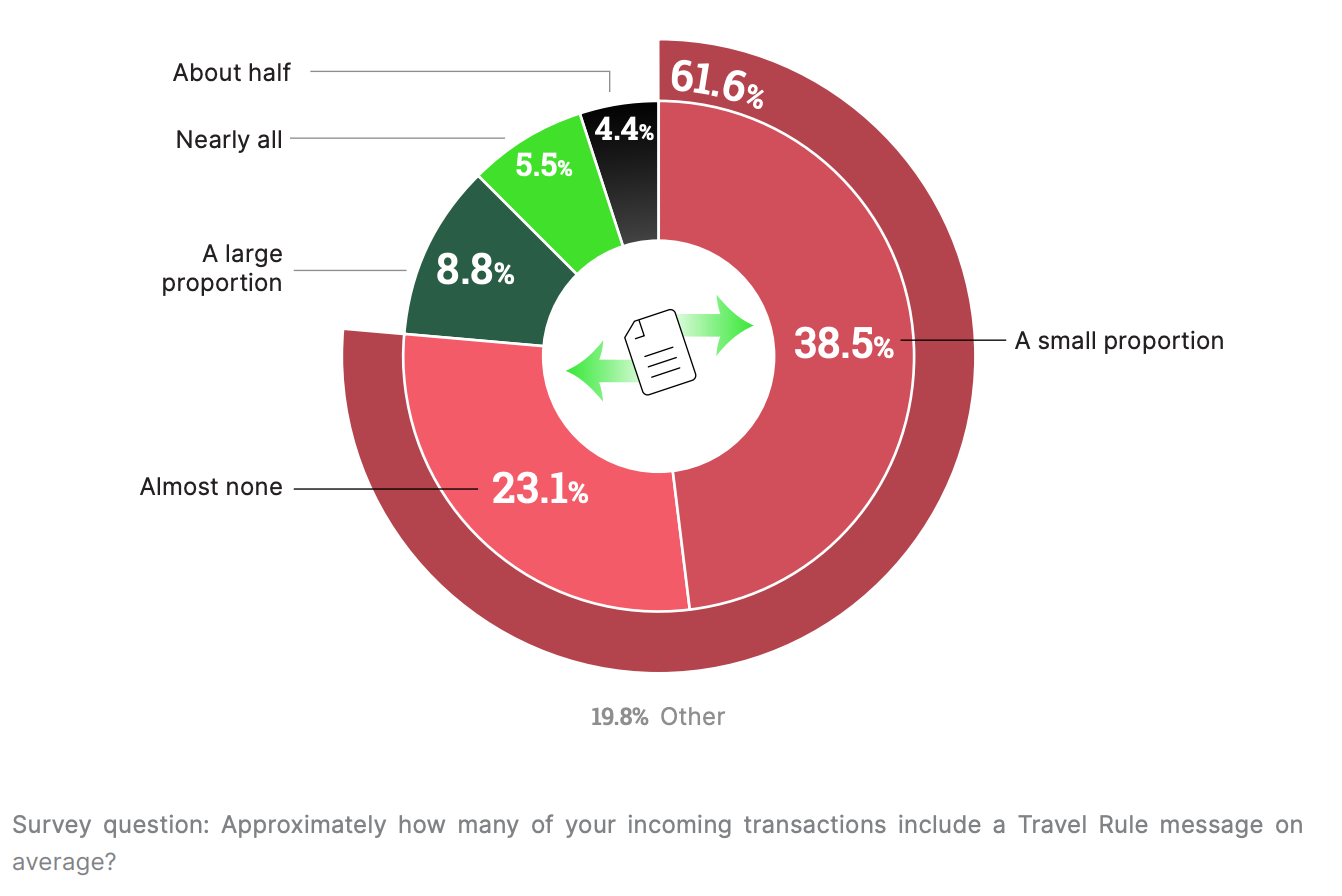
  • Compliance silos persist,  reflecting not just the lack of interoperability and open standards, but also the fragmented pace of Travel Rule adoption and enforcement worldwide. According to the 2025 State of Crypto Travel Rule survey, over 60% of respondents reported that almost none or only a small portion of incoming transactions include the required Travel Rule information
  • Law enforcement lacks access to critical information, limiting the ability to investigate and disrupt illicit activity
  • Crypto cannot fulfill its potential because it lacks the infrastructure necessary for integration into the global economy, as further explained in the above section

A Moment of Choice: Network Effects or Network Control

Overcoming the challenges in Travel Rule adoption is not simply about regulatory compliance; it is about unlocking crypto’s role as the next-generation backbone of global finance.

The core promise of crypto lies in openness: borderless settlement and universal reach. These advantages are only realized if the supporting messaging layer is equally open. Just as the internet scaled through universal protocols rather than private networks, crypto adoption can only reach its potential through open standards.

History has already shown that open networks win:

  • SWIFT and ISO 20022 created a shared messaging language that enables thousands of financial institutions to transact globally.
  • HTTP for web browsing, SMTP for email, and critically, SSL for secure transactions allowed any computer to connect to any other, regardless of service provider, enabling the open web to flourish and creating exponentially more value than the closed systems they replaced.

Crypto must follow this path. The messaging layer for Travel Rule compliance and transaction authorization cannot be proprietary and controlled by a handful of market actors. It must be built on open standards that allow every institution to connect, transact, and innovate without seeking permission from a competitor. Closed, proprietary protocols create fragmentation, entrench market power, and suppress innovation, preventing crypto from fulfilling its economic potential.

Advantages of Open Standards

Innovation through competition

Open networks eliminate lock-in. Institutions can choose service providers freely without risking access to counterparties. This forces innovation to flourish as providers must compete on service quality, not network control. 

Connectivity over control

Open, neutral messaging standards ensure every institution retains autonomy over counterparties, risk rules, and transaction authorization, without ceding control to a central operator. An open messaging layer also creates the network effects that allow the industry to prosper. Every new participant increases the value of the network for all others.

The Cost of Fragmentation

The alternative is a fragmented ecosystem that undermines the value-add of crypto. Imagine if, instead of a unified network like SWIFT, the global financial system had evolved into dozens of incompatible, closed messaging networks,  each unable to communicate with the others. Payments would stall at borders, institutions would struggle to reach counterparties, and innovation would be stifled by inefficiency. This is precisely the path crypto risks taking without open standards. Competing silos may deliver short-term advantages to a few, but they erode the collective value for all. For a technology built on openness and global connectivity, allowing fragmentation to persist would mean falling short of its original promise. Without interoperability, crypto cannot fulfill its potential as a truly borderless financial system, and we risk setting the industry back by years.

A Call to the Industry

If the Travel Rule messaging layer is built on proprietary networks, the industry will remain trapped in compliance silos. Travel Rule will become a regulatory burden that slows down business, instead of a catalyst to build the infrastructural upgrade that crypto has been missing.

But if we embrace open standards, we can turn Travel Rule into an opportunity to adopt an open authorization and messaging layer that connects counterparties, unlocks network effects and  powers real-world adoption.

Solving Travel Rule interoperability is not only a compliance urgency, it is a strategic imperative for the industry to flourish. And it requires a collective endorsement of open standards.

Notabene is committed to an open and interoperable future. Our platform is powered by the Transaction Authorization Protocol (TAP), an open standard purpose-built for transaction authorization and Travel Rule compliance in digital assets. We invite all industry participants, regulators, and innovators to join us in advancing this standard, and we reaffirm our commitment to ensuring full interoperability with other open standards that share our vision for a connected and transparent digital finance ecosystem.


¹ FATF, June 2025, VIRTUAL ASSETS: TARGETED UPDATE ON IMPLEMENTATION OF THE FATF STANDARDS, Figure 1.11.  

² https://www.ecb.europa.eu/press/financial-stability-publications/fsr/focus/2005/pdf/ecb~d573ca68c6.fsrbox200512_18.pdf 

References

FAQs

Call for Open Travel Rule Standards to Power the Next Era of Digital Finance

Insights

We are standing at the edge of a defining opportunity for the crypto industry. The Travel Rule is still perceived by many as a burdensome obligation that should be met with a check-the-box approach. But in reality, it is the catalyst for building critical infrastructure needed to unlock stablecoin payments at global scale and connect digital assets to the real economy. Once it is understood in this light - not as another compliance obligation, but as the foundation of the next phase of market infrastructure - its effective implementation becomes a strategic imperative deserving of united industry action. Only collective alignment around interoperability and openness will make effective implementation possible.

The Value of the Travel Rule: A Catalyst for Real-World Adoption

The Travel Rule requires financial institutions to securely exchange originator and beneficiary information before or in parallel with a virtual asset transfer. At first glance, this might seem like a regulatory nuisance, another box to check. In reality, it introduces a profound change in how crypto transactions work.

Natively, crypto payments are unilateral and context-free: senders can move value without the receiver’s consent, and the information recorded on the blockchain provides no information about who was transacting or why. These characteristics have slowed down the adoption of crypto rails for business and institutional use cases that depend on context, authorization, and risk controls.

The Travel Rule changes that. By requiring counterparties to exchange information before settlement, it introduces, for the first time, an opportunity to build a pre-transaction authorization flow into crypto transactions. Institutions must communicate before funds move. This creates the missing messaging layer that connects transactions to compliance processes, payment context, and counterparties.

What began as a regulatory requirement has become a forcing function for the infrastructural upgrade that crypto has been missing. Through the Travel Rule, the industry is building the same kind of pre-settlement messaging rails that power traditional payments, where transactions carry context, receivers can approve or reject transfers, and value and information travel together.

In this sense, the Travel Rule is more than a compliance requirement - it serves as the catalyst for building the missing foundations of institutional trust in crypto. By requiring institutions to exchange information before settlement, it opens the door to systems that restore control and risk management to both sides of a transaction. By mandating data exchange, it attaches real-world context to payments. And by making counterparties visible, it creates a trust fabric that allows institutions to confidently transact with third-parties in open loop systems, opening up business opportunities.

Together, these shifts establish the trust layer that crypto has been missing and unlock its potential to move beyond speculative markets and power the next generation of global payment systems.

Why Travel Rule Implementation Has Stalled

Since its adoption by the FATF in 2019, the Travel Rule has been implemented as a regulatory requirement for virtual asset transactions across jurisdictions worldwide. The FATF reports that 99 jurisdictions have passed or are in the process of passing Travel Rule legislation¹. Regulatory clarity is no longer the barrier. The barrier is infrastructure and whether the industry will choose a future defined by open connectivity, or fragmentation and control.

From the outset, interoperability has been cited as a primary barrier to Travel Rule implementation. In hindsight, this was almost inevitable.

Travel Rule information pipelines are emerging as the financial messaging backbone of the crypto economy. In traditional finance, we have clear precedents: SWIFT is classified as a systemically important messaging network deserving of cooperative oversight by G10 central banks, the European Central Bank, and the chair of the G10 Committee on Payment and Settlement Systems². Control over the Travel Rule messaging layer is highly attractive as it ultimately provides control over market access. Thus far, the fight for control has come at the expense of effective Travel Rule implementation, with limited coordination toward establishing open standards or interoperability.

As a result:

  • Compliance silos persist,  reflecting not just the lack of interoperability and open standards, but also the fragmented pace of Travel Rule adoption and enforcement worldwide. According to the 2025 State of Crypto Travel Rule survey, over 60% of respondents reported that almost none or only a small portion of incoming transactions include the required Travel Rule information
  • Law enforcement lacks access to critical information, limiting the ability to investigate and disrupt illicit activity
  • Crypto cannot fulfill its potential because it lacks the infrastructure necessary for integration into the global economy, as further explained in the above section

A Moment of Choice: Network Effects or Network Control

Overcoming the challenges in Travel Rule adoption is not simply about regulatory compliance; it is about unlocking crypto’s role as the next-generation backbone of global finance.

The core promise of crypto lies in openness: borderless settlement and universal reach. These advantages are only realized if the supporting messaging layer is equally open. Just as the internet scaled through universal protocols rather than private networks, crypto adoption can only reach its potential through open standards.

History has already shown that open networks win:

  • SWIFT and ISO 20022 created a shared messaging language that enables thousands of financial institutions to transact globally.
  • HTTP for web browsing, SMTP for email, and critically, SSL for secure transactions allowed any computer to connect to any other, regardless of service provider, enabling the open web to flourish and creating exponentially more value than the closed systems they replaced.

Crypto must follow this path. The messaging layer for Travel Rule compliance and transaction authorization cannot be proprietary and controlled by a handful of market actors. It must be built on open standards that allow every institution to connect, transact, and innovate without seeking permission from a competitor. Closed, proprietary protocols create fragmentation, entrench market power, and suppress innovation, preventing crypto from fulfilling its economic potential.

Advantages of Open Standards

Innovation through competition

Open networks eliminate lock-in. Institutions can choose service providers freely without risking access to counterparties. This forces innovation to flourish as providers must compete on service quality, not network control. 

Connectivity over control

Open, neutral messaging standards ensure every institution retains autonomy over counterparties, risk rules, and transaction authorization, without ceding control to a central operator. An open messaging layer also creates the network effects that allow the industry to prosper. Every new participant increases the value of the network for all others.

The Cost of Fragmentation

The alternative is a fragmented ecosystem that undermines the value-add of crypto. Imagine if, instead of a unified network like SWIFT, the global financial system had evolved into dozens of incompatible, closed messaging networks,  each unable to communicate with the others. Payments would stall at borders, institutions would struggle to reach counterparties, and innovation would be stifled by inefficiency. This is precisely the path crypto risks taking without open standards. Competing silos may deliver short-term advantages to a few, but they erode the collective value for all. For a technology built on openness and global connectivity, allowing fragmentation to persist would mean falling short of its original promise. Without interoperability, crypto cannot fulfill its potential as a truly borderless financial system, and we risk setting the industry back by years.

A Call to the Industry

If the Travel Rule messaging layer is built on proprietary networks, the industry will remain trapped in compliance silos. Travel Rule will become a regulatory burden that slows down business, instead of a catalyst to build the infrastructural upgrade that crypto has been missing.

But if we embrace open standards, we can turn Travel Rule into an opportunity to adopt an open authorization and messaging layer that connects counterparties, unlocks network effects and  powers real-world adoption.

Solving Travel Rule interoperability is not only a compliance urgency, it is a strategic imperative for the industry to flourish. And it requires a collective endorsement of open standards.

Notabene is committed to an open and interoperable future. Our platform is powered by the Transaction Authorization Protocol (TAP), an open standard purpose-built for transaction authorization and Travel Rule compliance in digital assets. We invite all industry participants, regulators, and innovators to join us in advancing this standard, and we reaffirm our commitment to ensuring full interoperability with other open standards that share our vision for a connected and transparent digital finance ecosystem.


¹ FATF, June 2025, VIRTUAL ASSETS: TARGETED UPDATE ON IMPLEMENTATION OF THE FATF STANDARDS, Figure 1.11.  

² https://www.ecb.europa.eu/press/financial-stability-publications/fsr/focus/2005/pdf/ecb~d573ca68c6.fsrbox200512_18.pdf 

Notabene is the trust layer for global crypto money movement.

Notabene Flow — the first open stablecoin payments platform for businesses—and Notabene Transact—the world's largest Travel Rule-compliant transaction authorization platform for regulated institutions—are built on the Transaction Authorization Protocol (TAP), an open messaging standard that enables verified entities to transact securely.

The Notabene Network connects thousands of trusted counterparties, facilitating over $1T in transaction volume annually across over 100 jurisdictions.