

BLOG
Insights on building trust infrastructure for global money movement

São Paulo/New York - 25 February 2026
Notabene, Veirano Advogados and ABToken announced today the launch of the Brazil Virtual Asset Regulatory Playbook, a practical implementation guide designed to help institutions navigate Brazil’s new regulatory framework for virtual asset service providers, including licensing, operational, AML/CFT obligations and Travel Rule requirements.
With the Central Bank of Brazil’s (BCB) new rules for virtual asset service providers (VASPs) now in force, Brazil enters a new phase of supervised virtual asset activity. The framework established by BCB Resolutions 519, 520, and 521 introduces a comprehensive licensing, supervisory, and AML/CFT regime for VASPs, as defined under Brazilian Law No. 14,478/2022.
Crucially, while Travel Rule obligations will be phased in through 2028, certain foreign exchange (FX) reporting requirements begin much sooner. Under BCB Normative Instruction No. 693, institutions must begin monthly reporting of FX-scoped virtual asset transactions, including self-hosted wallet and cross-border transfers, starting in May 2026. In practice, this means key originator and beneficiary data collection capabilities must be operational well ahead of full Travel Rule enforceability.
Designed for compliance, legal, operations, and product teams, the Brazil Playbook provides detailed guidance on:
- The VASP licensing framework and supervisory timelines;
- A breakdown of Travel Rule obligations under BCB Resolution 520;
- How foreign exchange reporting requirements intersect with Travel Rule controls; including the May 2026 monthly reporting obligation;
- The requirement for SPSAVs conducting FX-scoped activities to obtain both SPSAV and foreign exchange market licenses; and
- A phased implementation roadmap aligned to 2026 - 2028 enforcement milestones.
The Travel Rule framework under BCB Resolution No. 520 requires SPSAVs to collect, verify, retain, and transmit originator and beneficiary information for all virtual asset transfers, regardless of value. The guide outlines the two-phase rollout of Travel Rule obligations, beginning with domestic transfers between Brazilian VASPs and extending to cross-border transfers by 2028.
“Brazil’s new framework brings clarity, structure, and accountability to the virtual asset market,” said Catarina Veloso, Director of Regulatory & Compliance at Notabene. “The May FX reporting milestone makes it clear that institutions cannot wait until 2027 or 2028 to operationalize Travel Rule capabilities. This Playbook is built to help firms make meaningful progress throughout the two-year phased implementation period, while ensuring they meet interim regulatory milestones along the way.”
“The Central Bank’s regulations represent a structural shift in how virtual asset services are supervised in Brazil”, said Marcos Rocha, Partner at Veirano Advogados. “By clarifying the interaction between licensing, AML/CFT controls, and foreign exchange obligations, we aim to give market participants quick practical guidance.”
“This is a defining moment for Brazil’s virtual asset ecosystem,” said Regina Pedroso, Executive Director at ABToken. “Clear rules and coordinated implementation strengthen trust across the market and position Brazil as a leading jurisdiction for responsible innovation in virtual asset services.”
The Brazil Virtual Asset Regulatory Playbook is available for download now. Download the guide: https://notabene.id/reports/brazil-virtual-asset-regulatory-playbook
ENDS
About the Contributors
Notabene is the trust layer for global crypto money movement. Our products include Notabene Flow, the first open stablecoin payments platform for businesses, and Notabene Transact, the world's largest Travel Rule-compliant transaction authorization platform for regulated institutions. The Notabene network connects thousands of trusted counterparties, facilitating over $2T in transaction volume annually across more than 100 jurisdictions. It’s built on the Transaction Authorization Protocol (TAP), our open messaging standard that enables verified entities to transact securely. Notabene provides industry-leading tools for stablecoin payment coordination, real-time transaction authorization, counterparty verification, and self-hosted wallet identification—helping institutions build trust into every transaction.
Veirano Advogados is a leading Brazilian law firm with extensive experience advising clients in the fintech and digital assets industries. The firm has been closely involved in some of the most relevant projects in the Brazilian financial and crypto-asset markets, assisting both domestic and international clients on licensing, regulatory structuring, product launches, and complex cross-border transactions. Veirano’s team combines deep knowledge of the Brazilian financial regulatory framework with practical experience in the implementation of compliance programs, providing clients with pragmatic and business-oriented legal solutions in a rapidly evolving regulatory environment.
ABToken is a leading Brazilian industry association created to strengthen the country’s digital asset and tokenization ecosystem. The Association works to promote innovation alongside high standards of governance, regulatory compliance, and market integrity. ABToken represents tokenization platforms, blockchain companies, and virtual asset service providers (VASPs), serving as a unified voice for the sector in its engagement with regulators, policymakers, and market participants, and contributing to the development of a safe, credible, and sustainable digital finance environment in Brazil.
London / New York — 9 February 2026
Notabene today announces new regulated banking customer, AMINA Bank AG (“AMINA Bank”), a Swiss Financial Market Supervisory Authority (FINMA)-regulated crypto bank with global reach, to advance trusted infrastructure for transactions across crypto and traditional financial rails.
As digital assets continue to intersect with regulated finance, institutions on both sides are increasingly subject to the same regulatory expectations, even when operating on fundamentally different infrastructures. Standards developed for traditional finance, including FATF’s payment transparency requirements under Recommendation 16, have long been embedded in banking workflows. These expectations have since been extended to virtual assets and VASPs through the Crypto Travel Rule, creating a shared regulatory baseline across the two systems.
However, regulatory alignment has not translated into operational consistency. Differences in infrastructure, workflows, and counterparties mean that applying long-established expectations of counterparty trust to crypto transactions, particularly when value moves between the two environments, remains an operational challenge.
With this partnership, Notabene and AMINA Bank are addressing the real-world application of Travel Rule requirements across crypto-native infrastructure and regulated banking environments. Notabene’s platform enables secure information exchange and transaction transparency across crypto transactions. AMINA Bank provides banking services across traditional financial and digital assets in one place, serving clients from over 40 countries. Through this integration, AMINA Bank can now extend a more streamlined and automated experience for Travel Rule compliance.
“As institutional portfolios increasingly include crypto alongside traditional holdings, clients require infrastructure that works across both environments without creatng compliance friction,” said Myles Harrison, Chief Product Officer at AMINA Bank. “Integrating Notabene’s technology allows us to provide a more streamlined compliance framework that reduces operational friction, allowing clients to transact between crypto and traditional finance with ease.”
“FATF standards are well established in banking, but applying them consistently when value moves between crypto and traditional financial systems is still an open operational challenge,” said Pelle Braendgaard, CEO of Notabene. “AMINA is able to leverage the Notabene platform as a system of record for seamless, trusted transactions as these markets continue to converge.”
As the trust layer for global money movement, Notabene works with crypto-native firms and financial institutions to support secure information exchange, authorisation, and transparency across all transactions. Through partnerships such as the one with AMINA Bank, Notabene is moving the industry towards more consistent, operationally viable transaction flows between crypto and traditional finance.
This partnership marks an important step toward bridging operational and regulatory understanding between crypto and traditional finance, as institutions seek practical ways to support compliant, trusted digital asset activity within existing financial frameworks.
ENDS
Media Inquiries
We previously reported on Hong Kong’s new stablecoin issuer regime, which introduced a comprehensive set of Travel Rule obligations for licensed issuers. As the HKMA now moves from reviewing applications to making licensing decisions, issuers that treat Travel Rule as an afterthought risk delaying their go-live—operational readiness on Day 1 will be the real differentiator.
The Stablecoins Ordinance took effect on August 1, 2025, alongside the HKMA’s AML/CFT Guideline for licensed stablecoin issuers. The HKMA made clear that AML/CFT requirements—including Travel Rule compliance—apply to licensed stablecoin issuers.
The Guideline states explicitly in section 1.6 that the minimum AML/CFT criteria
“apply when a licensee is granted a license and continue to apply throughout the licensee’s conduct of licensed stablecoin activities.” HKMA AML/CFT Guideline for Licensed Stablecoin Issuers
In practice, the HKMA expects Travel Rule compliance to be addressed in the AML/CFT policies and procedures submitted as part of the license application. Once a license is granted, stablecoin issuers cannot commence operations until they are able to comply with the Travel Rule—meaning the necessary systems must be fully implemented, tested, and ready to go live before any regulated stablecoin activity begins.
The Ordinance included a transitional regime for entities already conducting regulated stablecoin activities before August 1, 2025, allowing eligible firms to continue operating while their license applications were assessed. This transitional window closes at the end of January 2026, with the HKMA able to grant provisional licenses up to February 1, 2026.
In practice, however, no entity actually benefited from the transitional regime, meaning there are no issuers operating under transitional status while awaiting approval.
The market is now entering the next phase: the HKMA is reviewing the first wave of applications, specifically those submitted by the end of September 2025, and expects to issue licensing decisions early this year.
The market is now entering the next phase: the HKMA is reviewing the first wave of applications, specifically those submitted by the end of September 2025, and expects to issue licensing decisions early this year. For applicants in this first cohort, the priority is to avoid a post-approval scramble—because the fastest route to launch is the one where operational compliance is ready before the license arrives.
For teams navigating this next phase of approvals and compliance readiness, join our upcoming webinar: HKMA Stablecoin Licensing Decisions Are Coming — Are You Ready?
What issuers should be doing now to protect go-live timelines
- Finalize your Travel Rule solution selection process and complete vendor due diligence
- Map end-to-end stablecoin transfer flows, including self-hosted wallet scenarios
- Approve detailed operating procedures and internal controls for stablecoin transfers
- Assess counterparty readiness, including messaging standards and data availability
- Integrate Travel Rule data into transaction monitoring and sanctions screening
- Produce evidence of testing and operational readiness, so compliance is demonstrable on Day 1
A closer look into Travel Rule obligations for Stablecoin Issuers
Scope of Application
The Guideline on Anti-Money Laundering and Counter-Financing of Terrorism (For Licensed Stablecoin Issuers) applies to stablecoin issuers that hold a license granted under section 15 of the Stablecoins Ordinance.
In the HKMA’s words:
“This Guideline is issued … for a stablecoin issuer which holds a license granted under section 15 of the Stablecoins Ordinance (hereafter referred as ‘licensee’). A licensee is a financial institution as defined in Part 2 of Schedule 1 to the AMLO.”
The HKMA is explicit that compliance with the Guideline is necessary to meet statutory obligations under both the Stablecoins Ordinance and the Anti-Money Laundering and Counter-Terrorist Financing Ordinance (AMLO).
“A licensee should meet these requirements in order to comply with the statutory requirements under the Stablecoins Ordinance and the AMLO.” HKMA AML/CFT Guideline
What that means in practice
- Only licensed stablecoin issuers are directly subject to these guidelines.
- Once licensed, the issuer is treated as an AML/CFT-obliged financial institution under Hong Kong law.
- The obligations apply to:
- the entity itself,
- its officers, senior management, and staff, and
- its licensed stablecoin activities, including issuance, redemption, and stablecoin transfers.
When the obligations apply
Importantly, the guidelines are not just ongoing supervisory expectations. They apply:
“when a licensee is granted a license and continue to apply throughout the licensee’s conduct of licensed stablecoin activities.”
This is why the HKMA expects applicants to demonstrate compliance readiness at the point of licensing, not after.
Who they do not directly apply to
- Unlicensed stablecoin issuers (though they cannot legally operate once licensing is required)
- Wallet providers, VASPs, banks, or intermediaries unless they are also licensed stablecoin issuers
- Overseas group entities, except to the extent group-wide AML/CFT controls are required by the licensed issuer (Chapter 3)
That said, counterparties do feel the impact indirectly, because licensed issuers must assess whether counterparties can meet Travel Rule and data-protection requirements before transacting with them (Chapter 6).
For pre-existing issuers operating under transitional arrangements, January marks the end of the window to continue business without a full license. For new applicants, January is when the HKMA starts deciding who's actually ready versus who's just talking about readiness.
Zero Tolerance for Compliance Gaps
Unlike jurisdictions that set minimum thresholds for Travel Rule compliance, Hong Kong takes a zero-threshold approach. Every stablecoin transfer requires travel rule compliance, regardless of amount. For transfers below $8,000, issuers must still collect and transmit originator and recipient names plus account information. Above $8,000, they need to transmit a broader scope of originator identifying information, as further detailed in our Hong Kong jurisdiction page.
End-to-end Travel Rule processes
Chapter 6 of the Guideline sets out detailed obligations for ordering, intermediary, and beneficiary institutions, in which they need documented procedures for collecting and verifying originator and beneficiary information, transmitting required data immediately and securely, and rejecting or escalating transfers with missing information. For more details, consult our Hong Kong jurisdiction page.
A functioning Travel Rule technology solution
If you rely on a third-party Travel Rule solution, the responsibility still sits with you. The HKMA requires due diligence proving your solution can identify counterparties, transmit data securely in real-time, handle transaction volume, and support sanctions screening.
Counterparty due diligence
Travel Rule compliance depends on who you transact with. The HKMA requires issuers to assess whether counterparties can meet Travel Rule and data-protection obligations before entering into stablecoin transfer relationships.
This is particularly important given the global patchwork of Travel Rule implementation. Issuers must be able to justify why a counterparty is acceptable or restricted.
Integration with monitoring and sanctions screening
Travel Rule data isn’t standalone. The HKMA expects it to feed into transaction monitoring and sanctions screening programs under Chapters 5 and 7 of the Guideline.
That includes screening originators and beneficiaries before executing transfers and using Travel Rule information to detect suspicious activity.
Self-hosted Wallets Get Enhanced Scrutiny
The guidelines take a particularly cautious approach to self-hosted wallet transactions. Stablecoin issuers must:
- Screen wallet addresses against databases of illicit activity
- Implement enhanced monitoring for higher-risk wallets
- Apply transaction limits where appropriate
- Collect originator/recipient information for all transfers to/from unhosted wallets
For more details, consult our Hong Kong jurisdiction page.
Ongoing monitoring
The HKMA recognizes that stablecoin transactions are visible on-chain and that tools like blockchain analytics, wallet screening, blacklists, and freezing mechanisms can help detect and respond to illicit activity. However, the HKMA takes the view that “the effectiveness of these risk mitigating measures is yet to be proven”—especially for peer-to-peer transfers involving self-hosted wallets—the HKMA expects issuers to take a cautious approach. This means that unless an issuer can clearly demonstrate that its risk controls are effective, the HKMA’s default expectation is that the identity of every stablecoin holder should be verified, even where that holder is not a customer of the issuer. In practice, this can create an obligation to verify the identity of third parties, either directly by the issuer or via a supervised financial institution/VASP or another reliable third party.
Operational readiness is your competitive edge
With the HKMA reviewing the first applications, Hong Kong’s stablecoin regime is moving from paper to practice. The framework sets a high bar, and issuers that can translate policies into operational capability will be better positioned to launch quickly once licensed. Travel Rule compliance, in particular, needs to be designed into the operating model from the start—it can’t be treated as a bolt-on—because it shapes everything from customer flows to monitoring, investigations, and SAR reporting. As licensing decisions begin to come through, the first-to-market issuers will be those that can demonstrate readiness and begin operating without delay.
For teams navigating this next phase of approvals and compliance readiness, join our upcoming webinar: HKMA Stablecoin Licensing Decisions Are Coming — Are You Ready?
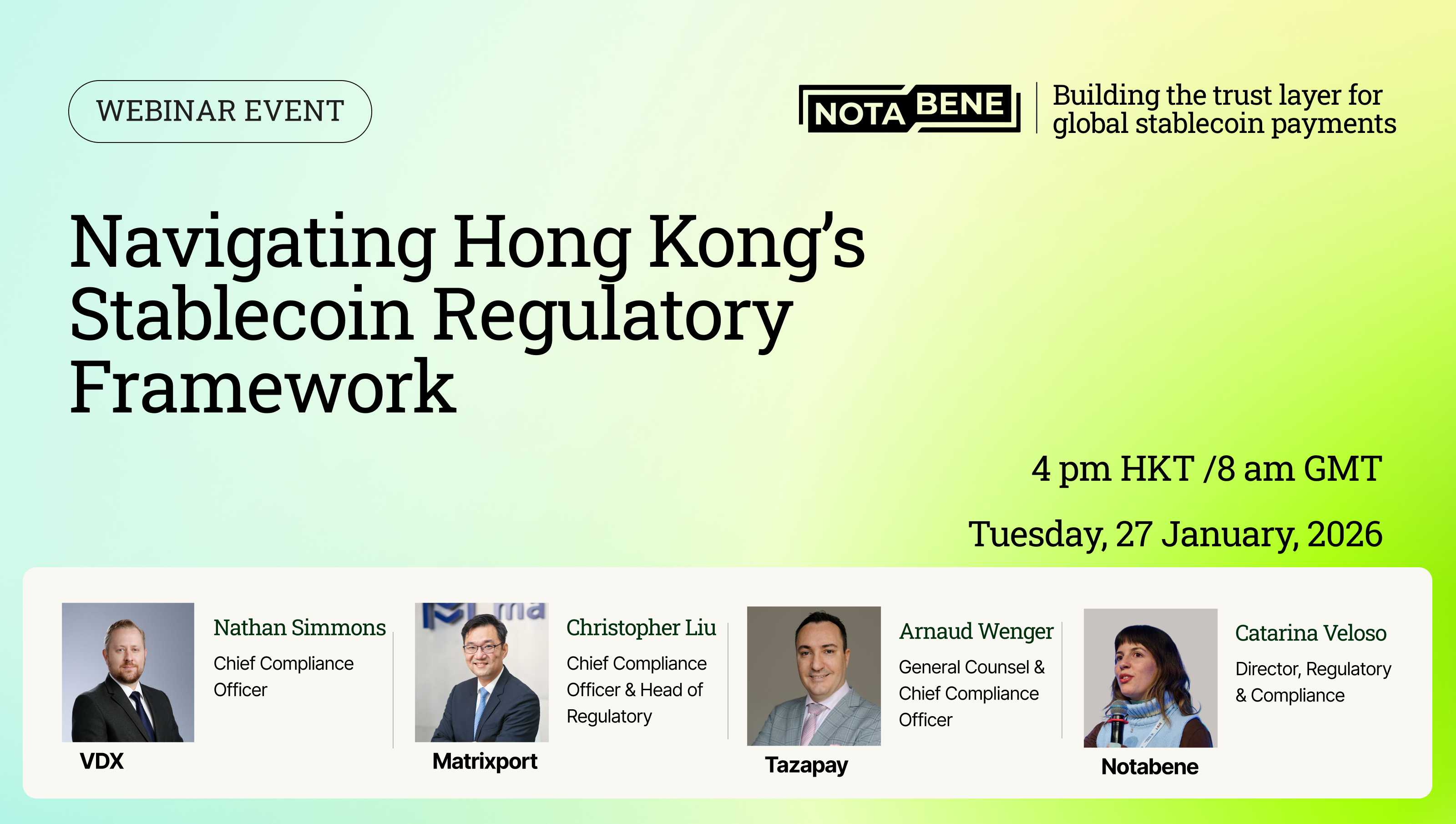
The Digital Asset Market Clarity Act is the most comprehensive effort so far to establish a federal framework for digital assets in the United States. While much of the debate has focused on securities classification and innovation, the bill’s most consequential shift sits elsewhere, specifically in how it governs illicit finance and the movement of funds.
Rather than treating compliance as an afterthought applied after transactions occur, the proposed bill advances a different premise: that payment integrity must be built into the transaction itself. This approach aligns digital asset markets with long-standing expectations in traditional finance, where authorization, counterparty assurance, and traceability are prerequisites—not afterthoughts—for moving money.
Anti-money laundering controls, sanctions compliance, and the Travel Rule are no longer framed as constraints on innovation. They are framed as the trust infrastructure required for digital assets to function as real payment rails.
This is not about reinventing financial crime compliance. It is about extending it deliberately into digital asset markets, and in doing so, laying the foundation for crypto payments that institutions, regulators, and users can trust.
Bringing digital asset intermediaries under the Bank Secrecy Act
Title II explicitly places digital commodity brokers, dealers, and exchanges under the Bank Secrecy Act (BSA).
Section 201 removes any remaining ambiguity about whether crypto intermediaries are covered financial institutions. It directs the Treasury, through FinCEN, to apply AML and counter-terrorist financing requirements in a risk-based manner, consistent with how banks and payment providers are supervised today.
That includes:
- Risk-based AML/CFT programs
- Customer identification and due diligence
- Recordkeeping and suspicious activity reporting
- Compliance with U.S. sanctions administered by OFAC
This matters because BSA coverage is the legal foundation for the Travel Rule. Once an entity is clearly in scope, requirements to collect, transmit, and retain originator and beneficiary information are no longer theoretical, they are enforceable.
The Travel Rule: reinforced, not reinvented
The bill does not rewrite the Travel Rule. Instead, it strengthens the legal perimeter that allows it to function in digital asset markets.
Two provisions are critical:
First, by confirming that digital commodity intermediaries are BSA-covered institutions, the bill eliminates arguments that crypto transfers fall outside the transmittal-of-funds framework altogether.
Second, Title III, Section 303 introduces a special measure for certain transmittals of funds, modeled on Section 5318A of the BSA. This is the same authority Treasury uses to restrict or cut off transactions involving jurisdictions, institutions, or transaction types that present elevated money laundering risk.
Applied to digital assets, this authority allows Treasury to condition, monitor, or prohibit specific crypto fund flows where transparency or compliance breaks down.
The bill reinforces this approach further by explicitly including digital assets in the definition of monetary instruments, closing any remaining gap between crypto transfers and established concepts of value transmission.
Why the Travel Rule makes crypto payments safer
The Travel Rule is often framed as a compliance burden. In practice, it’s a basic safety mechanism.
By requiring originator and beneficiary information to accompany a transaction, the Travel Rule creates accountability across payment chains. It allows institutions to assess counterparty risk before execution, rather than relying solely on post-transaction monitoring.
This is how traditional payment systems work. Wire transfers, correspondent banking, and cross-border settlement depend on shared information standards to function safely.
Without those standards, payments become fragmented and high-risk. The same is true in crypto. When no one knows who is sending or receiving value, legitimate actors pay the price and illicit actors benefit.
The Travel Rule is about authorization and risk management. It enables compliant institutions to transact with confidence and limits the ability of bad actors to exploit opacity.
From transaction monitoring to transaction authorization
Another important shift in the bill is its emphasis on pre-transaction controls, not just after-the-fact reporting.
Several provisions authorize temporary holds, enhanced scrutiny, or conditions on execution where illicit finance risk is elevated. This brings crypto compliance closer to how mature payment systems actually operate.
In traditional finance:
- Certain payments require additional review before execution
- High-risk transfers may be delayed or blocked
- Authorization workflows are built directly into payment rails
By explicitly addressing digital asset transmittals within the BSA framework, the bill opens the door for similar controls in crypto especially for institutional, cross-border, and high-value transactions.
This reflects a simple reality: reporting suspicious activity after value has moved is often too late. Preventing abuse requires the ability to stop or condition transactions before settlement.
Payments transparency as operational infrastructure
Title II treats payments transparency as an operational requirement, not a policy aspiration.
The bill:
- Encourages the use of blockchain analytics in AML programs
- Expands examination standards for digital asset firms
- Directs attention to mixers, kiosks, and offshore intermediaries
It also focuses enforcement at key access points, such as digital asset kiosks and user-facing application layers. Even where underlying protocols are decentralized, the interfaces that enable access are expected to screen for sanctions exposure and high-risk activity.
This reflects how illicit finance actually works. Risk concentrates at entry and exit points, not deep inside protocol code.
Transparency at these points allows regulators to distinguish lawful activity from abuse—and allows compliant institutions to transact without assuming unnecessary risk.
What this means for crypto payments
Taken together, the illicit finance provisions of the Digital Asset Market Clarity Act point to three clear conclusions:
- Crypto payments will be held to the same standards as traditional payments
- Including AML controls, sanctions screening, and Travel Rule compliance.
- Risk assessment is moving closer to execution
- Authorization, not just monitoring, becomes central to compliance.
- Compliance is a condition for access, not a barrier to innovation
- Firms that cannot support transparency and authorization will struggle to connect to regulated payment networks.
The bill doesn’t solve every implementation challenge. But it draws a clear line: crypto payments that connect to the U.S. financial system must be traceable, authorizable, and accountable.
That’s how crypto payments become infrastructure—not an exception.
So what’s next: from markup to the President’s desk
The Clarity Act has already cleared an important milestone: it passed the U.S. House of Representatives with bipartisan support. The bill now moves to the Senate.
The next major milestone is markup, where the Senate will decide whether to take up the House-passed bill as written or advance its own version. That process includes committee review and potential amendments, particularly around market structure and illicit finance provisions. If the Senate’s version differs, the two chambers will need to reconcile the text before final passage.
Only once both the House and Senate pass identical language can the bill be sent to the President for signature.
Even then, the work won’t be finished. Much of the real impact will come through Treasury and FinCEN rulemaking, which will determine how AML, sanctions apply in practice especially for transaction authorization and cross-border crypto payments.
For compliance and payments teams, this is a key moment. The direction is set: crypto payments connected to the U.S. financial system will be expected to meet the same trust standards as traditional payments. What’s still being decided is how those standards are implemented.
Have questions about how this legislation might impact your business? Schedule a call with our Regulatory & Compliance team—we’d be happy to provide our perspective help you navigate this new regulatory landscape.
In 2025, the conversation around crypto and stablecoins fundamentally changed.
What was once framed as innovation at the bleeding edge of technology became infrastructure at the center of how financial organizations do business. Regulations matured, transaction volumes surged, and institutions moved decisively from experimentation to execution. In this environment, trust was no longer an aspiration. It became a prerequisite for scale.
For Notabene, 2025 was the year our founding vision became undeniable to the rest of the crypto and financial worlds. When the Financial Action Task Force (FATF) extended the Travel Rule to crypto in 2019, much of the industry viewed it as added friction—a compliance requirement imposed on a fast-moving ecosystem. At Notabene, we saw something fundamentally different.
We saw a catalyst for building what crypto had been missing since day one: a transaction authorization layer that enables digital assets to function as essential financial infrastructure. That belief has guided our work from the start, and in 2025 it began to fully take shape on Notabene as a powerful platform for trusted, programmable and revenue-generating transactions across the globe.
As the market evolved, so did our platform.
In 2025, Notabene evolved into a core payments infrastructure provider and system of record for financial institutions globally
.png)
That evolution was anchored by the launch of Notabene Transact, our next-generation transaction authorization and compliance engine.
Transact is the operational core of the Notabene platform and the system of record that regulated financial institutions rely on to move digital assets at scale. It is where counterparty due diligence, policy enforcement, and transaction authorization come together in real time, enabling institutions to make automated, risk-aware decisions before value moves.
By embedding compliance and authorization directly into transaction flows, Transact enables high straight-through processing rates while meeting the regulatory requirements of operating across jurisdictions. What began as Travel Rule infrastructure has evolved into a foundational layer that institutions depend on to operate, scale, and connect with confidence on the Notabene Network.
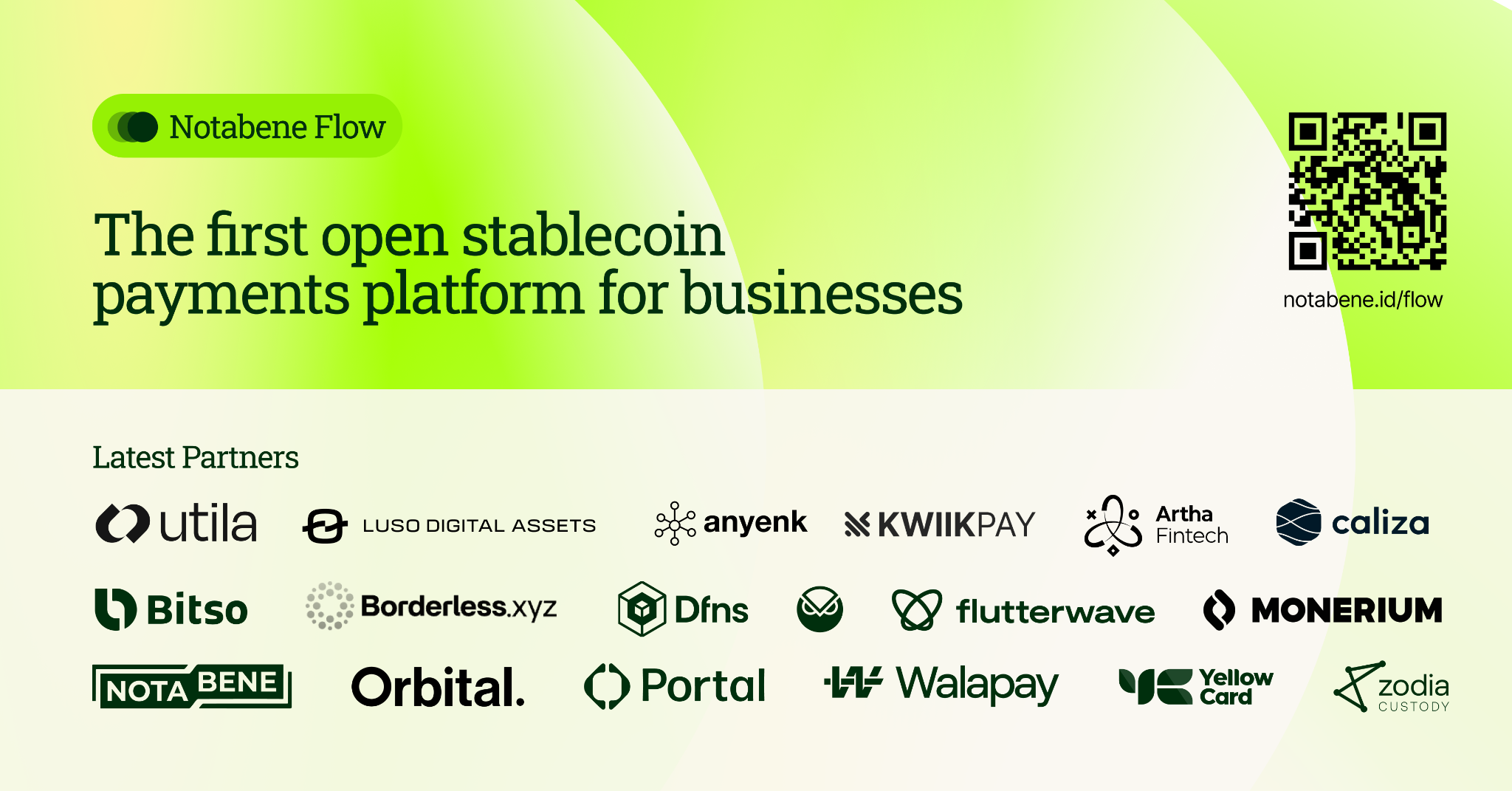
When we started Notabene, we saw compliance as a critical stepping stone—the core—but not the end goal. Enabling compliant transactions at scale meant starting with the hardest problem first: getting compliance right. The vision was to embed trust directly into how transactions are authorized, coordinated, and settled so that digital assets could support real-world payments at scale. We made this possible last year with the launch of Notabene Flow, the first open stablecoin payments platform built for businesses.
Notabene Flow introduces new payment capabilities such as pull payments and recurring subscriptions, enabling our fast-growing network to provide instantaneous stablecoin payments to the global B2B market. It also represents a shift from enabling individual transactions to enabling complete payment workflows that meet both operational and regulatory expectations.
By embedding compliance, identity, and authorization directly into payment flows, Notabene Flow takes stablecoins beyond simple transfers and into real commercial use, enabling new revenue flows for institutions in our network. It is a critical step toward making stablecoins usable at scale in everyday business.
When we look back at 2025, a few themes become clear to us.
Growing transaction volume across borders requires a built-in trust layer
In crypto’s early years, compliance was often treated as an add-on, implemented only when regulation made it unavoidable—and as a result, it was frequently viewed by business teams as friction rather than an enabler. By 2025, that mindset no longer held.
As transaction volumes grew and stablecoins moved into real payment flows, trust could no longer be bolted on after the fact. Growth itself began to require shared standards, interoperability, and regulatory alignment built directly into how value moves.
That shift was not anecdotal. It was visible in the data and in the scale of the Notabene Network, which by Mid-2025, surpassed $1 trillion in total transaction volume processed across our network. While the first $500 billion took us three and a half years to grow into, the second happened in just 6 months. This exponential growth trend continues with the Notabene Network knocking on the door of $2T just a few months later.
This milestone reflects both the scale at which our customers operate and the role Notabene plays in enabling compliant global transactions. As institutions handle higher volumes across more jurisdictions, Notabene increasingly serves as the connective infrastructure that allows crypto and stablecoin payments to move safely between counterparties.
Compliance became an enabler of doing business for anyone working with digital assets
As regulatory expectations moved from concept to enforcement across 2025, one question dominated the industry: Is the market ready?
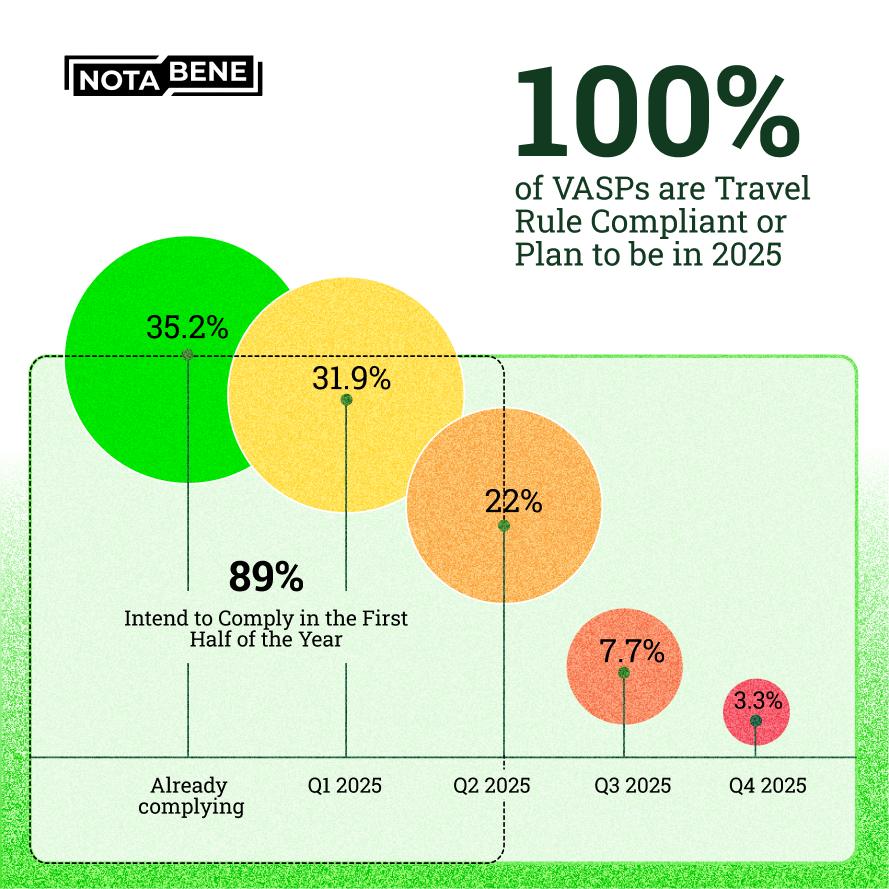
In April 2025, Notabene released the State of Crypto Travel Rule 2025 Report, the fourth annual edition of our comprehensive analysis of Travel Rule adoption, readiness, and implementation trends across the digital asset ecosystem. The report draws on survey data from nearly one hundred Virtual Asset Service Providers and input from regulatory bodies to capture how the industry is navigating evolving compliance landscapes.
One finding stood out. An unprecedented 100% of VASPs surveyed reported that they plan to be Travel Rule compliant by the end of 2025, reflecting a decisive shift from earlier years when compliance was optional or aspirational. Nearly nine in ten respondents expected to meet requirements in the first half of the year, underscoring the urgency across the market.
What the survey data shows is reinforced, and in many cases surpassed, by what we see across the Notabene platform itself. Over the past year, there has been a sharp increase in due diligence questionnaire requests, rapid adoption of policy engines, and a growing density of live connections between institutions. These are not theoretical commitments. They are operational signals that firms are actively raising their compliance standards to work with one another.
The data also revealed deeper operational change. Institutions are increasingly blocking withdrawals until beneficiary information is confirmed and returning deposits if originator data is missing. Compliance is no longer a policy exercise. It is becoming embedded directly into transaction flows, counterparty selection, and go to market decisions.
Taken together, the message is clear. Travel Rule compliance is no longer a regulatory checkbox. Companies operating on the Notabene platform are setting a global standard for what good looks like, proving that robust compliance has become a prerequisite for participation, connectivity, and growth in an increasingly interconnected and regulated digital asset economy.
Open messaging layers are essential for global stablecoin payment networks
Stablecoins will only deliver on truly global, borderless payments if the messaging layer is open. We’ve seen this before: shared standards like SWIFT and ISO 20022 made global bank-to-bank transactions possible, just as HTTP, SMTP, and SSL allowed the open internet to scale beyond closed, proprietary networks.
The same is true for crypto. Travel Rule compliance and transaction authorization cannot rely on closed protocols controlled by a few players. That approach fragments the ecosystem and limits innovation.
This is why we built the Transaction Authorization Protocol (TAP). TAP is an open messaging standard that enables pre-settlement coordination while preserving the permissionless nature of blockchain networks. It adds the missing authorization layer so transactions carry intent, compliance, and accountability alongside value.
By embedding regulatory checks directly into transaction flows, TAP turns compliance into infrastructure. Stablecoin payments become faster, safer, and more interoperable than traditional rails.Backed by Notabene’s open network of 2,000+ institutions, TAP lays the foundation for mainstream, compliant global stablecoin adoption.
Policy, payments, and infrastructure are converging
Trust is not built by infrastructure alone. It is reinforced through community. Our community-building initiatives in 2025 helped to generate a shared understanding, open dialogue, and alignment across the crypto payments ecosystem.
At our second annual Notabene Summit in New York City, we convened leaders from financial institutions, crypto-native companies, regulators, and infrastructure providers as stablecoins and compliant payments moved from theory to execution. The Summit focused on the convergence of traditional finance and crypto, the role of stablecoins in cross-border payments, and the importance of industry-regulator collaboration as adoption accelerates.
The event also marked a major milestone for Notabene with the launch of Notabene Flow, opening a new chapter in compliant stablecoin payments. Panels featured senior leaders from organizations including Mastercard, Robinhood, the U.S. Treasury, the Blockchain Association, BVNK, and Bitso, with discussions centered on real-world execution: operationalizing stablecoin payments, navigating regulatory expectations, and building interoperable infrastructure that can scale globally.
We carried these conversations forward with Stack Chats, a video interview series focused on the strategic and operational realities of payments, compliance, and digital asset infrastructure. Episodes featured leaders including Clarisse Hagege, Anoosh Arevshatian, and Kevin Lehtiniitty, sharing candid perspectives on innovation, regulation, and global scale.
The next episode will launch in early 2026 as these conversations continue into the year ahead.
Looking Ahead to 2026: From Momentum to Execution
The foundation we laid in 2025 sets a clear direction for the year ahead and we could not be more excited to execute our vision for an open, trusted, and value-accruing network of regulated financial institutions.
We’re focused on the following areas as we hit the ground running in 2026.
Building the system of record for regulated financial institutions
As large financial institutions and regulated crypto exchanges continue to build and grow in additional jurisdictions across the globe, they demand a best-in-class authorization and orchestration layer to power their transactions in a compliant and trusted way.
In the United States, proposed legislation such as the GENIUS Act reflects a broader shift toward clear, enforceable expectations for digital asset transactions. While regulatory frameworks differ by jurisdiction, the direction is consistent: regulated institutions need infrastructure that can support authorization, compliance, and reporting by default. This continued alignment reinforces the need for a shared system of record as digital assets move further into mainstream financial activity.
With our powerful set of tooling that facilitates automated decision-making and compliance engine with unmatched straight-through processing rates, we are fast becoming the de facto system of record for FIs, fintechs, and crypto-natives as they build out their payments infrastructure. Our commitment to open standards, interoperability, and industry-leading security have made Notabene the first name that regulated institutions turn to for compliant, trusted digital asset transactions.
Combined with automated reporting and analytics, our powerful transaction authorization platform has evolved beyond so much more than a Travel Rule compliance solution. Our customers are now turning to us as a foundational piece of their core digital asset infrastructure—and we're doubling down on our investment in product innovation to help our customers drive even more efficiency and compliant transaction volume on their platforms while de-risking their business at the same time. You can expect many more product enhancements on our core platform in 2026 to drive even more value for our customers.
Enabling high-value B2B stablecoin payment flows across the globe
As we write about in our Notabene Flow whitepaper, there is a good reason that stablecoins have yet to take a meaningful bite out of the $120T global B2B payments market. Context is missing. Trust is missing. Authorization is missing. While the gains in transaction speed and affordability are undeniable for a classic one-directional push payment, the reality is that the higher-value payments that unlock real utility for large enterprise need to have Trust, Context, and Authorization in place to enable payment types that they rely on for daily commerce, pull payments and recurring subscriptions, and metered billing.
This is where the Notabene Flow vision meets reality. By bringing this payment layer to our existing network of active regulated FIs and exchanges, Notabene is set to kickstart the adoption of stablecoins for B2B payment applications in 2026. We’re thrilled to be working side-by-side with our founding partners of Notabene Flow to continue building out our APIs and tooling to support their business use cases and many more as the year unfolds.
You can sign up today to join the network, and join us in-person in New York and London to learn more at our Notabene Flow Roadshow meetups next month.
Accelerating the agentic payments future
Perhaps the only word more ubiquitous than stablecoins last year was agentic. And for good reason, with agentic payments poised to revolutionize the way that consumers and businesses operate in 2026 and beyond. Notabene is actively investing in building this future with some exciting new developments in our Transact product, bringing robust and instantaneous counterparty due diligence to our 250+ customers, as well as working to bring more complex payment routing to members of the Notabene Flow network with real-time payment orchestration built not only on efficient routing but also factoring in the critical elements of counterparty trust and transaction context so that agentic payments can really prioritize what matters most to each individual party.
Keep an eye on this space as we invest in accelerating the future of agentic payments for our customers in 2026.
Thank you for building with us in 2025. Here’s to an even more incredible 2026!
To our customers, partners, and community, thank you for being a part of the Notabene ecosystem in 2025. A core part of our philosophy is the belief that no one company alone can build the future we all want to see. We thank you for being a part of our story in 2025 and are honored for you to join us as we move forward in 2026 with clarity of vision and a commitment to building real value for businesses across the globe.
2025 was the year trust became infrastructure.
2026 will be the year we scale it into everyday global payments.
Join us as we continue building the trust layer for global money movement.
Anastasiia from the Notabene product team walks through an example of a pull transaction on Notabene Flow. This demo shows the full end-to-end flow, with Travel Rule compliance and transaction authorization built-in to every payment on the Flow network.
To learn more, schedule a custom demo with the team or read our introduction to Notabene Flow developer documentation at devx.notabene.id.
This morning at the Blockchain Association's Policy Summit, Senator Cynthia Lummis dropped significant news: the Senate's bipartisan market structure draft will be released by the end of this week, with markup planned for next week.
With the GENIUS Act now law and its rule-making process underway, Washington has turned its attention to the fundamental question that's been hanging over the industry: who regulates what in crypto?
The answer matters because it determines whether the SEC or CFTC has jurisdiction, what registration requirements apply, and ultimately how digital asset markets can operate in the United States.
After months of negotiations between Senate Banking and Agriculture Committees, the legislative framework that will determine how digital assets are regulated in the United States is finally ready for public review.

Timeline: How We Got Here & What Comes Next
Let’s quickly review how we got here. On July 17, 2025 Digital Asset Market Clarity Act of 2025 (CLARITY Act, now it has to pass the Senate, and after that it goes to the president to be signed into law.
- July 17, 2025: House passes CLARITY Act (H.R. 3633) with bipartisan support, 294-134
- November 10, 2025: Senate Agriculture Committee releases 155-page bipartisan discussion draft on digital commodities and CFTC oversight
- September-December 2025: Senate Banking Committee negotiates bipartisan draft covering SEC jurisdiction (not yet public)
- Last week: First bipartisan member meeting between Senate Democrats and Republicans
- Last night (Mon, Dec. 8): Democrats delivered final asks to Republican staff
- This week: Draft bill to be released by week's end
- Next week: Markup planned
- End of 2025: Senate Banking Chair Tim Scott's goal for committee votes on both bills
- Early 2026: Target for merged Senate floor vote
The Two-Committee Process
The Senate is taking a different approach than the House. Rather than the joint committee process used in the House, the Senate has two separate committees working in parallel.
The Senate Banking Committee handles SEC-facing aspects of market structure: how to define investment contracts, what qualifies as an ancillary asset, and related securities questions. Chair Tim Scott started with Republican-led discussion drafts, most recently the Responsible Financial Innovation Act of 2025, then worked to turn this into a bipartisan product through meetings with crypto-friendly Democrats and industry roundtables.
The Senate Agriculture Committee focuses on digital commodities and CFTC oversight. On November 10, Chair John Boozman and Senator Cory Booker released a 155-page bipartisan discussion draft that builds on the House CLARITY Act but takes a more prescriptive approach to customer protection. It includes tighter proprietary trading limits, detailed conflict-of-interest rules, enhanced retail protections, and would create an Office of the Digital Commodity Retail Advocate at the CFTC.
The two committees communicate extensively to ensure their bills work together, even though they're moving on separate tracks. Once both bills pass committee, they'll be stitched together on the Senate floor as a two-committee product.
Why This Week Matters
The timing is deliberate. With fewer than 10 legislative days left in 2025, Senate leadership wants to move quickly. According to Lummis, their staffs are exhausted after working through weekends and late nights, and it's time to reveal the product, give everyone a chance to review it over the holiday break, and move forward.
The first bipartisan member meeting happened last week and went well. Democrats delivered their final asks to Republican staff last night. Today, Gillibrand, Lummis, and other key senators are meeting to work through remaining issues.
"Industry is getting a little concerned about what's happening behind closed doors," Lummis said. “Our staffs are exhausted. I'm worried about the temperature and the flare, and it's just time to reveal a product."
Both senators were direct: when the draft drops, industry will be on a tight timeline to read it, vet it, and provide feedback. This is prime time for getting this done.
What Makes the Senate Bill Different
The Senate bill tackles issues the House CLARITY Act didn't address. According to Gillibrand, the House didn't have time to bring Democratic negotiators in to add their contributions, so while the House bill was bipartisan in vote count (294-134 in July), it was largely drafted by Republicans.
The Senate version includes substantial new provisions on decentralized finance exchanges and illicit finance. The Agriculture Committee draft explicitly left sections on DeFi and anti-money laundering incomplete, with bracketed language marking areas still under negotiation. These aren't just placeholders. They represent some of the hardest policy questions Congress has to answer.
On DeFi specifically, the challenge is determining what activities should be exempt from intermediary registration with the CFTC. It's complicated by the fact that KYC requirements fall under Banking Committee jurisdiction, so whatever Agriculture produces needs to mesh with Banking's approach even though they're working in parallel.
But the most significant innovation is how the Senate bill handles network tokens.
The Network Token Framework
Gillibrand explained that when she and Lummis started working together four years ago, their draft created a binary choice: tokens were either digital securities or digital commodities. Some would fall in between, and a committee would assess them on a case-by-case basis.
But over those four years, they realized that most network tokens don't fit neatly into either category. They have characteristics of both.
"Most network tokens are offered for sale like a security to raise money for their company, for their idea, for their token," Gillibrand said. "And there's still a board. There's still a CEO. There's still some centralized management. The value of that token still derives from who those people are and how smart they are and how capable they are and what their vision is."
Over time, these projects aim to become fully decentralized and fungible, essentially becoming commodities. But that transition might take one year, three years, or ten years.
"Why should we make them be one thing or the other?" Gillibrand asked. "Let them be what they want to be. Let us regulate their business model based on their function and what they're doing, and write regulation that meets their needs, as opposed to forcing them by label to fit one category or the other under existing law."
The approach acknowledges that this ecosystem is fundamentally different from traditional securities and commodities markets. While a token's ambition might be to become a commodity, during the period when there's still a board, still a CEO, and the project's reputation is still relevant to the token's value, the regulatory framework should reflect that reality.
Lummis credited Gillibrand with developing this framework, noting that one benefit of the long legislative process has been the ability to adapt the bill as the industry itself evolved and changed over four years.
Reconciling House and Senate Approaches
The House and Senate are taking fundamentally different approaches to key definitions. How they classify tokens versus ancillary assets versus commodities differs in material ways.
When GENIUS moved through Congress, the Senate was able to push its approach and the final law reflected mostly Senate priorities. That's unlikely to happen with market structure legislation. The differences here are too significant, and finding middle ground will be necessary.
The Senate Banking Committee has been particularly focused on getting the ancillary asset test right, understanding that a few words in these provisions can have dramatic downstream effects. Senate staffers have been meeting late into the night working through these details, recognizing they get one shot at getting this right.
Coordinating on Multiple Fronts
The negotiations aren't just between Democrats and Republicans. According to Lummis, they're also coordinating with industry and the White House simultaneously.
One key sticking point has been ethics language. Senator Lummis and Senator Ruben Gallego negotiated language and sent it to the White House, which sent it back saying they could do better. Senator Lummis plans to sit down with staffers and rework it, then potentially lobby the White House on two issues: the revised ethics language and advancing Democratic nominees to the CFTC and SEC as a show of good faith.
Democrats are focused on bringing consumer protections and fairness provisions that will apply across the board. Senator Angela Alsobrooks, who recently joined the Banking Committee negotiations, emphasized that Democrats want to make sure people are safe to engage in crypto markets. "People lose millions of dollars in crypto scams last year," she noted. "We want to be able to put forward a product that protects consumers while allowing innovators to enter this space."
Senator Cory Booker, leading negotiations on the Agriculture Committee side, stressed the balance required on DeFi: "We can't criminalize people writing code, for crying out loud. We have got to protect the innovators." At the same time, he acknowledged legitimate national security concerns about illicit finance that need to be addressed.
The "dynamic dozen" Democratic senators working on market structure have been meeting throughout the process. Alsobrooks confirmed they're working together well and have made significant progress on issues that matter to Republicans, while Republicans need to lean in on Democratic priorities. She left a negotiating session in Chairman Scott's office just before speaking this morning, where discussions have been happening in good faith.
Democrats are focused on bringing consumer protections and fairness provisions that will apply across the board. Republicans are focused on innovation and regulatory clarity. The bill is stronger because both sides are contributing.
The Bipartisan Dynamic
Gillibrand and Lummis have been working together on this for four years, sharing staff and meeting constantly. As Gillibrand put it, they were "on an island" when they started, but they share excitement about the industry and agree on almost everything.
The partnership matters because in a place where division dominates the daily news cycle, this bill represents genuine bipartisan coalition-building. It's the first financial services innovation law to come out of the Senate Banking Committee in eight years, and the first significant changes to financial law since the 2008-2009 financial crisis.
Both senators emphasized that this needs to remain nonpartisan. The opportunities the technology creates for the US economy, for access to capital in underbanked communities, and for democratizing finance require regulatory certainty that can only come from durable, bipartisan legislation.
What Happens Next
The Senate needs at least seven Democrats to vote yes, and probably more (60 to 80 votes) to be truly durable.
Behind the scenes, Senate staffers have been clear about what helps: be direct about what works and what doesn't. They need to understand which issues are existential threats to business models versus which are merely uncomfortable preferences. And they need specificity on technical details.
When the draft drops this week, industry will have limited time to review before markup next week. Both senators stressed that this is the moment to set aside time, comb through the bill carefully, and provide detailed feedback quickly.
The timeline is ambitious. If both committees move their bills by year-end and produce a merged Senate bill, we could see a Senate floor vote in Q1 2026. After that comes reconciliation with the House CLARITY Act.
Looking Beyond Market Structure
Assuming market structure passes, tax reform is likely to be next. Lummis has put together a comprehensive tax package for digital assets that Senate Finance has already held hearings on. The House Ways and Means Committee has also embraced the approach.
The strategy makes sense: establish what these assets are under market structure legislation, then figure out how to tax them. In her appearance today at the Blockchain Association's Policy Summit, Lummis predicted this will happen in 2026.
The Bottom Line
After four years of work, the Senate's market structure bill is ready for public review. The draft coming this week will show how the Senate plans to create what Gillibrand called "the best regulatory framework in all jurisdictions worldwide."
The window is narrow, and with fewer than 10 legislative days left in 2025, momentum matters. This is the moment when years of negotiation become actual legislative text that industry can read, assess, and respond to.
As Lummis put it today, "We are at prime time."
Brazil is entering a new phase for crypto oversight. With the Central Bank of Brazil (BCB) publishing Resolutions 519, 520 and 521, Virtual Asset Service Providers (VASPs) finally have a clear rulebook for how they are expected to operate.
On 24 November, Notabene’s Regulatory & Compliance team brought together regulators, legal experts and market leaders who are directly involved in crafting, interpreting and applying these rules. This recap pulls together the main points from that discussion and what they mean in practice for firms operating in or serving Brazil.
We were joined by:
- Pedro Henrique Nascimento Silva, Coordinator, Financial System Regulation Department, Central Bank of Brazil
- Marcos Coelho da Rocha, Partner, Veirano Advogados
- Nicole Dyskant, Co-Founder & CEO, RegDoor
- Bruno Antoniolli, Director of Risk, Controls & AML, Mercado Bitcoin
Moderated by Lana Schwartzman and Catarina Veloso from Notabene’s Regulatory & Compliance team.
1. How we got here: Brazil’s path to a full framework
Pedro opened by walking us through the path that brought us to this critical regulatory milestone. .
- In 2022, Brazil passed its virtual asset law. It set AML expectations and made clear that there would be a specific authority responsible for supervising virtual asset service providers.
- In mid-2023, a presidential decree formally designated the Central Bank of Brazil as that authority.
- From there, the BCB did something unusual for its regulatory process: instead of starting with a draft rule, it began with 38 open questions to the market.
That consultation step mattered. Market participants, including Notabene and many of our customers, have highlighted practical challenges and risks that only become apparent once you are deeply entrenched in operations. The BCB used that input to shape three core pieces of regulation:
- The authorization process for VASPs and related entities
- The business rules for VASPs and for other regulated institutions that offer virtual asset services
- The FX perimeter, defining when virtual asset activity is treated as foreign exchange
Across these, the BCB chose to align the new regime with existing financial sector regulation wherever possible: cybersecurity, AML/CFT, governance, risk management and vendor oversight. For VASPs, the framework also introduces three basic business models:
- Intermediary
- Custodian
- Exchange / combined model
2. Upcoming Milestones: What is Coming in 2026?
Nicole focused on what most firms are currently asking: what happens next and when.
Here is the high-level timeline as it stands today:
- February 2026: Resolutions come into effect. Firms can start submitting license applications.
- By end of October 2026:
- Existing VASPs that are already operating in Brazil must apply for authorization under one of the new categories.
- Eligible authorized institutions (e.g., banks, broker-dealers) do not require a separate license, but must notify the BCB of the provisioning of crypto asset services and adjust procedures as needed.
- Foreign firms serving Brazilian clients and seeking to maintain that activity must also transfer activities to an eligible authorised instituion or a existing VASP.
During this transition period, firms should be working toward:
- Clear internal mapping to the correct license type
- Governance, risk and control frameworks that match the BCB’s expectations
- Consistent AML, sanctions, reporting, accounting and corporate governance practices
- Documentation that reflects reality, not “what we plan to do later”
Nicole stressed one point in particular: because the timelines are generous, the BCB expects applications to be substantive, not placeholders. Submitting an incomplete file and promising to “fix it later” is likely to result in a refusal.
3. How a major VASP is preparing: Mercado Bitcoin’s view
Bruno brought the operator angle, sharing how Mercado Bitcoin is preparing internally.
A few themes stood out:
- Much of the work started years ago. Mercado Bitcoin already runs annual cybersecurity audits, has listing and delisting processes, and maintains established AML and risk frameworks.
- The new regime is less about starting from scratch and more about elevating documentation and governance: making sure processes are written down, reviewed regularly and escalated through the right committees.
- One key challenge is ensuring a unified view of risk: linking on-chain monitoring, off-chain financial flows, and customer behaviour into a single methodology and risk scoring system.
On prudential rules, Bruno flagged that this will be a critical piece to watch. VASPs do not operate like banks, so the calibration of these rules will matter. The BCB’s Public Consultation no. 125/2025 on prudential treatment is open until 30 January 2026.
4. Travel Rule: What Resolution 520 actually requires
As this was a Notabene-hosted webinar, we dedicated part of the session to reviewing the Travel Rule and its implications. Catarina provided an overview of the obligations set out in Resolution 520:
- The Travel Rule applies to all virtual asset transfers, regardless of amount.
- The originator institution must transmit identifying information about both the originator and the beneficiary.
- The required data includes a richer set of information on the originator (your own customer) and a more limited set on the beneficiary (as provided by your customer).
On top of the data elements themselves, the resolution reinforces two core obligations:
- Suspicious activity reporting
The Travel Rule is there to support detection of illicit activity, not to create a data-sharing exercise for its own sake. Firms should design their implementation so that Travel Rule data meaningfully strengthens AML and sanctions controls.
- Reporting of non-cooperative counterparties
If a BCB-supervised counterparty prevents you from complying with the Travel Rule, you are required to notify the central bank. That gives the BCB visibility into systemic obstacles and repeat offenders.
Phased rollout: domestic first, cross-border next
Article 89 sets out a phased approach over two years:
- Phase 1: February 2026 to February 2027
Travel Rule applies to domestic transfers between institutions operating in Brazil.
- Phase 2: February 2027 to February 2028
Travel Rule extends to cross-border transfers involving foreign institutions.
- From February 2028, full compliance is expected.
Throughout both phases, VASPs can rely on documented self-declarations from customers when dealing with self-hosted wallets, provided those declarations are properly documented and can be produced to the BCB on request.
Pedro highlighted that Travel Rule compliance is non-negotiable and called attention to an important milestone: by 2 February 2027, any firm operating legally in Brazil will either already be licensed or be in the licensing process, and will be expected to comply with Travel Rule requirements for domestic activity.
5. Notabene’s Brazil Travel Rule Testnet
From Notabene’s experience in other regions, we know Travel Rule implementation cannot be left to the last minute. It affects transaction flows, customer UX, sanctions screening and counterparty relationships all at once.
In this context, during the webinar, we announced that we are launching a Brazil-specific Travel Rule testnet program. This will allow Brazilian VASPs and global firms serving Brazil to:
- Test Travel Rule data exchange aligned with Resolution 520
- Trial customer journeys and transaction flows before go-live
- Identify and fix counterparty frictions early
We have seen how powerful this approach can be. In 2023, we supported two successful rounds of testing in the UK under the FCA’s sandbox, which helped firms enter enforcement with fewer surprises in production.
We’re now bringing that proven model to Brazil, tailored specifically to the obligations and technical realities of Resolution 520.
Any institution is welcome to join the program by signing up below.
It’s a unique opportunity for the industry to prepare together before full enforcement begins. Register your interest to join the Brail Travel Rule Testnet today.
6. Stablecoins: Where the rules stand today
The BCB has made it clear that stablecoins dominate crypto flows in Brazil, with an estimated 80–90 percent of volume in recent years involving stablecoin pairs.
Marcos outlined how the resolutions handle this reality:
- Algorithmic stablecoins are banned. Brazilian VASPs will not be allowed to offer or intermediate purely algorithmic pegs.
- The rules focus on fiat-backed stablecoins, defined as virtual assets backed by reserve assets and intended to maintain a peg to a specific fiat currency.
- VASPs must carry out and document due diligence on:
- The issuer's compliance with the token with the offering and public markets regulations of its home jurisdictions
- The issuer’s regulatory and legal status
- The structure and quality of the reserve
- Concentration risks in those reserves
- The stabilization mechanism and its track record
- Audited financial statements of issuers and custodians
- Finally, Article 65 also requires VASPs to publicly disclose their methodology for selecting and maintaining stablecoin listings. The intention is that customers can evaluate whether a firm’s criteria align with their own risk appetite.
Pedro noted that stablecoins will be a central regulatory priority for 2026. He explained that although assets like Bitcoin and Ethereum once dominated Brazil’s crypto market, stablecoins have now become the primary vehicle for transactions. According to the BCB’s early, though still incomplete, data analysis, USD-denominated stablecoins account for the overwhelming majority of activity. Congress is debating several bills specific to stablecoins. Depending on which proposals advance, the BCB’s mandate may expand or shift, potentially requiring a more comprehensive regulatory framework governing issuance, reserve structures, and overall oversight.
What firms should be doing now
Across all speakers, a few practical messages were repeated:
- Map your activities to the new categories. Assess whether you are an intermediary, custodian, combined broker or a regulated financial institution expanding into virtual assets.
- Start license preparation early. Governance, documentation, audits and risk assessments take time.
- Treat Travel Rule as a core compliance project, not an add-on. It touches customer onboarding, transaction monitoring, sanctions, product and engineering.
- Take stablecoin due diligence seriously. Given their dominance in Brazilian flows, they will be a major focus for supervisors.
At Notabene, we will keep working with both Brazilian and global firms as they prepare for this next phase, including through our Brazil Travel Rule testnet and ongoing regulatory updates.
If you would like to participate in the testnet program or want a more tailored discussion on how these rules affect your specific business model, our team would be happy to talk to you today.
Notabene has submitted a detailed response to the US Treasury’s recent advance notice of proposed rulemaking (ANPRM) on GENIUS Act implementation—guidance that will shape how stablecoin issuers meet illicit finance requirements in the United States. Alongside our October 17 response to Treasury’s request for comment on innovative methods to detect illicit activity involving digital assets, our recommendations on GENIUS ACT implementation center on one main goal: shifting stablecoin compliance from after-the-fact detection to pre-transaction prevention.
By opening this rulemaking to public comment, Treasury is giving the industry a rare chance to surface operational challenges, propose technical solutions, and shape how compliance obligations become law. The decisions made in the coming months will directly influence how issuers, banks, and digital asset service providers design programs and manage risk.
In our response, we call for authorization-before-settlement, clarified Travel Rule expectations, open and interoperable standards, alignment with global frameworks, and outcome-based supervision. Drawing on operational data from our network—over $1.5 trillion in transactions across 2,000+ institutions in 100+ jurisdictions—we argue for controls that stop illicit payments before they reach the blockchain.
.
What the GENIUS Act Means for US Stablecoin Regulation
The GENIUS Act, signed into law on July 18, 2025, established the first federal framework for payment stablecoins. It sets reserve, disclosure, and supervisory requirements designed to align stablecoin issuance with banking law principles like capital adequacy and consumer protection.
Most importantly for compliance teams, the GENIUS Act designates stablecoin issuers as financial institutions under the Bank Secrecy Act (BSA), bringing them under the same AML/CFT obligations as banks and other covered entities.
Since enactment in July, Treasury has been working to translate the statute into enforceable regulations. This process opened with two major consultations: a request for comment on innovative methods to detect illicit activity involving digital assets (required by the GENIUS Act) with a comment deadline of October 17, and an ANPRM on GENIUS Act implementation released September 18 with a comment deadline of November 4.
Two Consultations, One Goal: Preventing Illicit Finance
Treasury's ANPRM on GENIUS Act implementation sought public comment across six major categories:
- Stablecoin issuers and digital asset service providers (issuance, treatment and requirements for payment stablecoins)
- Illicit finance
- Foreign payment stablecoin issuers
- Taxation
- Insurance
- Economic data
This consultation moved the conversation from law on paper to rulemaking and implementation, giving theindustry an opportunity to highlight practical challenges and propose technical solutions before final regulations are written. The most important sections for compliance leaders and market participants centered on illicit finance and Travel Rule compliance, where Treasury explicitly sought input on how stablecoin issuers and their partners should design AML/CFT frameworks.
The separate request for comment on innovative methods to detect illicit activity asked specifically about tools that regulated financial institutions use or could use to detect illicit activity involving digital assets. Treasury highlighted APIs, artificial intelligence, digital identity verification, and blockchain monitoring as areas of particular interest. The GENIUS Act requires Treasury to use public comments to inform research on the effectiveness, costs, privacy and cybersecurity risks, and other considerations related to these tools.
Together, these consultations signal Treasury's focus on operational readiness and AML/CFT safeguards as stablecoin regulation moves from statute to practice.
Illicit Finance and Travel Rule: Treasury's Compliance Expectations for Stablecoins
The ANPRM reiterates that stablecoin issuers will be treated as financial institutions under the BSA, making them subject to the full range of AML/CFT obligations including customer identification, due diligence, Travel Rule, and reporting requirements.
By opening the door to public comment, Treasury is providing the industry with an opportunity to highlight practical challenges, propose technical solutions, and influence how compliance frameworks will be written into law. For issuers, banks, and digital asset service providers, this means that the decisions made over the coming months will directly affect how they design compliance programs, structure partnerships, and approach risk management. In other words, the ANPRM is where law begins to meet practice.
Treasury's ANPRM invited comments on whether distributed ledger design creates barriers to meeting AML/CFT obligations. The request for comment on innovative methods asked directly about the role of APIs, AI-driven monitoring, blockchain analytics, and digital identity solutions in enabling compliance at scale.
These consultations signal that both stablecoin issuers and banks are converging under a shared set of expectations for mitigating illicit finance risk.
What We Told Treasury
Our responses to both consultations focused on a fundamental compliance challenge: crypto's "settle first, ask questions later" architecture. Traditional payments authorize before settling. Blockchain transactions invert this. Once a private key holder initiates a transaction, it executes without the recipient's consent, leaving minimal opportunity for preventive controls.
In our ANPRM response, we recommended five core measures for stablecoin regulation:
1. Mandate authorization before settlement. Require Travel Rule data exchange, sanctions screening, and beneficiary verification before a permitted payment stablecoin issuer reveals a settlement address or executes a transfer. This restores standard payment discipline and creates a window to block illicit payments before they happen.
2. Clarify Travel Rule obligations for stablecoin issuers. Issuers should collect, verify, and transmit originator and beneficiary data pre-transaction. They should verify beneficiary information before execution and collect minimally necessary counterparty information to enable sanctions screening.
3. Require open, interoperable standards. Issuers should use open messaging and authorization standards like IVMS-101 for data format and TAP for pre-transaction authorization. This prevents proprietary fragmentation and enables cross-border interoperability.
4. Coordinate with global precedents. Align US requirements with FATF Recommendation 16 and frameworks in jurisdictions like Hong Kong, Singapore, and the EU so US-regulated stablecoins can interoperate globally.
5. Measure what matters. Evaluate issuers on pre-transaction authorization rates, time-to-respond, Travel Rule responsiveness, and freeze actions taken, not just SAR counts.
How Innovative Tools Enable Compliance at Scale
In our response on innovative methods to detect illicit activity, we demonstrated how APIs, the Travel Rule, and pre-transaction authorization protocols work together to prevent illicit finance rather than merely detecting it after the fact.
APIs serve as the critical infrastructure for real-time compliance data exchange—connecting systems, counterparties, and authorization processes. They allow institutions to perform crucial checks in milliseconds, such as querying sanctions databases via API keys and verifying counterparty information to coordinate rapid authorization decisions. This speed is essential given blockchain’s near-instant settlement finality, and is particularly important for sanctions enforcement, where timing determines whether illicit transactions can be intercepted.
When implemented securely through APIs and pre-transaction authorization, the Travel Rule enables the transmission of compliance information at scale using standardized formats such as IVMS-101.
Most importantly, APIs enable holistic, pre-transaction risk assessment. Our system integrates connections to multiple risk intelligence sources—including sanctions screening providers and blockchain analytics platforms—into a configurable policy engine. This allows institutions to embed their own risk frameworks into automated decisioning. The result is an automated, pre-settlement risk determination that reflects each institution’s compliance posture while ensuring illicit finance risks are identified and mitigated before blockchain settlement occurs.
The Travel Rule as Prevention Control
The Travel Rule, formally codified in FinCEN's regulation 31 CFR § 1010.410(f), requires financial institutions to obtain, hold, and transmit required originator and beneficiary information for transactions of $3,000 or more. When implemented pre-transaction, the Travel Rule becomes a prevention control rather than an after-the-fact record-keeping rule.
Through the Transaction Authorization Protocol (TAP), originator and beneficiary institutions exchange data and settlement instructions before a transaction is broadcast. Both sides screen for sanctions and other AML/CFT risks. This prevents inadvertent transfers to designated parties and gives institutions a defensible basis to halt or refuse settlement in real time.
FATF guidance makes clear that the Travel Rule's core purpose extends beyond information transmission. Institutions must use this information to "take freezing actions and prohibit transactions with designated persons and entities." When correctly implemented through pre-transaction authorization, institutions gain the ability to screen both originators and beneficiaries against OFAC's SDN List before any funds move, detect indirect exposure to sanctioned parties through the payment chain, block transactions in real time before irreversible settlement, and maintain compliance even when customers attempt to send funds to sanctioned counterparties.
Beyond Illicit Finance: Foreign Issuers, Taxation, and Economic Data
The ANPRM solicits input on several additional fronts. One is the oversight of foreign stablecoin issuers, a category that raises questions about cross-border supervision and market access. Another is the treatment of taxation and insurance, which could affect both issuers' reporting requirements and consumer protections. Treasury is also asking how to design economic data collection frameworks that can capture the systemic and macroeconomic impacts of stablecoins.
These areas show that regulators are thinking beyond compliance mechanics to the wider implications of stablecoins for financial stability, market integrity, and consumer confidence.
What This Means for Stablecoin Issuers, Banks, and Compliance Teams
For the US market, these consultations create stronger incentives for onshore issuance under a compliant framework. For banks, they clarify partnership opportunities with issuers but also raise diligence requirements as both sides come under converging AML/CFT obligations.
For compliance teams, the message is clear: Travel Rule readiness and robust AML infrastructure are now table stakes.
Our platform enables secure interoperability between issuers, banks, and intermediaries by supporting counterparty identification, identity verification, and compliant transaction data-sharing. These are the capabilities Treasury is emphasizing as essential for stablecoin issuers to meet regulatory expectations. With proper implementation, stablecoin systems can prevent illicit activity before settlement rather than detecting it afterward, provide transparency through immutable audit trails while preserving legitimate privacy, and enable real-time compliance at global scale.
Read our full response to Treasury here.
Sources
Blockchain-based payments have reached an inflection point. Tokenization and stablecoins are no longer experiments—they’re actively shaping the future of payments.
Yet beneath the optimism lies a stark reality. Despite their potential for speed, cost savings, and global reach, stablecoins make up just 0.03% of B2B payments. The gap is due to missing infrastructure, not lack of interest. Today’s blockchain rails don’t provide the basic elements businesses need: trust, context, and authorization.
The Hidden Barriers Slowing Stablecoin Adoption in B2B Payments
Despite their obvious advantages for speed, cost, and global reach, as of June 2025, stablecoins accounted for just 0.03% of B2B payments. While adoption is trending upward, this gap between potential and reality reveals a fundamental challenge: blockchain transactions, in their native form, lack three essential elements that businesses require.
- Institutions demand counterparty trust
When large established institutions transact, whether it be fiat or crypto, they demand a level of counterparty trust that has been missing from crypto-native payment flows. The crypto Travel Rule was introduced in 2019 in part to replicate the trust mechanisms that have been established in traditional finance for decades, and not being able to easily and confidently verify who is on the other side of a transaction is a deal-breaker for institutional players. - Blockchain transactions lack context
What you see on a public ledger tells you nothing about the counterparty or what invoice a payment satisfies. For businesses that need to match payments to contractual obligations, this absence of information creates operational chaos. - Blockchain transactions lack authorization flows
Traditional blockchain transactions are unilateral—whoever holds the private keys decides if settlement happens. As a receiver, you don't get a say in whether you want to accept those funds. This creates significant compliance and risk management challenges for regulated institutions.
Without these elements of trust, context and authorization, crypto rails are simply unable to power real-world business payments. The opportunity now is to add these missing layers without losing the efficiency of blockchain settlement.
The next era for payments: TradFi meets stablecoins
At the Federal Reserve’s first-ever Payments Innovation Conference last October, policymakers and market leaders sent a clear and unified signal that the convergence of traditional finance and decentralized systems is here. Federal Reserve Governor Chris Waller captured the shift succinctly when he urged conference attendees to “embrace the disruption.”
As Paxos CEO Charles Cascarilla noted in a panel on stablecoin use cases and business models, "We're in a bit of a strange interregnum, with stablecoins proliferating while regulatory frameworks like the GENIUS Act prepare to bring clarity and standardization to the market.”
Of course, since October this momentum has accelerated even more and the US market in particular seems to be closer than ever to the long-awaited crypto market structure bill aiming to remove any remaining regulatory uncertainty slowing efforts by traditional finance firms to fully embrace crypto and merge the worlds of TradFi and crypto.
This convergence creates tremendous opportunity, but also adds complexity. The question now isn't whether these worlds will merge, but how quickly and seamlessly that integration will happen and whether we can build the trust layer that enables blockchain payments to function like traditional business payments.
The Travel Rule as a catalyst
To understand how the industry can solve for this, we need to go back to the Travel Rule, introduced in June 2019 to require regulated VASPs (Virtual Asset Service Providers) to exchange originator and beneficiary information before or during value transfers. While initially seen by some crypto-native organizations as a regulatory burden, we recognized it as an opportunity. An opportunity to build the trust mechanisms, contextual messaging layer, and authorization flows that would truly enable crypto to become part of the everyday economy.
By mid-2025, 85% of jurisdictions with material crypto activity had implemented or were implementing Travel Rule requirements, according to the Financial Action Task Force (FATF). As compliance obligations expanded, so did the underlying authorization flows. In fact, the Notabene network alone has processed over $2 trillion in authorized transactions to-date.
But a critical problem remained: authorization wasn't enforceable. According to Notabene's 2025 State of Crypto Travel Rule Report, 61.6% of surveyed VASPs receive few or no incoming transactions with required Travel Rule data. Institutions could not block non-compliant transfers because traditional blockchain rails don’t allow receivers to control what hits their wallets.
Notabene Flow fundamentally changes this model with an innovation that is simple but transformative: no one receives a settlement address until authorization is complete.
Unlike with traditional crypto transactions, where anyone can send funds to your wallet address whether you want them or not, Notabene Flow only shares settlement addresses with counterparties after authorization.
This ensures that all due diligence, consent, and compliance checks complete before settlement, giving institutions control over their deposit flows while maintaining the efficiency benefits of blockchain settlement. This ability to ensure fully Travel Rule-compliant flows is critical for regulated entities to adopt stablecoins as an efficient and B2B payment method in regulated jurisdictions.
What makes Notabene different? It’s open network
Notabene Flow isn’t a point-to-point payments solution. It’s a network. In fact, it is the same powerful network that connects our more than 2,000 counterparties already transacting compliantly across the globe. We sidestep the cold start problem that new payment networks will encounter by leveraging the active open network that we’ve been building for the past 5 years. Any participant can transact with any other participant using shared standards, common authorization flows, and built-in compliance.
Notabene Flow is built on our open foundations:
- TAP (Transaction Authorization Protocol): An open-source messaging standard defining how institutions communicate about transactions
- Global Network: Regulated entities transacting digital assets across 100+ jurisdictions who have already processed over $2T in transaction volume
- Embedded compliance: Travel Rule requirements for 50+ jurisdictions built directly into the system
This approach is as practical as it is philosophical. We heard repeatedly throughout last fall’s Payments Innovation Conference, as well as every other event since, that this open-loop network design and protocol interoperability is crucial. The industry clearly doesn’t see a world with "one stablecoin to rule them all," but rather a variety of trusted assets and rails, all sharing clear standards for how they interact. Notabene Flow is designed for this multi-rail future.
Building the trust layer for stablecoin payments
As Tim Spence of Fifth Third Bank noted in October, innovation in payments comes down to "whether the incumbents get the innovation faster than the disruptors get distribution." Flow addresses both sides of this equation.
- For traditional institutions: A compliant gateway to blockchain-based payments without building infrastructure from scratch.
- For crypto-native companies: Enterprise-grade reliability and regulatory compliance that opens doors to institutional adoption.
- For businesses of all types: The ability to choose the best payment method for each transaction while maintaining necessary controls.
It's no longer a question of if traditional finance and blockchain will converge, but when and how.
The missing piece has always been trust. Stablecoins offer a fast, global settlement layer, but without counterparty confidence, businesses cannot fully leverage them.
Notabene Flow provides that missing trust layer by embedding authorization flows, delivering transaction context tied to real-world obligations, and ensuring compliance with Travel Rule requirements for virtually all payments on our open network with standardized protocols for seamless interoperability.
With three core payment types supporting the full range of business needs, Notabene Flow enables companies to embrace the efficiency of stablecoin payments today while maintaining the risk management and compliance frameworks they require. This is how we bridge the 0.03% gap to mainstream adoption—not by compromising on efficiency or control, but by building the infrastructure that provides both.
To learn more about Notabene Flow or explore partnership opportunities, visit notabene.id or contact our team.
On November 10, 2025, the Banco Central do Brasil (BCB) published three major resolutions — 519, 520, and 521 — establishing a comprehensive regulatory framework for virtual asset service providers (VASPs), officially termed “sociedades prestadoras de serviços de ativos virtuais” (SPSAVs).
This marks a historic milestone in Brazil’s journey toward implementing Law No. 14,478/2022, the country’s legal foundation for virtual assets, and positions Brazil among the most advanced jurisdictions in Latin America in providing legal certainty on how digital asset service providers can operate.
Scope of the New Resolutions
- Resolution 519/2025 – This resolution defines the authorization process for SPSVAs. It clarifies how entities must apply for approval by the BCB before engaging in virtual-asset services.
- Resolution 520/2025 – This key regulation governs how SPSVAs and other authorised institutions can operate within Brazil’s virtual-asset market. It covers the types of services, governance, risk management, anti-money-laundering (AML) and counter-terrorist-financing (CTF) obligations (including Travel Rule requirements), and transition provisions.
- Resolution 521/2025 – This resolution integrates virtual-asset activities into Brazil’s foreign-exchange (FX) regime. It recognizes operations such as cross-border payments, stablecoin transactions and transfers involving self-hosted wallets as falling under the FX regulatory framework in Brazil.
Who Can Operate in Brazil’s Virtual Asset Market?
1. Sociedades Prestadoras de Serviços de Ativos Virtuais (SPSAVs)
Under Article 4 of Resolution 520, SPSAVs must be authorized by the BCB and may be classified as:
- Virtual Asset Intermediaries — Entities facilitating the purchase, sale, exchange, and management of virtual assets, including staking and FX-related operations.
- Virtual Asset Custodians — Entities responsible for safeguarding assets and private keys, maintaining records, and executing client instructions.
- Virtual Asset Brokers — Entities performing both intermediary and custodial functions.
2. Eligible Authorized Financial Institutions
The following already-regulated financial institutions may also offer virtual asset services, provided they formally notify the BCB in accordance with the established procedures:
- Commercial, investment, and “bancos multiplos”, as well as Caixa Econômica Federal.
- Securities brokers, distributors, and foreign exchange dealers.
These are henceforth referred to as eligible authorized institutions.
Transition and Grandfathering: Preparing for Compliance
Institutions currently offering virtual asset services in Brazil must transition into the new regulatory regime established by the BCB. To ensure business continuity, the framework allows these entities to continue operating provided that they meet the following obligations by October 30, 2026 (270 days from the entry into force of Resolution 520 on February 2, 2026):
- Eligible authorized institutions (e.g., banks, brokers, distributors) must notify the BCB of their intent to continue providing virtual asset services.
- Other institutions currently providing virtual asset services must apply for authorization from the BCB to operate as SPSAVs.
- Foreign institutions offering virtual asset services to Brazilian clients must migrate their operations and customer base to either:(i) an eligible authorized institution, or
- (ii) an SPSAV already operating or established to carry out these activities.
To benefit from the grandfathering period, institutions must have already been offering virtual asset services before February 2, 2026.
After October 30, 2026, any institution that has not complied with the transition requirements will no longer be permitted to operate in Brazil’s virtual asset market and must cease operations within 30 days.
Finally, it is worth noting that Article 88 of Resolution 520 establishes an adjustment period between February 2, 2026 and the BCB’s decision on phase 1 of the authorization process, during which SPSVAs must demonstrate compliance with a defined set of obligations. These include:
- Implementing a risk-management framework covering market, credit (where applicable), operational, and liquidity risks.
- Maintaining a cybersecurity policy, an incident-response and action plan, and appropriate data processing, storage, and cloud-computing arrangements.
- Establishing internal controls to prevent the use of the Brazilian Financial System and Payment System for money laundering or asset-concealment crimes.
- Implementing procedures to comply with Law 13,810/2019 regarding UN Security Council sanctions.
- Adopting the accounting and audit standards applicable to financial institutions authorized by the Central Bank of Brazil.
- Complying with any additional requirements expressly imposed by regulation for institutions in the adjustment phase.
Once the aforementioned adjustment period has ended, SPSVAs must fully comply with the provisions of Law No. 14,478 of December 21, 2022, and with the regulations issued by the Central Bank of Brazil, even if no final decision has yet been made regarding their authorization request.
Travel Rule Implementation: Timeline and Requirements
Under Article 44 of Resolution 520, SPSAVs must comply with AML/CTF obligations and the Travel Rule, ensuring that identifying information accompanies virtual asset transfers.
Requirements
For each transfer, the originator’s institution must transmit data on both the originator and the beneficiary, as follows:
.png)
The resolution explicitly establishes the obligation to report suspicious activities and to notify the BCB of any difficulties in complying with the Travel Rule that stem from the practices adopted by counterparties authorized by the BCB.
Two-Year Phased Implementation
Travel Rule implementation will occur in two stages between 2026 and 2028, according to Article 89 of Resolution 520:
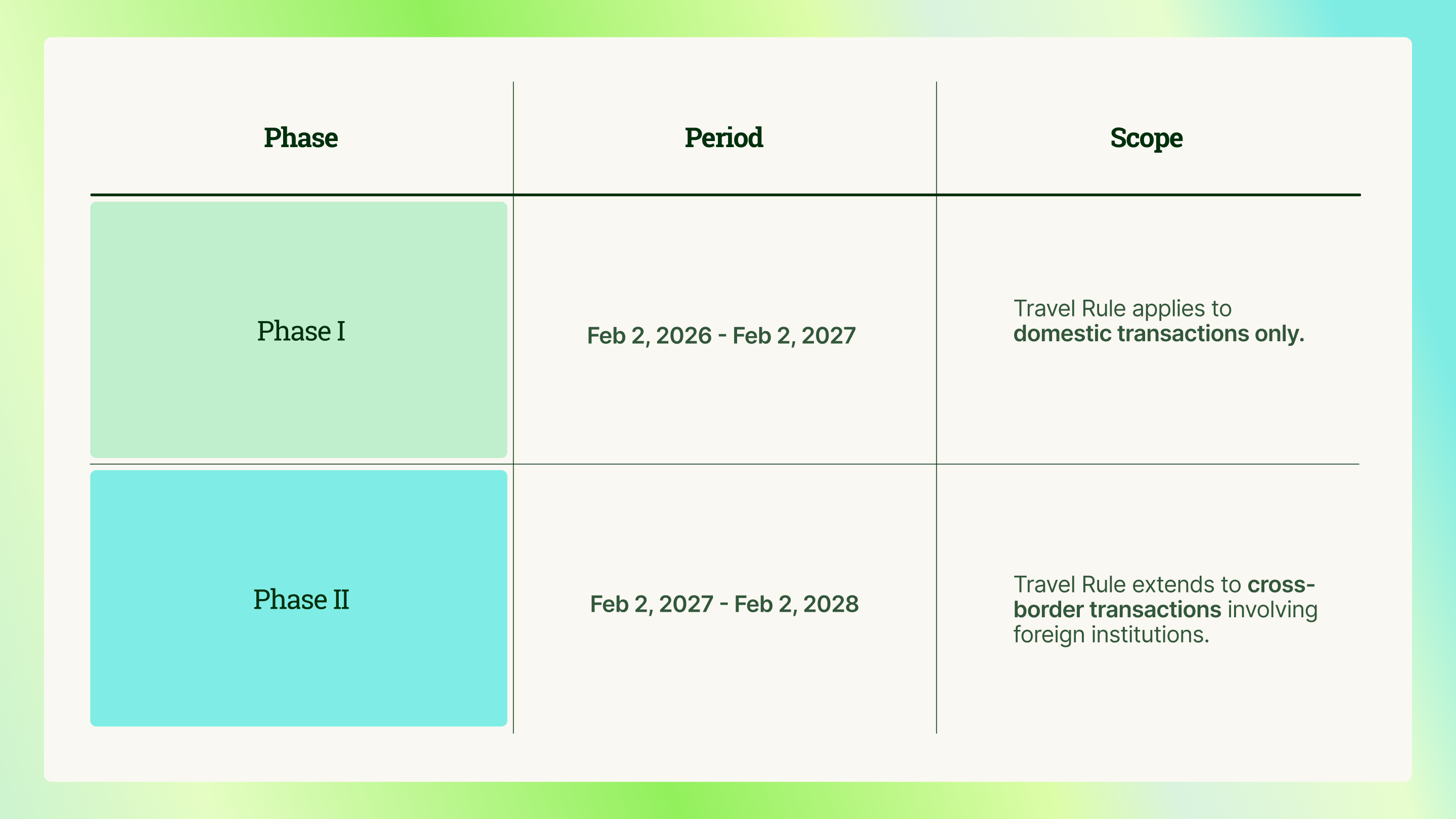
During both phases, SPSAVs may rely on self-declarations from clients to identify the transacting parties and the purposes of the transactions, provided these are documented and accessible to the BCB.
Full compliance will be mandatory starting February 2, 2028.
The illustration below provides an overview of the grandfathering timeline and the phased implementation schedule for Travel Rule requirements.
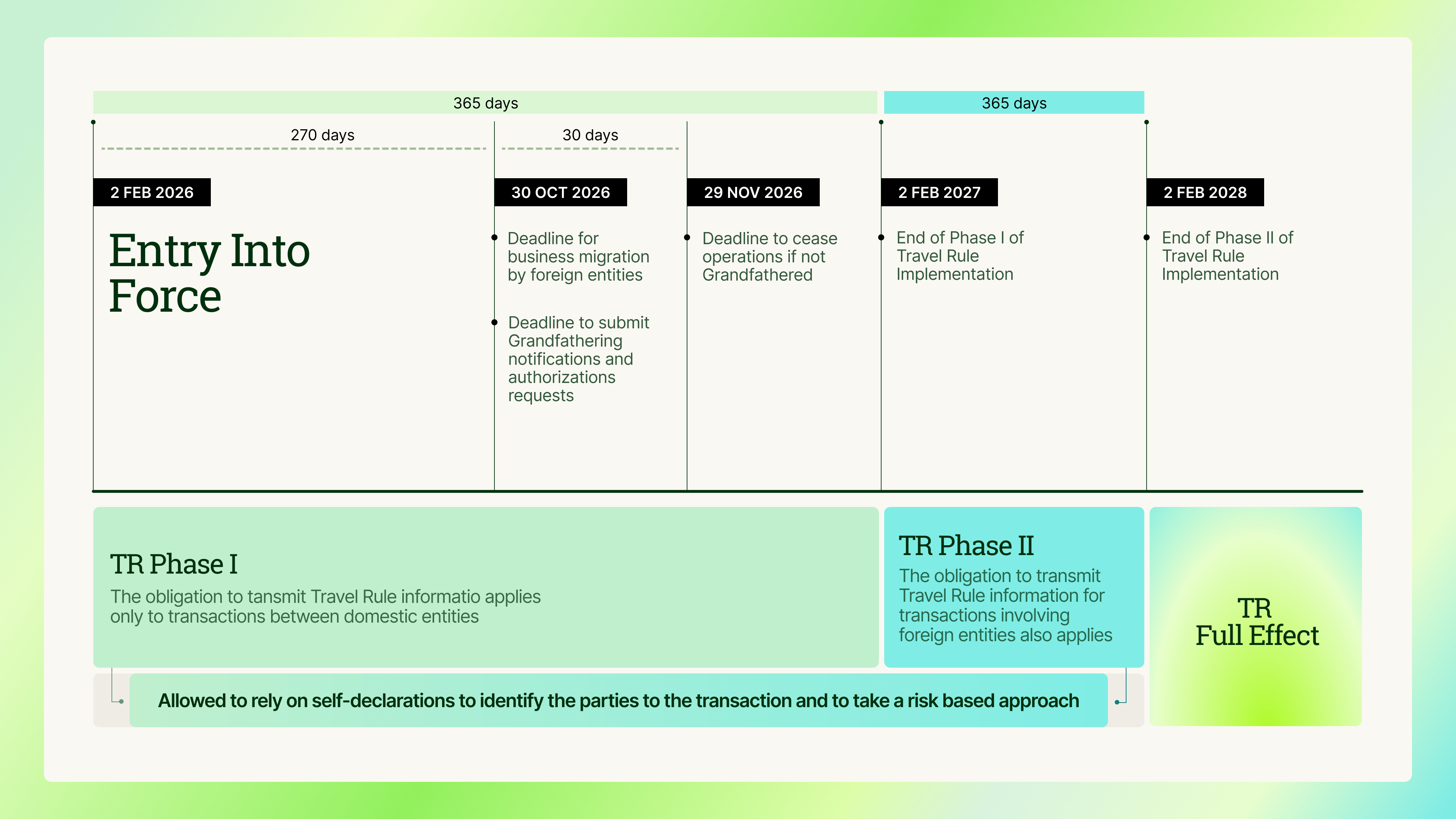
Self-Hosted Wallets and FX Integration
Resolution 521 defines self-hosted wallets (“carteiras autocustodiadas”) as wallets where the user controls the private keys without a third-party intermediary.
Under the resolution, the provision of services that include transfer to or from a self-hosted wallet is subject to Brazil’s foreign exchange (FX) framework, and SPSAVs are required to identify the wallet owner.
Key Takeaways
- Brazil’s Central Bank (BCB) is assuming full regulatory responsibility for the country’s virtual asset ecosystem, establishing clear rules for authorization, operation, and supervision.
- A grandfathering period allows existing providers to continue operating compliantly, provided they meet the notification and authorization requirements outlined in the resolutions by October 30, 2026.
- The two-year phased rollout of Travel Rule obligations offers the industry a measured timeline to adapt systems, processes, and counterpart relationships to the new compliance expectations.
- The requirement to identify self-hosted wallet owners under the foreign exchange (FX) regime represents a move toward comprehensive transaction traceability across the digital asset ecosystem.
- By implementing these measures, Brazil aligns its framework with global AML and Travel Rule standards, setting a regional benchmark for regulatory modernization in Latin America.
Prepare your business for Brazil’s new Travel Rule requirements.
Notabene helps virtual asset service providers automate compliance, exchange Travel Rule data securely, and stay aligned with local and global regulations.
👉 Register for our upcoming webinar: How to Prepare for Brazil’s New Crypto Regulatory Framework if you operate in Brazil or support customers who do. This session will help you understand what’s changing and what comes next.
Stack Chats Episode 3: The Future of Payments and the Rise of Money 3.0
In this episode of Stack Chats, Notabene CEO Pelle Braendgaard sits down with Kevin Lehtiniitty, CEO of Borderless.xyz, to explore how stablecoins are evolving from speculative assets into functional payment infrastructure. Kevin shares insights on building the foundational rails that connect global stablecoin networks to local financial systems, unlocking seamless interoperability and real-world utility. Watch the full episode below:
From the limitations of traditional cross-border payments to the promise of “Money 3.0,” this conversation dives deep into how Borderless is making stablecoin adoption practical—and compliant—for fintechs, wallets, and regulated entities.
📌 Topics include:
- Bridging stablecoin networks with local payment systems
- Regulatory interoperability and compliance-by-design
- What “Money 3.0” means for the future of finance
- Building for developers and scaling across jurisdictions
Pelle and Kevin set the stage by looking at where stablecoins fit into today’s financial landscape and why so many companies are turning to them as part of their core infrastructure. Their conversation moves from the challenges businesses face today to the emerging solutions shaping the next generation of payments. What follows is a look at the key themes they explored and why they matter for anyone building or using stablecoin-based systems. Read on for a breakdown of the rest of the discussion points:
Why global payments still feel local
Once the conversation begins, one theme emerges right away. Even though stablecoins let value move across the world as easily as sending an email, the financial systems around them remain deeply local. Stablecoins operate on global, always-on networks. But banks, licensing regimes and national currencies still function in country-by-country silos.
Kevin has watched this play out throughout his years in the industry. Whether working on issuance, custody, collateral or payments, the same challenge appears: as soon as stablecoins touch the real world, companies encounter a maze of regulatory requirements, fragmented liquidity and inconsistent banking access.
This is the problem Borderless.xyz set out to solve. Rather than becoming another regional on or off ramp, Borderless focuses on the connective layer between them. A single integration gives companies access to diverse liquidity providers, payment partners and banking channels across many markets. Instead of every business rebuilding the same integrations repeatedly, Borderless abstracts that work into one unified network.
The hidden cost of pre-funding in global money movement
A major theme Pelle and Kevin explore is the role of pre-funding in today’s payments ecosystem. For most cross-border flows, especially in emerging markets, companies must lock funds in multiple partner accounts to simulate real-time settlement.
This creates several issues:
- Large amounts of capital sit idle across bank accounts in many countries.
- That capital is exposed to local banking risk.
- Treasury teams face constant operational pressure to balance and rebalance accounts.
Kevin shares examples of remittance companies holding more than four hundred million dollars in pre-funded balances simply to keep corridors running. This cost ultimately flows to end users through fees.
Stablecoins change the equation. Because they can move globally in near real time, they allow companies to:
- Reduce pre-funding from days of coverage to a few hours.
- Move liquidity around the clock, including weekends and holidays.
- Unlock capital that can go back into product, growth or customer acquisition.
Businesses do not have to overhaul their existing treasury workflows to gain these benefits. Stablecoins simply let them operate with far more flexibility and lower capital cost.
Open networks outpace closed loops
As the discussion evolves, Pelle and Kevin look closely at the difference between closed loop payment networks and open ones. Closed networks are controlled by a single company that determines participation and flow. They can work in limited contexts, but their total value is capped by the value of the operator controlling them.
Open networks grow far larger because value is created by everyone participating, not just the administrator. Kevin highlights several historical examples:
- The shift from isolated charge-card programs to the Visa consortium.
- The standardization of rail gauges that unlocked interstate commerce.
- The rise of Linux as the foundation of cloud computing and modern devices.
Stablecoins and public blockchains follow the same pattern. They create shared standards that many companies can build on, which expands use cases far beyond what any one entity could design.
Notabene takes the same approach. Its Transact product is built on TAP, an open messaging protocol that supports different transaction types and authorization flows without locking users into a closed database or proprietary environment. This keeps innovation open to the entire ecosystem while providing strong compliance controls.
Moving stablecoins from simple transfers to real business workflows
Most stablecoin payments today are push-only. Tokens sit in a wallet and move only when someone signs a transaction. This works for one-time transfers, but not for the full range of business payments the world runs on.
Traditional payments rely heavily on pull flows, such as:
- Subscriptions and recurring billing.
- Invoicing and accounts receivable versus accounts payable processes.
- Automated treasury and liquidity management.
- Merchant settlement and reconciliation.
Card networks became central to commerce not only because they moved money, but because they integrated directly into business systems and workflows.
This is the missing capability in stablecoin-based payments today. It is also where the partnership between Borderless.xyz and Notabene becomes important.
By combining:
- Borderless’s connectivity to stablecoin and fiat liquidity in more than seventy countries.
- Notabene’s open messaging and compliance layer built on TAP.
They are bringing stablecoin pull payments, treasury automation and workflow connectivity to businesses that want to move beyond one-off transfers. The result is a stablecoin infrastructure layer that mirrors how businesses already operate, while taking advantage of global, always-on settlement.
Money 1.0, Money 2.0 and the arrival of Money 3.0
Kevin introduces a simple framework for understanding how global money movement has evolved.
Money 1.0
Traditional networks like Swift and card schemes created the first generation of cross-border connectivity. These systems were built before the internet era. Settlement is slow, fragmented and expensive.
Money 2.0
Fintech companies improved the experience but did not change the underlying rails. To cover the limitations, they added layers of pre-funding, user-friendly interfaces and workflow tools. This produced many successful companies but did not solve the core infrastructure challenges.
Money 3.0
With blockchains and stablecoins, payments can finally be modernized at the foundation. Instead of adding more band-aids, value can move directly between counterparties that support the same stablecoin and blockchain network. This removes unnecessary intermediaries and supports real-time global settlement.
Pelle and Kevin argue that the next five to ten years will determine whether global payments continue relying on legacy patches or shift decisively to this new model.
What the next decade could look like
As stablecoin adoption accelerates across remittance providers, PSPs and global businesses, the need for an open, infrastructure-ready payments layer becomes clearer. The vision that Notabene and Borderless share is grounded in a few core ideas:
- Stablecoins can settle business payments directly.
- Local liquidity can be accessed without each company rebuilding the same integrations.
- Workflows and compliance can run on open messaging networks like TAP.
- Money can finally move at the speed of the internet rather than the speed of legacy rails.
For businesses exploring stablecoins, this episode offers a practical look at what it takes to move from experimentation to production. Money 3.0 is not a distant idea. It is already taking shape, and the companies building it are laying the groundwork today.
Episode breakdown
Here is a quick minute-by-minute guide to the conversation:
- 00:00 - 03:00
- Introductions. Pelle and Kevin talk about their history in stablecoins and why stablecoin adoption has felt like "it is coming next year" for nearly a decade.
- 03:00 - 08:00
- Global assets vs local fragmentation. Why regulatory licenses, banking rails and central bank currencies will always remain local, and what that means for anyone building on stablecoins.
- 08:00 - 15:00
- On and off ramps as the next generation of banks. Borderless’ view of orchestrators, market makers and local liquidity partners, and why building the same integrations again and again adds no real enterprise value.
- 15:00 - 22:00
- Where stablecoins deliver the most value today. Dollarization and the "store of value" use case in emerging markets versus the much bigger opportunity in global payments.
- 22:00 - 30:00
- Pre-funding and the illusion of real-time. How correspondent banking actually works, the risks of pre-funding in different markets and why stablecoins can release hundreds of millions in trapped capital.
- 30:00 - 36:00
- Open networks vs closed loops. Visa, railroads and Linux as case studies for why open systems outcompete walled gardens over time, and what that means for stablecoin ecosystems.
- 36:00 - 42:00
- TAP, open messaging and Flow / Flow Forward. How Notabene uses an open protocol rather than a closed database, and how that supports many use cases from payments to trade settlement on the same compliance rails.
- 42:00 - end
- Money 1.0, 2.0 and 3.0. Kevin’s framework for the future of money, and how Borderless XYZ and Notabene think about success over a 5 to 10 year horizon.
🎙️ Stack Chats is Notabene’s video series for product leaders, fintech builders, and infrastructure innovators shaping the next generation of blockchain-based payments.