


Building the Trust Layer: 3 Key Takeaways From Notabene Summit 2025


On September 29, Notabene Summit 2025 brought stablecoin operators, payment innovators, and compliance experts together in New York City to explore a critical question: how do we build the trust infrastructure that turns global stablecoin payments into a reality?
Against the Manhattan skyline, industry leaders gathered to discuss the $120 trillion B2B payments opportunity, and the role that stablecoins will play in capturing it. The timing couldn't be better. With regulatory clarity emerging in the US and institutional adoption accelerating globally, the conversation around stablecoin adoption has shifted from "if" and “when”, to "how."
These were the three defining insights from the day:
1. Trust Infrastructure Unlocks Institutional Adoption
Regulatory clarity was the first domino to fall. With the GENIUS Act now law and broader market structure legislation advancing, the US is finally signaling openness to innovation. As Chris Shimizu, AML Program Manager for Robinhood, put it after 14 years in crypto compliance: “It’s amazing to finally see this level of openness in the US.”
Now comes the harder part: turning that clarity into operational reality.
In the first two panels of the day, leaders from Blockchain Association, the US Treasury Department, Anchorage Digital, Talos, Apollo, Digital Asset, and DRW outlined what needs to happen next. Christine Moy from Apollo described the institutional trust challenge:
"You couldn't trust the technology because it was new and parametrically different from anything that you ever built internally at a centralized financial institution." —Christine Moy, Partner, Strategy (Digital Assets, Data, AI), Apollo

Mark DuBose from Anchorage summed up the moment:
"GENIUS was good for the United States. Clarity will be really good for the industry."
Regulatory progress opened the door. Now institutions need the tools to walk through it.
The operational barriers are formidable:
- Travel Rule compliance is required across jurisdictions with differing implementations
- Real-time counterparty verification is needed for multiple transaction participants
- Due diligence at scale is a significant operational burden
The principle repeated throughout the day was clear: trust can’t be outsourced to a closed network. Institutions need open, interoperable tools that let them enforce their own policies while operating at scale.
Regulation provides the framework. Trust infrastructure makes it work.
2. B2B Stablecoins Face a $120T Opportunity
The numbers are staggering: $120 trillion in annual B2B payment flows, and stablecoins currently capture 0.03% of it. The gap isn’t demand. It’s infrastructure that doesn’t yet serve real business needs.
During the Summit, Alice Nawfal walked through a simple example: a Portuguese clothing manufacturer paying a Turkish fabric supplier. This simple transaction involves five intermediaries, six SWIFT messages, transfer fees, and operational overhead at every step.
"Traditional banking rails were designed to optimize for domestic payments, not the kind of fast global trade businesses need today," Notabene's Pelle Braendgaard added.
Stablecoins natively solve one half of the settlement problem with 24/7 availability, low costs, and instant finality for sending payments. But their "push-only" transaction model leaves out essential B2B workflows: no pull payments, recurring billing, payment requests, nor dispute resolution.
The closing panel—featuring leaders from Walapay, Bitso, Mastercard, and Borderless—dialed up the urgency. Kevin Lehtiniitty of Borderless noted that one of the most common questions from TradFi companies is how to enable requests for payments — a capability that, until now, hasn’t existed. "How can we stop moving money on Telegram, please, as an industry," he pled with the audience.

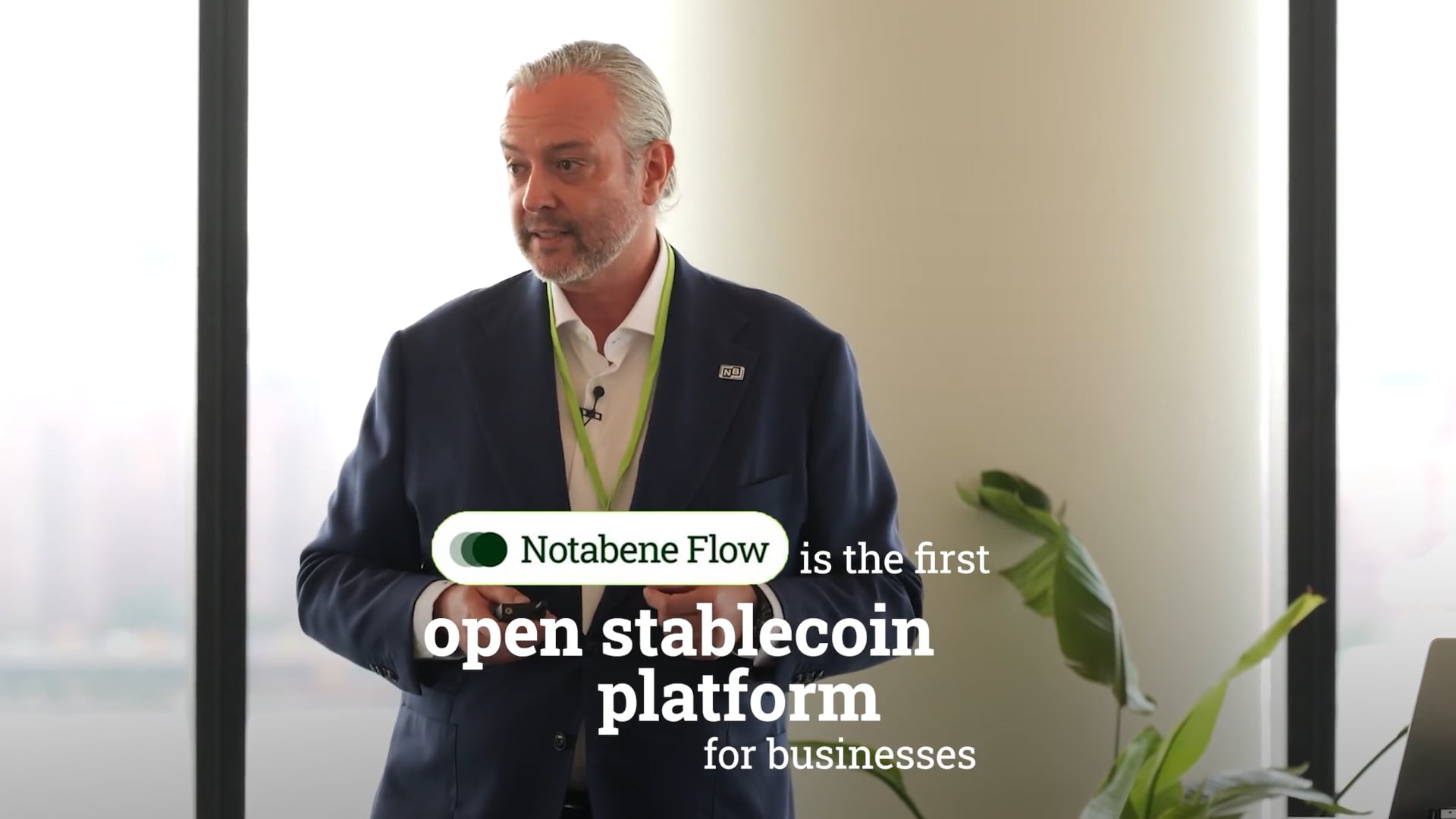
Announced live at the Summit, Notabene Flow is the our next major product evolution: an open coordination layer for trusted B2B stablecoin payments. Built on Notabene's existing network of 2,000+ regulated entities processing $1.5 trillion annually, Flow combines three elements:
- Context - Provided by secure data messaging between entities, related to the transaction, and facilitated by the open-source TAP protocol
- Trust - Provided by 2,000+ trusted entities completing Travel Rule-compliant transactions on the Notabene Network today
- Authorization - Via Notabene Transact’s automated transaction authorization platform that allows counterparties to use custom policy engines to approve, reject, or flag transactions based on their own unique business needs and risk factors.
The combination of these three key elements is what allows us to build a payments layer on top of our existing network that can enable pull payments. This payment type, which includes recurring billing, payment requests, and subscription flows, is an essential capability that traditional businesses rely on —and a key reason that stablecoins have not yet been able to make a dent in the massive B2B payments market.
The result is near-100% straight-through processing rates and a pathway to scale compliant stablecoin payments across borders with no need for costly and burdensome bilateral banking relationships in each jurisdiction.
Anoosh Arevshatian from Zodia Custody (one of twelve Founding Partners of Notabene Flow, also including Bitso, Borderless.xyz, Dfns, Flutterwave, Gnosis, Monerium, Orbital, Portal, Walapay, Yellow Card) said of the launch:
"Compliance and trust aren't optional—they're the foundation of how we operate. That's why we value working with partners like Notabene, who embed instant counterparty trust into every transaction."
Mukul Tripathi from Mastercard added, "Notabene is very uniquely positioned to solve some of the very pressing pain points that exist in the industry with compliance first... making the whole ecosystem trustworthy."
Notabene CEO Pelle's Brændgaard summarized the vision:
"This is really why I got into crypto in the first place 15 years ago. We're going from being SWIFT for crypto to let's just be a better SWIFT."
3. Open Architecture Drives Adoption
The way payment networks are structured isn’t just a technical choice. Architecture determines which institutions can participate and how efficiently they can operate.
Kevin Lehtiniitty of Borderless.xyz highlighted the industry shift:
"A year and a half ago, VCs were saying 'you have issuers, blockchains, and on-ramps—we're done.' Now with Circle CPN and Fireblocks Network launching, people are circling back: 'Wait, maybe there's more to this.'"
Payment networks need to evolve in an open context rather than creating a series of walled gardens. Without that openness, the industry risks returning to the same limited structures that blockchain was supposed to improve.

The open vs. closed question is practical, not philosophical. Closed networks force binary choices: join our ecosystem on our terms, or build everything yourself. The practical benefits of open networks are clear:
- Implement your own counterparty verification policies
- Connect to multiple liquidity sources simultaneously
- Work with preferred compliance and custody providers
- Operate across jurisdictions with different requirements
Across the Summit, examples illustrated how open networks unlock real-world B2B payments. Ben Reid from Bitso is creating on-ramps for Mexican peso and Brazilian real stablecoins. Tom Borgers of Walapay is connecting emerging market corridors. Kevin Lehtiniitty of Borderless.xyz is building scalable transaction processing infrastructure. And Notabene Flow provides the coordination layer that ties it all together.
The pieces only work together if they're interoperable.
As Brændgaard put it:
"Crypto should be open, stablecoins should be open, payments should be open."
What’s Next?
The decisions made today will determine whether stablecoins scale in B2B payments or remain a promising but limited technology. To realize the opportunity, three building blocks must come together:
1. Trust infrastructure that institutions can build on: Not just compliance checkboxes, but tools for real-time counterparty verification and risk management at scale.
2. Payment coordination that serves real business needs: Pull payments, recurring billing, dispute resolution—the real-world capabilities that make large payment volumes work.
3. Open networks that preserve control: Interoperable infrastructure that lets participants maintain their own policies while gaining the benefits of coordination.
The validation throughout the 2025 Notabene Summit suggested that the industry recognizes what's needed. The companies building these solutions aren't waiting for permission. They're solving immediate problems for customers who need better payment rails today.
Stablecoins will transform B2B payments. The only question is how quickly we build the infrastructure needed to make it happen.
Let’s build it together.
Notabene Flow testnet is live, APIs and documentation ready, and Founding Partners already integrated. To learn more and join the open network, visit notabene.id/flow.

Notabene is the trust layer for global crypto money movement.
Notabene Flow — the first open stablecoin payments platform for businesses—and Notabene Transact—the world's largest Travel Rule-compliant transaction authorization platform for regulated institutions—are built on the Transaction Authorization Protocol (TAP), an open messaging standard that enables verified entities to transact securely.
The Notabene Network connects thousands of trusted counterparties, facilitating over $1T in transaction volume annually across over 100 jurisdictions.
Subscribe to Notabene Blog
Subscribe to our product updates, news on crypto regulations and more
Request a demo
Notabene offers a demo for you to learn and understand how to use our products
Book demo