

BLOG
Insights on building trust infrastructure for global money movement

We are standing at the edge of a defining opportunity for the crypto industry. The Travel Rule is still perceived by many as a burdensome obligation that should be met with a check-the-box approach. But in reality, it is the catalyst for building critical infrastructure needed to unlock stablecoin payments at global scale and connect digital assets to the real economy. Once it is understood in this light - not as another compliance obligation, but as the foundation of the next phase of market infrastructure - its effective implementation becomes a strategic imperative deserving of united industry action. Only collective alignment around interoperability and openness will make effective implementation possible.
The Value of the Travel Rule: A Catalyst for Real-World Adoption
The Travel Rule requires financial institutions to securely exchange originator and beneficiary information before or in parallel with a virtual asset transfer. At first glance, this might seem like a regulatory nuisance, another box to check. In reality, it introduces a profound change in how crypto transactions work.
Natively, crypto payments are unilateral and context-free: senders can move value without the receiver’s consent, and the information recorded on the blockchain provides no information about who was transacting or why. These characteristics have slowed down the adoption of crypto rails for business and institutional use cases that depend on context, authorization, and risk controls.
The Travel Rule changes that. By requiring counterparties to exchange information before settlement, it introduces, for the first time, an opportunity to build a pre-transaction authorization flow into crypto transactions. Institutions must communicate before funds move. This creates the missing messaging layer that connects transactions to compliance processes, payment context, and counterparties.
What began as a regulatory requirement has become a forcing function for the infrastructural upgrade that crypto has been missing. Through the Travel Rule, the industry is building the same kind of pre-settlement messaging rails that power traditional payments, where transactions carry context, receivers can approve or reject transfers, and value and information travel together.
In this sense, the Travel Rule is more than a compliance requirement - it serves as the catalyst for building the missing foundations of institutional trust in crypto. By requiring institutions to exchange information before settlement, it opens the door to systems that restore control and risk management to both sides of a transaction. By mandating data exchange, it attaches real-world context to payments. And by making counterparties visible, it creates a trust fabric that allows institutions to confidently transact with third-parties in open loop systems, opening up business opportunities.
Together, these shifts establish the trust layer that crypto has been missing and unlock its potential to move beyond speculative markets and power the next generation of global payment systems.
Why Travel Rule Implementation Has Stalled
Since its adoption by the FATF in 2019, the Travel Rule has been implemented as a regulatory requirement for virtual asset transactions across jurisdictions worldwide. The FATF reports that 99 jurisdictions have passed or are in the process of passing Travel Rule legislation¹. Regulatory clarity is no longer the barrier. The barrier is infrastructure and whether the industry will choose a future defined by open connectivity, or fragmentation and control.
From the outset, interoperability has been cited as a primary barrier to Travel Rule implementation. In hindsight, this was almost inevitable.
Travel Rule information pipelines are emerging as the financial messaging backbone of the crypto economy. In traditional finance, we have clear precedents: SWIFT is classified as a systemically important messaging network deserving of cooperative oversight by G10 central banks, the European Central Bank, and the chair of the G10 Committee on Payment and Settlement Systems². Control over the Travel Rule messaging layer is highly attractive as it ultimately provides control over market access. Thus far, the fight for control has come at the expense of effective Travel Rule implementation, with limited coordination toward establishing open standards or interoperability.
As a result:
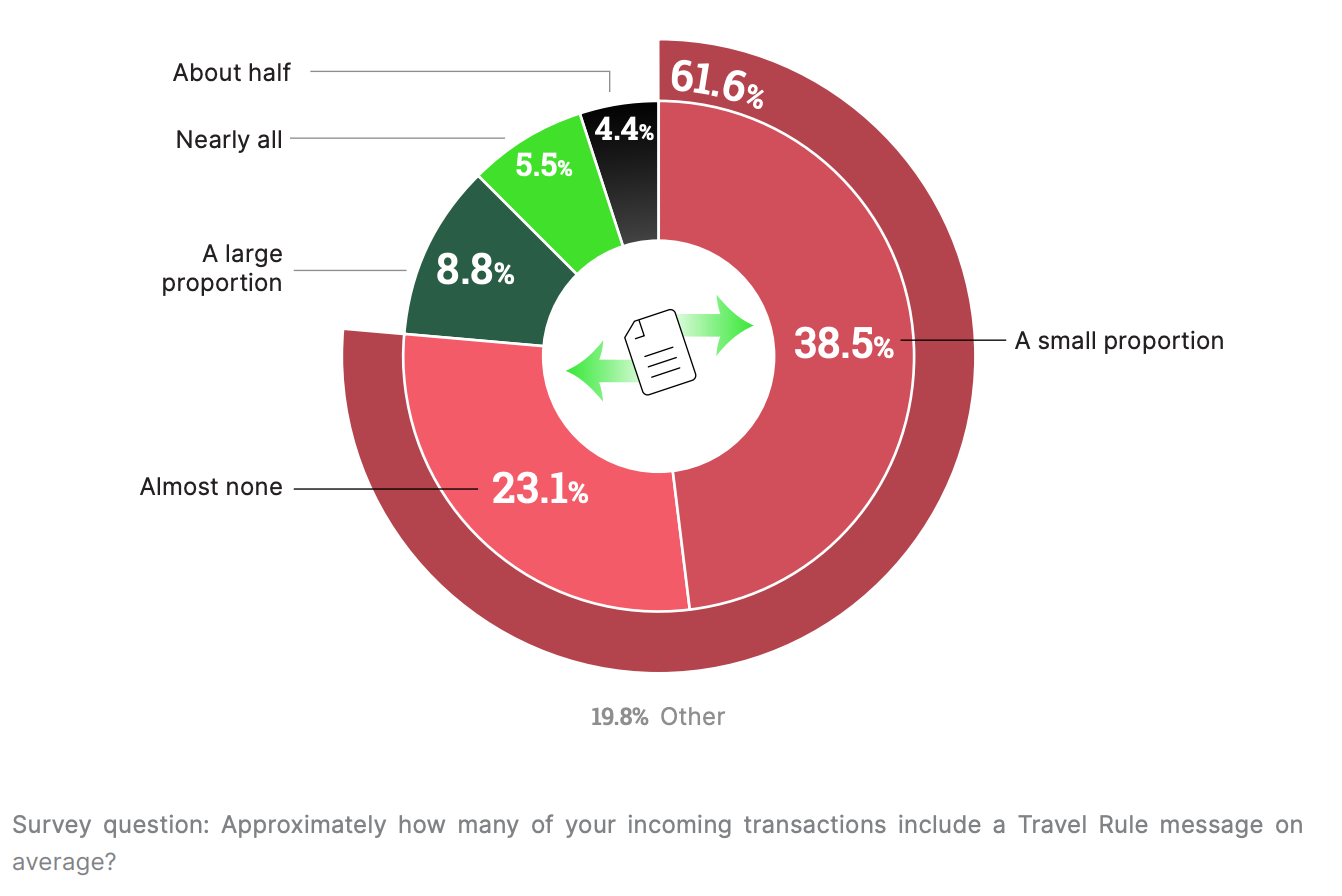
- Compliance silos persist, reflecting not just the lack of interoperability and open standards, but also the fragmented pace of Travel Rule adoption and enforcement worldwide. According to the 2025 State of Crypto Travel Rule survey, over 60% of respondents reported that almost none or only a small portion of incoming transactions include the required Travel Rule information
- Law enforcement lacks access to critical information, limiting the ability to investigate and disrupt illicit activity
- Crypto cannot fulfill its potential because it lacks the infrastructure necessary for integration into the global economy, as further explained in the above section
A Moment of Choice: Network Effects or Network Control
Overcoming the challenges in Travel Rule adoption is not simply about regulatory compliance; it is about unlocking crypto’s role as the next-generation backbone of global finance.
The core promise of crypto lies in openness: borderless settlement and universal reach. These advantages are only realized if the supporting messaging layer is equally open. Just as the internet scaled through universal protocols rather than private networks, crypto adoption can only reach its potential through open standards.
History has already shown that open networks win:
- SWIFT and ISO 20022 created a shared messaging language that enables thousands of financial institutions to transact globally.
- HTTP for web browsing, SMTP for email, and critically, SSL for secure transactions allowed any computer to connect to any other, regardless of service provider, enabling the open web to flourish and creating exponentially more value than the closed systems they replaced.
Crypto must follow this path. The messaging layer for Travel Rule compliance and transaction authorization cannot be proprietary and controlled by a handful of market actors. It must be built on open standards that allow every institution to connect, transact, and innovate without seeking permission from a competitor. Closed, proprietary protocols create fragmentation, entrench market power, and suppress innovation, preventing crypto from fulfilling its economic potential.
Advantages of Open Standards
Innovation through competition
Open networks eliminate lock-in. Institutions can choose service providers freely without risking access to counterparties. This forces innovation to flourish as providers must compete on service quality, not network control.
Connectivity over control
Open, neutral messaging standards ensure every institution retains autonomy over counterparties, risk rules, and transaction authorization, without ceding control to a central operator. An open messaging layer also creates the network effects that allow the industry to prosper. Every new participant increases the value of the network for all others.
The Cost of Fragmentation
The alternative is a fragmented ecosystem that undermines the value-add of crypto. Imagine if, instead of a unified network like SWIFT, the global financial system had evolved into dozens of incompatible, closed messaging networks, each unable to communicate with the others. Payments would stall at borders, institutions would struggle to reach counterparties, and innovation would be stifled by inefficiency. This is precisely the path crypto risks taking without open standards. Competing silos may deliver short-term advantages to a few, but they erode the collective value for all. For a technology built on openness and global connectivity, allowing fragmentation to persist would mean falling short of its original promise. Without interoperability, crypto cannot fulfill its potential as a truly borderless financial system, and we risk setting the industry back by years.
A Call to the Industry
If the Travel Rule messaging layer is built on proprietary networks, the industry will remain trapped in compliance silos. Travel Rule will become a regulatory burden that slows down business, instead of a catalyst to build the infrastructural upgrade that crypto has been missing.
But if we embrace open standards, we can turn Travel Rule into an opportunity to adopt an open authorization and messaging layer that connects counterparties, unlocks network effects and powers real-world adoption.
Solving Travel Rule interoperability is not only a compliance urgency, it is a strategic imperative for the industry to flourish. And it requires a collective endorsement of open standards.
Notabene is committed to an open and interoperable future. Our platform is powered by the Transaction Authorization Protocol (TAP), an open standard purpose-built for transaction authorization and Travel Rule compliance in digital assets. We invite all industry participants, regulators, and innovators to join us in advancing this standard, and we reaffirm our commitment to ensuring full interoperability with other open standards that share our vision for a connected and transparent digital finance ecosystem.
¹ FATF, June 2025, VIRTUAL ASSETS: TARGETED UPDATE ON IMPLEMENTATION OF THE FATF STANDARDS, Figure 1.11.
Few technologies have captured the imagination of the financial world quite like stablecoins. They promise to make money programmable, borderless, and instant. With blockchain as their foundation, stablecoins can streamline settlement, reduce costs, and open up a new era of global commerce.
Yet despite their growing adoption, stablecoins represent only 0.03% of the $120 trillion B2B payments market. The reason is simple: on their own, stablecoins don’t constitute a full payment system.
Businesses need more than fast transfers. They need context—the ability to link payments to contracts, invoices, and compliance data. Institutions processing payments for businesses also need to operate with counterparty trust and robust compliance frameworks.
The potential of stablecoins to revolutionize payments will remain largely untapped until these missing layers are built.
Why Stablecoin Payments Need Authorization and Context
Traditional payment systems have long relied on authorization—the ability to approve a transaction before settlement. When a card is swiped or a wire is initiated, institutions verify funds, screen for fraud, and apply compliance checks. This two-step process—authorization first, settlement later—is what makes payments reliable, reversible when needed, and compliant.
Equally important is the context: the information that moves alongside the funds. Payment messages transmit essential information for compliance and business operations, including Travel Rule data, invoice numbers, merchant details, and customer identifiers. This context allows businesses to reconcile payments with contracts, match them with invoices, and meet AML/CTF requirements.
Crypto transactions, by contrast, are unilateral and lack context. Whoever holds the private keys decides has full control to decide whether settlement happens. Without a pre-transaction authorization step or counterparty context, institutions have no way to vet, approve, or refuse incoming funds. Additionally, blockchains record only the amount, asset, and wallet addresses—no information about the counterparty, purpose, or which invoice it references.
Without a pre-transaction authorization step or counterparty context, crypto rails can’t power real-world payments. Businesses need to know who they’re transacting with, why a payment is being made, and whether it meets compliance criteria before funds move.
This is a key limitation stablecoins face today. They enable instant, global value transfer, but lack the context, trust signals, and institutional coordination that make payments truly work for businesses.
How the FATF Travel Rule Became a Catalyst for Crypto Authorization
When the FATF introduced the Travel Rule in 2019, it created the perfect conditions to build a compliant authorization layer for crypto. The rule requires counterparties in a virtual asset transaction to exchange originator and beneficiary information before settlement.
For the first time, crypto institutions were required to collaborate before a transaction occurred, mirroring the same pre-transaction authorization and due diligence flows that underpin traditional finance.
At Notabene, we saw this as a pivotal opportunity. The Travel Rule isn’t just a regulatory requirement—it’s an architectural upgrade. It gives the industry a shared standard to exchange trusted information, unlock counterparty confidence, and enable compliant, authorized crypto transactions at scale.
We’ve Already Built It: Pre-Transaction Authorization as Best Practice
Over the past five years, Notabene has turned Travel Rule compliance into an operational standard for the industry.
Today, more than 2,000 institutions across 100+ jurisdictions rely on Notabene’s open Transaction Authorization Protocol (TAP) to exchange verified transaction data and pre-transaction authorizations. To date, the Notabene Network has powered more than $2 trillion in compliant transaction volume.
Within our network, pre-transaction authorization has become an established best practice. Counterparties exchange compliance data, verify each other’s risk profiles, and explicitly approve transactions before funds move.
The Dilemma: Global Travel Rule Adoption Still Faces Gaps
Since the FATF introduced the Travel Rule in 2019, global implementation has expanded rapidly but unevenly.
According to the FATF’s June 2025 targeted review, 85 jurisdictions now enforce or have enacted Travel Rule legislation, up from 65 in 2024. 99 out of 117 jurisdictions had either passed or were in the process of passing relevant legislation at the time of the report.
However, only 35 jurisdictions have initiated active enforcement or supervisory actions. Nearly 60% of jurisdictions with legislation have yet to begin active Travel Rule enforcement.
Even where rules exist, VASPs face structural barriers to compliance. Because public blockchains are open settlement layers, VASPs cannot fully control the origin of incoming transfers. Many VASPs still lack the ability to reject deposits that arrive without verified Travel Rule data or from untrusted counterparties, which undermines their ability to maintain consistent counterparty risk controls.
This fragmented and inconsistent implementation, coupled with persistent technical interoperability challenges, limits the Travel Rule’s full potential. To unlock the next generation of payments, authorization and compliance must become built-in properties of the transaction, not optional layers added after the fact.
Notabene Flow: Stablecoin Payments with Authorization Built In
Enter Notabene Flow, the open stablecoin payments platform that makes authorization and Travel Rule compliance native to every payment.
Flow uses an addressless payments architecture: settlement addresses are revealed only after all Travel Rule information is exchanged and the required due diligence, consent, and compliance checks are completed. No address, no payment—and as a result, no possibility of unauthorized or non-compliant settlements.
Here’s how it works in a Pull Payment scenario:
- Payment initiation – The merchant’s payment service provider (PSP) issues an invoice and payment request in Flow, automatically generating a Travel Rule message that includes payee data and transaction details.
- Payment response – The payer selects their payment provider, who adds payer information to the Travel Rule record.
- Dual authorization – Both counterparties conduct compliance and risk checks.
- Settlement and disclosure – Once both counterparties have completed their compliance checks and authorized the transaction, the agent representing the payee sends an authorization message back to the agent representing the payer. This message includes the settlement address, which is revealed only at this stage. .
This model elevates pre-transaction authorization from a best practice to a built-in feature of every Flow payment. It also transforms the Travel Rule from an isolated compliance task into a requirement enforced by the design of the payment itself.
By revealing settlement addresses only after both sides complete authorization and exchange verified information, Flow makes it technically impossible to receive unvetted or non-compliant deposits. Institutions regain full control over inbound payment flows, strengthening their ability to apply consistent counterparty risk policies, prevent unwanted exposure, and enforce compliance at the protocol level.
Business-Ready Stablecoin Payments—Built for the Real World
Notabene Flow transforms stablecoins from fast settlement tools into a fully authorized, compliant, and business-ready payment network.
By combining the instant settlement of stablecoins with a pre-transaction authorization and compliance layer, Flow delivers what neither can achieve alone:
- Instant, borderless settlement without intermediaries
- Pre-transaction authorization, counterparty verification, and Travel Rule compliance
- End-to-end control and transparency across every transaction
With Flow, companies can finally unlock the efficiency of stablecoins — without sacrificing oversight, trust, or regulatory alignment.
This is the foundation for the future of B2B payments: instant, compliant, and ready for the real world.
Explore Notabene Flow and join the network.
Stack Chats Episode 2: Custody, Compliance, and Building Open Networks for Stablecoin Payments
In this episode of Stack Chats, a new video series from Notabene, Pelle sits down with Anoosh Arevshatian, CPO of Zodia Custody, to talk about the complex world of custodial services in the digital assets space. Anoosh shares a custodian’s perspective on key management versus custody, the accelerating involvement of banks, and what it takes to enable compliant value transfer across a fragmented ecosystem. Watch the full episode below:
As stablecoins move from niche crypto use cases into mainstream financial infrastructure, institutions are rethinking how value moves across borders, how assets are secured, and how compliance can be built directly into digital networks. Pelle and Anoosh discuss the role of custodians, the rise of institutional blockchain adoption, and why open networks may ultimately unlock the full potential of stablecoin payments.
📌 Topics include:
- The role of custodians in digital asset infrastructure
- Why stablecoins have reached product-market fit
- Open versus closed payment networks
- Institutional adoption of digital assets
- The future of interoperability and on-chain finance
Pelle and Anoosh begin by exploring how custody has evolved beyond simple wallet management into a critical layer of institutional infrastructure. Their conversation then expands into stablecoins, compliance, network effects, and the future of financial services. What follows is a breakdown of the key themes discussed throughout the episode.
Custody is more than wallet management
One of the first topics Anoosh addresses is the difference between a wallet provider and a custodian.
While wallet providers focus primarily on key management, custodians operate a much broader infrastructure stack. Beyond securing assets, custodians are responsible for governance, reporting, accounting, insurance, policy controls, and operational workflows that allow institutions to interact safely with markets, counterparties, and liquidity providers.
As institutions enter the digital asset space, these additional layers become increasingly important. Custody is no longer just about holding assets securely. It is about providing the operational framework that enables organizations to use those assets safely and at scale.
For firms moving into stablecoins and digital assets, custody has become foundational infrastructure rather than a standalone service.
Institutional adoption is accelerating
Zodia Custody was founded by a consortium of major financial institutions, giving Anoosh a unique perspective on how traditional finance has approached digital assets over the last decade.
According to Anoosh, one of the most significant shifts has occurred over the past year. What was once largely a market of crypto-native participants is increasingly attracting banks, financial institutions, and regulated financial service providers.
As regulatory frameworks continue to develop across multiple jurisdictions, digital asset strategies are becoming a board-level priority. Institutions that may have previously viewed digital assets as experimental are now actively evaluating how stablecoins, tokenized assets, and blockchain infrastructure fit into their long-term plans.
For many organizations, the question is no longer whether digital assets matter. The question is how quickly they can build the capabilities needed to participate.
Stablecoins have found product-market fit
The conversation naturally turns to stablecoins, which both Pelle and Anoosh see as one of the clearest success stories in the digital asset ecosystem.
While early cryptocurrencies struggled to gain traction for payments, stablecoins are increasingly being used for real-world financial activity. Cross-border payments, trade finance, treasury operations, and B2B transactions are all emerging as practical use cases where stablecoins deliver measurable advantages.
Businesses are increasingly using stablecoins to move value globally, reduce friction in cross-border transactions, and create more efficient payment workflows.
Rather than replacing every existing payment rail, stablecoins are creating a new layer of financial infrastructure that complements traditional systems while introducing greater speed, flexibility, and global accessibility.
As regulation matures and payment providers continue building around stablecoins, adoption is likely to expand further across both traditional finance and crypto-native markets.
Open networks versus closed loops
A major theme throughout the discussion is the distinction between open and closed financial networks.
Closed-loop systems operate within a defined set of participants, often controlled by a single institution or platform. Open networks, by contrast, allow a broader ecosystem of participants to interact through shared standards and protocols.
Pelle argues that many of the most successful financial and communications networks in history have benefited from open participation. Stablecoins and blockchain infrastructure create an opportunity to build similarly open systems for global value transfer.
Anoosh emphasizes that success depends on more than simply allowing access. Open networks must also support strong standards, participant requirements, compliance controls, and incentives that encourage responsible participation.
The challenge is finding the right balance between accessibility, security, compliance, and usability. The organizations that solve this balance effectively may help define the next generation of payment infrastructure.
Beyond the US dollar
Anoosh and Pelle also discuss how today's stablecoin market remains overwhelmingly dollar-denominated. While this structure makes sense for trading markets that benefit from concentrated liquidity, payments may evolve differently.
Pelle suggests that payment flows could eventually become more efficient through direct liquidity pairs between local currency stablecoins rather than routing everything through a US dollar intermediary.
This could create new opportunities for regional payment corridors while reducing unnecessary conversion steps.
Anoosh agrees that this evolution will be worth watching, particularly as wholesale foreign exchange markets increasingly explore on-chain settlement models. How banks, market makers, and payment providers adapt to these new liquidity structures may become one of the defining questions for the next phase of stablecoin adoption.
Compliance as infrastructure
Compliance is often viewed as a regulatory obligation, but Anoosh describes it as a core design principle.
From Zodia's earliest architecture decisions, security and compliance were embedded directly into the platform. Systems were designed to minimize unnecessary human intervention, provide clear transaction authorization processes, and create auditable controls around asset movement.
This compliance-by-design approach mirrors the philosophy behind Notabene's work. Rather than treating compliance as a separate layer added after the fact, both companies view it as a foundational component of trusted digital asset networks.
As more institutions enter the market, this approach becomes increasingly important. Strong compliance frameworks help create confidence among participants while enabling larger volumes of real-world financial activity to move through blockchain networks.
Building connectivity instead of silos
Another recurring theme is interoperability.
Today, many relationships across the digital asset ecosystem remain highly bilateral, requiring individual integrations between custodians, exchanges, wallet providers, payment companies, and other participants.
Anoosh argues that the industry will ultimately benefit from moving toward network-based connectivity models that allow participants to interact through shared standards rather than maintaining countless one-to-one integrations.
This shift from bilateral connections to network-based connectivity mirrors how payment systems and financial messaging networks evolved over time.
The result could be a more efficient ecosystem where institutions can connect to many counterparties through a smaller number of trusted infrastructure layers while maintaining appropriate compliance controls.
New blockchains are competing to solve real problems
The discussion also explores the growing number of blockchain networks being built specifically for payments and institutional finance.
From payment-focused chains to institutional networks like Canton, developers are experimenting with different approaches to privacy, scalability, interoperability, and compliance.
Rather than viewing this fragmentation as a problem, Anoosh sees it as a sign of healthy innovation. Different networks are optimizing for different use cases, and infrastructure providers must remain flexible enough to support multiple ecosystems.
For custodians and compliance providers, success depends on remaining chain-agnostic while helping users navigate an increasingly diverse blockchain landscape.
What the next three years could look like
Looking ahead, both Pelle and Anoosh expect the pace of innovation to accelerate.
On the retail side, new stablecoins, blockchain networks, and financial products continue to emerge at remarkable speed. On the institutional side, banks, payment service providers, exchanges, and fintech companies are all exploring how digital assets fit into their future business models.
Anoosh believes one of the biggest questions will be how these different participants converge. Banks bring trust, capital, and regulatory experience. Fintechs bring agility. Crypto-native companies bring innovation and new business models.
The future is unlikely to belong exclusively to banks, fintechs, or crypto-native companies. Instead, it will be shaped by the organizations that successfully combine trust, compliance, connectivity, and innovation.
What remains clear is that stablecoins, digital assets, and blockchain infrastructure are moving steadily toward the center of global finance. The next phase will be defined by the networks, standards, and partnerships that make those systems work at scale.
Episode breakdown
Here is a quick minute-by-minute guide to the conversation:
00:00 - 03:30
Introductions and the role of digital asset custodians. Anoosh explains the difference between wallet providers and custodians and why custody requires much more than key management.
03:30 - 06:15
Institutional adoption accelerates. How banks and traditional financial institutions are developing digital asset strategies and preparing for long-term participation.
06:15 - 08:45
Stablecoins find product-market fit. Cross-border payments, trade finance, and B2B transactions emerge as leading use cases.
08:45 - 12:05
Open versus closed networks. The benefits and trade-offs of open financial infrastructure, tokenized deposits, and stablecoin ecosystems.
12:05 - 16:15
Compliance as infrastructure. Why security and compliance must be built directly into digital asset systems from the beginning.
16:15 - 20:00
Interoperability and network effects. Moving beyond bilateral integrations toward shared infrastructure and network-based connectivity.
20:00 - 22:45
The rise of specialized blockchains. Canton, payment-focused chains, and the growing diversity of blockchain infrastructure.
22:45 - End
The next three years. Predictions for stablecoins, institutional finance, interoperability, AI, and the future of global financial infrastructure.
🎙️ Stack Chats is Notabene’s video series for product leaders, fintech builders, and infrastructure innovators shaping the next generation of blockchain-based payments.
On September 29, Notabene Summit 2025 brought stablecoin operators, payment innovators, and compliance experts together in New York City to explore a critical question: how do we build the trust infrastructure that turns global stablecoin payments into a reality?
Against the Manhattan skyline, industry leaders gathered to discuss the $120 trillion B2B payments opportunity, and the role that stablecoins will play in capturing it. The timing couldn't be better. With regulatory clarity emerging in the US and institutional adoption accelerating globally, the conversation around stablecoin adoption has shifted from "if" and “when”, to "how."
These were the three defining insights from the day:
1. Trust Infrastructure Unlocks Institutional Adoption
Regulatory clarity was the first domino to fall. With the GENIUS Act now law and broader market structure legislation advancing, the US is finally signaling openness to innovation. As Chris Shimizu, AML Program Manager for Robinhood, put it after 14 years in crypto compliance: “It’s amazing to finally see this level of openness in the US.”
Now comes the harder part: turning that clarity into operational reality.
In the first two panels of the day, leaders from Blockchain Association, the US Treasury Department, Anchorage Digital, Talos, Apollo, Digital Asset, and DRW outlined what needs to happen next. Christine Moy from Apollo described the institutional trust challenge:
"You couldn't trust the technology because it was new and parametrically different from anything that you ever built internally at a centralized financial institution." —Christine Moy, Partner, Strategy (Digital Assets, Data, AI), Apollo

Mark DuBose from Anchorage summed up the moment:
"GENIUS was good for the United States. Clarity will be really good for the industry."
Regulatory progress opened the door. Now institutions need the tools to walk through it.
The operational barriers are formidable:
- Travel Rule compliance is required across jurisdictions with differing implementations
- Real-time counterparty verification is needed for multiple transaction participants
- Due diligence at scale is a significant operational burden
The principle repeated throughout the day was clear: trust can’t be outsourced to a closed network. Institutions need open, interoperable tools that let them enforce their own policies while operating at scale.
Regulation provides the framework. Trust infrastructure makes it work.
2. B2B Stablecoins Face a $120T Opportunity
The numbers are staggering: $120 trillion in annual B2B payment flows, and stablecoins currently capture 0.03% of it. The gap isn’t demand. It’s infrastructure that doesn’t yet serve real business needs.
During the Summit, Alice Nawfal walked through a simple example: a Portuguese clothing manufacturer paying a Turkish fabric supplier. This simple transaction involves five intermediaries, six SWIFT messages, transfer fees, and operational overhead at every step.
"Traditional banking rails were designed to optimize for domestic payments, not the kind of fast global trade businesses need today," Notabene's Pelle Braendgaard added.

Stablecoins natively solve one half of the settlement problem with 24/7 availability, low costs, and instant finality for sending payments. But their "push-only" transaction model leaves out essential B2B workflows: no pull payments, recurring billing, payment requests, nor dispute resolution.
The closing panel—featuring leaders from Walapay, Bitso, Mastercard, and Borderless—dialed up the urgency. Kevin Lehtiniitty of Borderless noted that one of the most common questions from TradFi companies is how to enable requests for payments — a capability that, until now, hasn’t existed. "How can we stop moving money on Telegram, please, as an industry," he pled with the audience.

Announced live at the Summit, Notabene Flow is the our next major product evolution: an open coordination layer for trusted B2B stablecoin payments. Built on Notabene's existing network of 2,000+ regulated entities processing $1.5 trillion annually, Flow combines three elements:
- Context - Provided by secure data messaging between entities, related to the transaction, and facilitated by the open-source TAP protocol
- Trust - Provided by 2,000+ trusted entities completing Travel Rule-compliant transactions on the Notabene Network today
- Authorization - Via Notabene Transact’s automated transaction authorization platform that allows counterparties to use custom policy engines to approve, reject, or flag transactions based on their own unique business needs and risk factors.
The combination of these three key elements is what allows us to build a payments layer on top of our existing network that can enable pull payments. This payment type, which includes recurring billing, payment requests, and subscription flows, is an essential capability that traditional businesses rely on —and a key reason that stablecoins have not yet been able to make a dent in the massive B2B payments market.
The result is near-100% straight-through processing rates and a pathway to scale compliant stablecoin payments across borders with no need for costly and burdensome bilateral banking relationships in each jurisdiction.
Anoosh Arevshatian from Zodia Custody (one of twelve Founding Partners of Notabene Flow, also including Bitso, Borderless.xyz, Dfns, Flutterwave, Gnosis, Monerium, Orbital, Portal, Walapay, Yellow Card) said of the launch:
"Compliance and trust aren't optional—they're the foundation of how we operate. That's why we value working with partners like Notabene, who embed instant counterparty trust into every transaction."
Mukul Tripathi from Mastercard added, "Notabene is very uniquely positioned to solve some of the very pressing pain points that exist in the industry with compliance first... making the whole ecosystem trustworthy."
Notabene CEO Pelle's Brændgaard summarized the vision:
"This is really why I got into crypto in the first place 15 years ago. We're going from being SWIFT for crypto to let's just be a better SWIFT."
3. Open Architecture Drives Adoption
The way payment networks are structured isn’t just a technical choice. Architecture determines which institutions can participate and how efficiently they can operate.
Kevin Lehtiniitty of Borderless.xyz highlighted the industry shift:
"A year and a half ago, VCs were saying 'you have issuers, blockchains, and on-ramps—we're done.' Now with Circle CPN and Fireblocks Network launching, people are circling back: 'Wait, maybe there's more to this.'"
Payment networks need to evolve in an open context rather than creating a series of walled gardens. Without that openness, the industry risks returning to the same limited structures that blockchain was supposed to improve.

The open vs. closed question is practical, not philosophical. Closed networks force binary choices: join our ecosystem on our terms, or build everything yourself. The practical benefits of open networks are clear:
- Implement your own counterparty verification policies
- Connect to multiple liquidity sources simultaneously
- Work with preferred compliance and custody providers
- Operate across jurisdictions with different requirements
Across the Summit, examples illustrated how open networks unlock real-world B2B payments. Ben Reid from Bitso is creating on-ramps for Mexican peso and Brazilian real stablecoins. Tom Borgers of Walapay is connecting emerging market corridors. Kevin Lehtiniitty of Borderless.xyz is building scalable transaction processing infrastructure. And Notabene Flow provides the coordination layer that ties it all together.
The pieces only work together if they're interoperable.
As Brændgaard put it:
"Crypto should be open, stablecoins should be open, payments should be open."
What’s Next?
The decisions made today will determine whether stablecoins scale in B2B payments or remain a promising but limited technology. To realize the opportunity, three building blocks must come together:
1. Trust infrastructure that institutions can build on: Not just compliance checkboxes, but tools for real-time counterparty verification and risk management at scale.
2. Payment coordination that serves real business needs: Pull payments, recurring billing, dispute resolution—the real-world capabilities that make large payment volumes work.
3. Open networks that preserve control: Interoperable infrastructure that lets participants maintain their own policies while gaining the benefits of coordination.
The validation throughout the 2025 Notabene Summit suggested that the industry recognizes what's needed. The companies building these solutions aren't waiting for permission. They're solving immediate problems for customers who need better payment rails today.
Stablecoins will transform B2B payments. The only question is how quickly we build the infrastructure needed to make it happen.
Let’s build it together.
Notabene Flow testnet is live, APIs and documentation ready, and Founding Partners already integrated. To learn more and join the open network, visit notabene.id/flow.
Notabene Flow introduces new business payment capabilities like pull payments and recurring subscriptions, enabling its fast growing network to tackle the huge addressable B2B payment market. The launch is backed by founding partners Bitso, Borderless.xyz, Dfns, Flutterwave, Gnosis, Monerium, Orbital, Portal, Walapay, Yellow Card, and Zodia Custody.
NEW YORK — September 29, 2025
Notabene, the trust layer for global money movement, today announced the launch of Notabene Flow—the first open stablecoin payments platform built for high-value cross-border business payments, on its active network of 2,000+ regulated entities processing over $1T annually.
The $120T global B2B payments market is massive, and while stablecoins provide faster and more efficient transactions, they account for only a tiny 0.03% of this volume. Their role remains limited because today’s crypto rails lack the trust infrastructure that traditional payment systems provide—capabilities like coordination, authorization, invoicing, and dispute resolution. Without these, companies struggle to prevent fraud, block illicit activity, and manage payment reversals. The result: stablecoin businesses are locked out of the larger B2B market or limited to one-way, push-only payments.
Notabene Flow unlocks this market by delivering the payment coordination and authorization layer missing from crypto rails. It introduces pull payments, recurring subscriptions, and compliant multi-party flows, all built on the strength of the Notabene Network—the world’s largest regulated crypto network, active in 100+ jurisdictions and processing over $5B in transaction volume a day.
“At Bitso, we have seen firsthand how stablecoins are a foundational layer for the next evolution of financial infrastructure, particularly in Latin America. But in addition to the value layer provided by stablecoins and the movement layer enabled by blockchain, an interoperability and compliance layer is required to fully bring this evolution to the most demanding institutional payment flows. Notabene addresses this directly with Notabene Flow, and building on a trusted existing network that provides the necessary layers of security and transparency is crucial for Bitso's growth strategy in cross-border business payments.”
—Ben Reid, Head of Stablecoins at Bitso
Having already tackled one of the industry’s toughest challenges—cross-border Travel Rule compliance—Notabene is now transforming their compliance core into a revenue engine. Notabene Flow’s open-loop network and transparent economic model incentivizes verified participants through revenue-sharing on competitively priced, stablecoin-powered transactions and reduced operational overhead and compliance costs, creating a virtuous cycle of adoption that rewards network participants while fueling sustainable growth of B2B stablecoin payments worldwide.
“Cross-border B2B payments have always been slow, expensive, and complex. Stablecoins are the first real opportunity to change that—but these high-value payments need a trust framework to succeed at scale. Notabene Flow delivers that framework, giving businesses the ability to run trusted, compliant payment flows with the efficiency of stablecoins and the reliability they expect from traditional finance.”
—Pelle Braendgaard, CEO, Notabene
Notabene Flow delivers immediate value through a single API integration that unlocks Travel Rule–compliant, multi-party B2B payment flows—making launching cross-border digital payments as simple as flipping a switch. With one integration, businesses gain instant access to an established and trusted global network that combines regulatory certainty with the flexibility of stablecoin and digital-asset payments.
“At Zodia Custody, compliance and trust aren’t optional—they’re the foundation of how we operate. Our institutional clients demand the same. That’s why we value working with partners like Notabene, who embed instant counterparty trust into every transaction. With Notabene Flow, a single integration point provides us the opportunity to expand stablecoin payments in a way that meets the highest standards of security and interoperability, with no heavy technical lift on our end."
—Anoosh Arevshatian, Chief Product Officer, Zodia Custody
Through a partnership with the Global Legal Entity Identifier Foundation (GLEIF), entity verification is anchored to the internationally recognized LEI standard, giving every participant a reliable foundation of counterparty trust. As of mid-September 2025, the Global LEI Index records just over 3.05 million LEIs issued worldwide, with more than 93% (~2.85 million) active. This reach and interoperability allows institutions to implement custom policy-based workflows aligned to their risk tolerance and jurisdictional needs—strengthening compliance while enabling faster, more scalable growth.
Notabene Flow is open-loop by design and built on the Transaction Authorization Protocol (TAP)—an open messaging standard that enables any verified entity to transact securely with trusted participants. Open-loop means no gatekeeping: no restrictions on assets, blockchains, jurisdictions, or membership tiers. Standardized messaging across the ecosystem enables trusted payment coordination with built-in Travel Rule compliance, eliminating the regulatory and operational burden of setting up separate entities, licenses, or bilateral agreements. Just as SWIFT standardized financial messaging for banks, TAP provides a common language for transaction authorization in the digital asset economy.
"As the first and one of the largest stablecoin payment networks, we believe mass adoption requires open standards - not additional walled gardens that create more fragmentation and slow growth. Companies already face a patchwork of providers, regulations, and jurisdictions, and the limits of push-only payments are clear. Having rolled out our network with leading stablecoin providers across 70+ countries, including Bridge, Bitso, and Yellow Card, we have seen firsthand the need for pull and recurring payments. We’re excited to partner with Notabene Flow to make this possible across our global on- and off-ramp network."
—Kevin Lehtiniitty, CEO, Borderless.xyz
Notabene Flow builds on the proven scale of the Notabene Network, trusted for over 5 years by more than 240 institutions to power fully compliant, multi-party transactions with straight-through processing rates above 85%. With the launch of Notabene Flow, Notabene cements its position as the de facto trust layer for global money movement—expanding beyond compliance to solve the broader challenge of enabling trusted, interoperable transactions across stablecoin rails.
Businesses can join the network today at notabene.id/flow.
About Notabene
Notabene is the trust layer for global crypto money movement, powering the largest Travel Rule-compliant transaction authorization network for regulated institutions globally. Our platform enables regulated entities across 100+ global jurisdictions to securely and seamlessly verify counterparties, authorize transactions, and comply with regulations—ensuring trust in every transaction.
With SOC-2 certification, ISO27001 compliance, and a strong focus on privacy and user experience, Notabene provides industry-leading tools for stablecoin payments, real-time transaction authorization, counterparty sanctions screening, and self-hosted wallet identification.
Headquartered in New York, Notabene operates globally with a presence in Switzerland, Singapore, Germany, and the United Kingdom. Trusted by over 240 companies, including Copper, Luno, Crypto.com, and Bitstamp, Notabene helps institutions build trust into every transaction while ensuring compliance with evolving regulatory frameworks.
Learn more at Notabene.id
Connect with us on LinkedIn | X
In this first episode of Stack Chats, a new video series from Notabene, Pelle sits down with Clarisse Hagége, CEO & Co-Founder of Dfns, to talk about stablecoin payments infrastructure and unique institutional needs. Clarisse shares her perspective on why custody, payments, and security must evolve together, and why blockchain adoption depends on translating innovation into workflows financial institutions already understand. Watch the full episode below:
From early experiments in remittances to today’s institutional payment and custody use cases, this conversation dives deep into how Dfns approaches security, privacy, and interoperability as foundational requirements, not optional features.
📌 Topics include:
- Why blockchain adoption starts with backend infrastructure
- Bridging crypto-native and traditional finance workflows
- Payments beyond settlement: messaging, metadata, and compliance
- Privacy and security as prerequisites for institutional scale
- Incremental change versus full-stack reinvention
Pelle and Clarisse begin by grounding the discussion in their shared experience working at the intersection of traditional finance and blockchain. From there, the conversation moves through the practical challenges institutions face today and the architectural decisions required to make digital assets usable in real-world financial operations. What follows is a breakdown of the key themes they explored and why they matter for anyone building or operating institutional-grade digital asset systems. Read on for a breakdown of the rest of the discussion points:
Why blockchain is a backend revolution, not a front-end one
Early in the conversation, Clarisse explains that Dfnsd was not built to serve only the most mature crypto use case at the time, trading. Instead, the company was designed to help any organization leverage blockchain without rebuilding the same sensitive infrastructure from scratch.
From key management to wallet architecture and chain connectivity, these foundational components are both time-consuming and high risk. Dfns approached the problem by building an API-first platform designed to slot into existing institutional systems, allowing banks, fintechs, and newer exchanges to adopt blockchain capabilities without abandoning established operational controls.
Clarisse emphasizes that blockchain’s real impact is not cosmetic. Its value lies in improving how financial systems operate behind the scenes.
From banking to blockchain: an institutional lens
Clarisse traces her interest in blockchain back to her time in traditional banking, where she first explored how distributed ledgers could improve trade finance and cross-border value transfer. Long before smart contracts and modern stablecoins matured, she saw blockchain as a way to reduce manual processes, speed up settlement, and lower operational friction.
That experience shaped Dfns long-term strategy. Rather than chasing short-term crypto cycles, the company focused on building infrastructure that aligns with how institutions already manage risk, compliance, and security.
This institutional lens remains central to how Dfns prioritizes product decisions today.
Why crypto and traditional finance keep talking past each other
As the discussion turns to adoption, Pelle and Clarisse examine a recurring challenge: crypto-native teams and traditional finance teams often use the same words to mean very different things.
A “wallet,” for example, can mean an Apple Pay interface to a payments team and a blockchain account to an engineer. These mismatches create friction, slow down projects, and increase operational risk.
Dfns spends significant effort translating concepts, workflows, and risks into language institutions already understand, while also preparing for a future where these definitions converge instead of remaining siloed.
Payments are more than just settlement
One of the core themes of the episode is the difference between settlement and payments.
Clarisse explains that traditional payment systems rely heavily on messaging layers like Swift, Visa, and Mastercard. These layers carry metadata, compliance information, and authorization logic long before funds settle. Blockchain enables near-instant settlement, but without messaging, critical information is often exchanged off-chain.
This gap limits how far stablecoin-based payments can scale. For institutional use cases, settlement without structured messaging is not enough.
Institutional demand and the role of messaging
Retail crypto use cases can often operate with simple push transfers between wallets. Institutional workflows cannot.
Pelle and Clarisse discuss how institutional trading, treasury, and payments involve multiple custodians, counterparties, and venues. Coordinating these actors requires structured communication to manage counterparty risk and ensure synchronized settlement.
As institutions move deeper into digital assets, demand for embedded messaging and coordination layers continues to grow.
Privacy as a requirement for real-world payments
Privacy emerges as a central theme as the conversation deepens.
Clarisse explains that large-scale payment and wholesale use cases cannot operate on fully transparent public ledgers. Businesses do not want competitors, suppliers, or counterparties seeing payment terms or transaction flows.
She discusses how privacy-preserving architectures can coexist with regulatory oversight, noting that regulators and law enforcement are often more pragmatic about privacy than crypto narratives suggest. The goal is not secrecy, but controlled visibility.
Incremental change beats full reinvention
As institutions enter the space, Clarisse observes a consistent message: do not change everything at once.
Banks and payment providers want improvements that integrate with existing processes. Radical operational shifts slow adoption and increase risk. Dfns designs its platform to be modular, allowing institutions to adopt blockchain capabilities step by step while preserving familiar workflows.
This incremental approach, Clarisse argues, is essential for long-term adoption.
Security starts with fundamentals
Security is a recurring thread throughout the episode.
Clarisse emphasizes that many of the most damaging failures in crypto were not caused by novel blockchain threats, but by weak corporate security practices. Dfns started by applying well-established financial industry controls: audits, certifications, internal controls, and disciplined operations.
Advanced cryptography like MPC builds on these foundations. It does not replace them.
Reducing human error, improving usability, and aligning security with institutional behavior are key to making digital assets safe at scale.
Why Dfns partnered with Notabene
Toward the end of the conversation, Clarisse explains why Dfns chose to integrate with Notabene.
Payments and custody are core priorities for Dfns, particularly for cross-border, payroll, and PSP use cases. As these flows scale, structured messaging, compliance data, and secure settlement become essential.
Notabene’s messaging layer fits directly into this vision, helping institutions move beyond simple transfers and toward full payment workflows on-chain.
Episode breakdown
Here is a quick minute-by-minute guide to the conversation:
00:00 – 03:00
Introductions. Pelle and Clarisse discuss their backgrounds and early experiences with blockchain, banking, and remittances.
03:00 – 07:30
Why Dfns was built for institutions. API-first design, custody foundations, and avoiding repeated infrastructure rebuilds.
07:30 – 11:55
Crypto versus traditional finance language gaps. Why translation is critical for adoption.
11:55 – 15:10
Payments versus settlement. Messaging layers, metadata, and why settlement alone is not enough.
15:10 – 18:30
Institutional workflows and counterparty risk. Why messaging becomes essential at scale.
18:30 – 26:00
Privacy and confidentiality. Public chains, institutional requirements, and regulatory realities.
26:00 – 29:30
Incremental adoption. Why institutions want improvement without operational shock.
29:30 – 35:55
Security fundamentals. Audits, MPC, usability, and reducing human error.
35:55 – end
Dfns and Notabene. Payments, messaging, and building infrastructure that supports real-world workflows.
🎙️ Stack Chats is Notabene’s video series for product leaders, fintech builders, and infrastructure innovators shaping the next generation of blockchain-based financial systems.
US banking regulators have sent their clearest signal yet: the Travel Rule now applies to all banks offering crypto custody services.
In a July 2025 joint statement on crypto-asset safekeeping, the OCC, Federal Reserve, and FDIC outlined expectations for cybersecurity, operational resilience, and risk management. But one line in particular caught the attention of compliance teams: for the first time, US regulators explicitly named the Travel Rule as a compliance requirement for banks providing crypto custody.
Shifting US Regulatory Expectations for Crypto Custody and Travel Rule Compliance
The Travel Rule, first implemented under the Bank Secrecy Act (BSA) in 1996, requires financial institutions to transmit verified originator and beneficiary information with qualifying transfers. In traditional finance, it’s a cornerstone of AML compliance.
In the digital asset space, however, its application has long been debated. In the US, crypto (as “convertible virtual currency”) became explicitly subject to the Travel Rule when FinCEN issued guidance in 2013 and again in 2019, but the rule itself dates back to 1996. Many in the crypto industry have treated it as a requirement specific to crypto companies—something that only virtual asset service providers (VASPs) need to worry about, not banks.
The July 14 statement changes that. For the first time, US regulators have written the Travel Rule directly into formal interagency guidance for banks engaged in crypto custody:
“Crypto-asset safekeeping relationships are subject to applicable Bank Secrecy Act/anti-money laundering (BSA/AML), countering the financing of terrorism (CFT), and Office of Foreign Assets Control (OFAC) requirements … and follow the Travel Rule.”
— OCC, Federal Reserve, and FDIC, Interagency Statement on Crypto-Asset Safekeeping, July 14, 2025
This explicit mention transforms what was once implicit under broader BSA and AML obligations into a direct supervisory expectation.
How This Fits Into the Broader Regulatory Progression
This joint statement builds on a broader sequence of federal actions that have opened the door for national banks to offer digital-asset custody services. Find the complete timeline in our article on US banking regulators formally clearing national banks to engage in crypto custody.
What matters for this update is the regulatory trajectory: for the first time, the Travel Rule is explicitly written into interagency guidance for crypto-asset safekeeping, marking a shift from implied obligations to clear supervisory expectations.
Implications of Travel Rule Guidance for Banks
For banks entering or expanding crypto custody services, the joint statement removes longstanding ambiguity about compliance expectations. It makes clear that digital asset safekeeping is subject to the same regulatory rigor as traditional banking activities.
Key takeaways for compliance teams and leadership include:
- Compliance is explicit. The Travel Rule is now a named regulatory obligation, not an interpretive assumption.
- Identity-linked data sharing is required. Banks must be able to transmit verified originator and beneficiary information between counterparties.
- Architecture matters. Custody and ledger systems must support Travel Rule compliance, enabling secure data exchange and counterparty verification.
- Governance is essential. Boards, BSA officers, and compliance teams must integrate these requirements into their crypto risk management frameworks.
In short, Travel Rule compliance has evolved from a crypto industry best practice into a baseline expectation for banking supervision.
A Broader Signal for the Industry
The interagency statement doesn’t introduce new supervisory powers. It does, however, codify regulators’ view that Travel Rule compliance is integral to “safe and sound” digital-asset operations.
By positioning the Travel Rule alongside AML, CFT, and OFAC controls, regulators are signaling a convergence: the path forward for crypto custody depends on interoperable compliance infrastructure. Financial institutions will need solutions that make identity sharing seamless across ledgers, institutions, and jurisdictions.
Travel Rule Compliance as a Banking Baseline
The Travel Rule is moving from a crypto-industry guideline to a core requirement in US banking compliance. Firms entering or expanding crypto custody services must treat it not as an optional standard, but as a baseline obligation.
Compliance with the Travel Rule and transaction authorization need to be embedded from day one to operate safely, securely, and in line with regulatory expectations. Meeting these standards will be critical for both operational integrity and regulatory readiness.
Notabene Transact: The Trusted Approach to Travel Rule Compliance
Regulatory clarity is only half the challenge. Banks also need infrastructure that makes compliance operational. Notabene Transact provides that foundation.
Purpose-built for regulated financial institutions, Transact embeds pre-transaction authorization, counterparty verification, and Travel Rule compliance directly into the transaction flow. It automates decisioning before funds move, ensuring every crypto custody transaction is compliant, authorized, and secure.
With the world’s largest active network of Travel Rule–compliant entities, Notabene enables institutions to scale confidently as digital asset regulations mature. Notabene Transact turns Travel Rule compliance into a competitive advantage and a driver of trust. As regulators align expectations across traditional finance and digital assets, embedding trust and transparency into transaction infrastructure will determine which institutions lead the next phase of crypto adoption.
When the Financial Action Task Force (FATF) released revisions to Recommendation 16 (R.16) earlier this year, the headlines focused on “modernizing cross-border payment rules” and “championing transparency.” These goals sound good on paper, but the reality for financial institutions and virtual asset service providers (VASPs) is more complicated.
Compliance with R.16 is no longer just about transmitting fields like originator and beneficiary names. It’s about ensuring that every participant in a transaction is known, verified, and accountable. This requires standardized, high-quality information to flow seamlessly through complex global payment chains, while also embedding fraud prevention in every transaction.
The new standards demand greater coordination across financial intermediaries and technological innovation to handle evolving payment methods, including virtual assets, in a way that maintains both security and user privacy. This raises operational challenges but also opens the door for new solutions designed for the realities of crypto compliance.
Rules without real-world tools
The latest R.16 revisions aim to close gaps in payment transparency, requiring financial institutions to collect and transmit originator and beneficiary information throughout the payment chain. In practice, crypto payments and transfers are much harder than traditional currency to track.
Virtual IBANs and distributed wallets don’t map neatly to legal entities. Beneficiary verification, which is now a R.16 requirement, can be delayed or incomplete in instant-settlement crypto networks. Rigid data mandates, such as requiring geographic addresses, often do little to improve identification, and can even harm privacy or financial inclusion.
Without practical infrastructure, compliance becomes a checkbox exercise rather than a safeguard against fraud, money laundering, or sanctions violations. And without the right controls, real-world financial transactions can get messy, slow, or risky. That’s where the Transaction Authorization Protocol (TAP) comes in.
How TAP address real-world R.16 security challenges
TAP is an open-source, decentralized messaging protocol designed to securely and privately authorize and authenticate complex, multi-party digital asset transactions in real time. This enables compliant, scalable, and transparent global transaction flows across regulated entities, VASPs, DeFi, and self-hosted wallets.
TAP separates authorization from settlement, and gives institutions and VASPs the tools to build flexible, auditable workflows that meet their business needs while staying fully compliant with FATF regulations. It’s a protocol designed to address the practical challenges that FATF R.16 aims to solve, specifically with cross-border payments and virtual assets.
Here’s how TAP addresses the requirements established by R.16:
Separation of authorization and settlement.
R.16 emphasizes full transmission of originator and beneficiary information throughout the payment chain. TAP allows each transaction to be authorized before settlement, ensuring that all parties have verified the required information (names, IDs, compliance data) before funds move. This is especially important for crypto transactions, which settle instantly and irreversibly.
Built-in security and trust.
TAP creates a robust security layer that operates before any blockchain transaction is executed. By enabling the exchange of necessary information and requiring mutual agreement before settlement, TAP effectively mitigates the risks associated with unilateral and irreversible blockchain transactions. This pre-settlement framework allows for the detection and rejection of fraudulent or high-risk transactions, providing a crucial safety net that is often absent in standard cryptocurrency transfers.
Composable transaction workflows.
TAP supports flexible, threaded workflows (Transfers, Payments, Escrow, Swaps, Connect) that allow multiple participants to interact in a structured way. Each step references the previous one, creating an auditable chain of transactions that aligns with R.16’s goal of transparency in the payment chain.
Enhanced verification and compliance.
TAP enables pre-settlement verification: beneficiary institutions can confirm the accuracy of payment details and reject or authorize transactions as needed. Supports FATF-required data fields natively, making compliance built-in rather than an afterthought.
Dynamic participant discovery.
TAP allows for real-time discovery of all participants, including intermediaries and service providers. This ensures that the entire payment chain is known and auditable, solving the R.16 challenge of hidden participants and incomplete information flow.
Privacy and selective disclosure.
Sensitive data is shared only with authorized parties, allowing R.16 compliance without exposing unnecessary personal information.
Adaptable to virtual assets.
TAP solves key VA-specific R.16 challenges like virtual IBANs and blockchain addresses by using transfer requests instead of relying solely on account identifiers. Ensures accurate identification of counterparties and supports Travel Rule implementation for VASPs.
Making crypto payment transparency operational
TAP provides the infrastructure that makes full R.16 compliance feasible, especially for fast, complex, crypto transactions. It operationalizes transparency, verification, and compliance without slowing down transactions or compromising privacy. TAP also ensures pre-settlement verification and regulatory transparency without locking users into one system or region.
Open, permissionless, and auditable—TAP empowers financial institutions, VASPs, and regulators to move money with trust.
Download the whitepaper to learn more about the protocol.
When the Financial Action Task Force (FATF) extended the Travel Rule to crypto in 2019, most of the industry saw it primarily as a new compliance burden. At Notabene, we saw something bigger: a catalyst for building the transaction authorization layer crypto has been missing since day one.
Travel Rule: A Stepping Stone to Fix a Structural Gap in Crypto
Traditional finance has a fundamental separation between authorization and settlement. Settlement occurs only after a chain of processes (clearing, authorization, risk management) have been completed. This sequencing creates space to prevent fraud, block illicit activity, and reverse transactions when necessary.
Blockchains invert this logic. Once a user signs and submits a transaction, and it is confirmed by the network, it becomes irrevocable regardless of whether proper checks were conducted beforehand.
This inversion leaves crypto exposed to preventable risks like fraud, financial crime, sanctions breaches, and operational bottlenecks.
This same structural gap also explains much of the friction VASPs face when implementing the Travel Rule. But the Travel Rule itself isn’t the problem. In fact, it’s the perfect opportunity to solve it. By requiring VASPs to exchange compliance data before settlement, the FATF created a catalyst to build crypto’s missing authorization layer.
TAP: The Transaction Authorization Protocol
We founded Notabene in 2020 with a clear mission: to build crypto's transaction authorization layer that enables its integration into the everyday economy.
The Transaction Authorization Protocol (TAP) is a fundamental piece of that mission. TAP is an open messaging protocol that provides the missing authorization layer, enabling pre-settlement coordination between multiple parties while preserving blockchain networks' open and permissionless nature.
How?
- Transaction Context: Every transaction carries structured metadata that ensures business meaning, compliance, and reconciliation travel seamlessly with the payment.
- Authorization Flow: TAP enables flexible, policy-driven authorization where each party enforces its own requirements through signed message exchanges.
- Agent Architecture: Specialized agents transparently enforce regulations, business rules, value-added services, and legacy connectivity within TAP flows.
- Payment Transparency: TAP guarantees full visibility and authenticated traceability of all participants, preserving auditable transaction chains for compliance and risk management.
Laying the Foundation for Mainstream Stablecoin Payments
TAP transforms the Travel Rule from a compliance burden into competitive payment infrastructure. By embedding regulatory checks directly into the transaction flow, stablecoin payments become not only faster and cheaper than traditional rails, but also inherently safer.
Its open nature also creates powerful network effects: the more institutions that adopt TAP, the more seamlessly their customers can transact across the entire ecosystem. This is where the strength of our active and open network of more than 2,000 institutions really comes into focus. Unlike proprietary solutions that create walled gardens, TAP's open protocol design enables global adoption and true interoperability.
A standardized, interoperable authorization layer enables blockchain’s transparency, automation, and programmability to be harnessed in service of safer, lower-cost financial infrastructure.
TAP makes possible what the industry has been working toward: regulatory-compliant stablecoin payments that are faster, cheaper, and safer than existing alternatives. This transforms regulatory requirements from market barriers into competitive advantages for blockchain-based payments.
By solving the authorization gap, TAP doesn't just enable Travel Rule compliance, it is much more than that - it creates a new kind of open infrastructure for mainstream stablecoin adoption and the next generation of compliant global payments.
Want to see TAP in action? Contact us to learn more about how Notabene is helping VASPs and institutions future-proof crypto compliance and transform payment infrastructure for good.
The Financial Action Task Force (FATF)’s recent revision of Recommendation 16 (R.16) highlights a fundamental weakness in the global fight against illicit finance: the lack of transparency across today’s payment systems.
Today, as a single payment might travel through a maze of facilitators, processors, and service providers, each additional layer increases complexity and cost. More critically, each step in the payment chain increases opacity and makes illicit activity harder to detect. Bad actors thrive in these gaps.
This structural opacity is the real barrier to effective oversight. And it’s a barrier that crypto, if used intentionally, has the unique potential to solve.
The Promise and Risk of TradFi-Crypto Bridges
We’re seeing exciting progress in how crypto plugs into everyday life. Crypto cards are already handling millions in transactions, making it possible to buy a coffee with stablecoins.
But there’s a catch: behind every tap or swipe of a crypto card, there can be more than a dozen entities involved.
While accessible solutions like crypto cards accelerate adoption, they also risk rebuilding the very patchwork of intermediation that makes illicit activity detection so difficult in the first place.
The alternative? True open-loop payments.
Imagine scanning a QR code to send USDC directly to a merchant's provider. Settlement happens in seconds, with only 3–4 parties involved instead of a dozen. Costs fall, risks fall, and transparency increases.
To avoid rebuilding the same opaque payment structures, we must lean into what makes blockchain unique: openness and transparency by design.
Making Open Payment Systems Work
Openness should not mean chaos. It still requires compliance, controls, and oversight. The challenge is enforcing these standards without closing the system back down.
That’s where the Transaction Authorization Protocol (TAP) comes in.
TAP is designed as a neutral, open protocol: no single company, consortium, or jurisdiction controls it. Regulators can engage without sovereignty concerns, and industries can apply regional requirements without fragmenting the ecosystem.
By aligning authorization and settlement in a single transparent flow, TAP ensures that controls and accountability coexist with speed and openness.
Building the Right Future for Payments
The fight against illicit finance requires us to rethink how payments are built, and to prioritize:
- Open, transparent systems by default;
- Fewer intermediaries who add value rather than opacity;
- Embedded compliance that preserves trust without undermining openness.
Blockchains gives us the tools to get there if we choose to lean into openness rather than falling back into consolidation, control and opacity.
Today, Hong Kong just raised the bar for stablecoin regulation worldwide. The Hong Kong Monetary Authority's (HKMA) new AML/CFT guidelines for licensed stablecoin issuers established a comprehensive Travel Rule framework, which will come into effect on 1 August 2025, and it has significant implications for the global stablecoin ecosystem.
Compliance with the Guidelines is enforced through the Stablecoins Ordinance and the AMLO. A licensee who fails to comply with this Guideline may be subject to disciplinary or other actions under the Stablecoins Ordinance and/or the AMLO.
Zero Tolerance for Compliance Gaps
Unlike jurisdictions that set minimum thresholds for Travel Rule compliance, Hong Kong takes a zero-threshold approach. Travel Rule compliance is required for every stablecoin transfer, no matter the value.
Ordering Institutions
Ordering institutions, meaning those initiating the stablecoin transfer, bear the most extensive obligations. They must “obtain and record” detailed originator and recipient information for all transactions.
For transfers above $8,000:
- Issuers must obtain and record the originator's name, account number (or unique reference number), address (geographical, registered office, or principal place of business), customer identification number or ID document number (or date/place of birth for individuals), the recipient's name, and the recipient's account number (or unique reference number).
- The submitted originator information must be accurate, meaning it has been verified as part of the customer due diligence (CDD) process.
- Additionally, for occasional transfers ≥ $8,000, the originator's identity must be verified.
Before executing a transfer, the ordering institution must securely and immediately transmit this data to the beneficiary institution.
- "Securely" means protecting the integrity, availability, and confidentiality of the information from unauthorized access or disclosure. This involves counterparty due diligence, potential bilateral data sharing agreements, encryption, and adequate information security controls.
- “Immediately” means the information must be sent before or simultaneously with the transfer.
For transfers below $8,000:
- Issuers must must obtain and record the originator's name, account number (or unique reference number), the recipient's name, and the recipient's account number (or unique reference number).
- Occasional transfers under the threshold don’t require identity verification unless linked transactions collectively exceed the threshold or if suspicious activity is suspected.
Execution cannot proceed unless all these requirements are met. Ordering institutions must also keep detailed records to demonstrate how they fulfilled the transmission, security, and timing obligations.
Intermediary Institutions
Intermediary institutions, those participating in the transfer chain the transaction, must retain all originator and recipient information they receive and transmit it unchanged to the next party in the chain, whether another intermediary or the final beneficiary institution. This information must be submitted securely and immediately, mirroring the expectations placed on ordering institutions. They cannot modify or delay this transmission.
Beneficiary Institutions
Beneficiary institutions, those receiving the stablecoin transfer on behalf of the recipient, must obtain and record the information transmitted to them. If the transfer equals or exceeds HKD 8,000 and the recipient has not been previously verified under customer due diligence, they must complete that verification. They must also confirm that the recipient’s name and account number match the data received, and follow up with appropriate measures if any discrepancies arise.
This eliminates the compliance fragmentation we see in other markets where different thresholds and enforcement timelines create operational complexity. When dealing with Hong Kong-licensed stablecoin issuers, there's no guessing about when Travel Rule applies—it always does (see Notabene’s 2025 State of Crypto Travel Rule Report for a global comparison of thresholds and regulatory approaches).
Handling Incoming Transfers Lacking Required Information
Instructed institutions, meaning intermediary or beneficiary institutions, must implement robust procedures for handling incoming stablecoin transfers that lack the required originator or recipient information. They are expected to proactively identify such transfers through reasonable measures, which may include real-time or post-event transaction monitoring. Once identified, the institution must apply a risk-based approach to determine whether to proceed with the transfer, temporarily suspend the funds, or return the stablecoins to the sender. These policies should also guide what follow-up actions are appropriate based on the severity and context of the deficiency. Institutions must attempt to obtain the missing information from the instructing institution as soon as reasonably practicable. If the information cannot be retrieved, they should evaluate whether to restrict or terminate the relationship or apply other risk mitigation steps to address potential money laundering or terrorist financing risks. Additionally, if any submitted data is found to be incomplete or nonsensical, the institution must take prompt and reasonable actions to address the resulting ML/TF exposure.
Technology Providers: No Safe Harbor
Here's where things get particularly interesting for our industry. The guidelines make crystal clear that stablecoin issuers remain fully liable for Travel Rule compliance even when using third-party technology solutions. There's no safe harbor for outsourcing compliance.
The HKMA requires issuers to conduct thorough due diligence on any Travel Rule technology provider, evaluating:
- Identify a transfer: Can the solution accurately identify stablecoin transfer counterparties and securely submit and retrieve required originator and recipient information in real time—including in cross-jurisdictional scenarios where data may be incomplete or missing.
- Interoperability: Can the solution communicate with other systems?
- Scalability: Will it handle high transaction volumes reliably?
- Security: Does it adequately protect transmitted information?
- Compliance integration: Can it support ongoing monitoring and sanctions screening?
Additionally, the solution should support counterparty due diligence workflows, facilitate information requests between institutions, and maintain robust record-keeping capabilities.
Counterparty Due Diligence Gets Serious
Perhaps the most operationally challenging aspect is the comprehensive counterparty due diligence requirements. The HKMA makes it clear: the risk doesn’t end at the licensee’s perimeter. It extends to any other financial institution or VASP involved in a stablecoin transfer. The objective is twofold: prevent transfers to or from illicit actors or sanctioned entities, and ensure Travel Rule compliance throughout the transaction chain.
Before a licensee conducts a transfer or makes stablecoins available to a recipient, it must assess the ML/TF risk posed by the stablecoin transfer counterparty. This involves determining whether the transfer involves another regulated entity or an unhosted wallet, and if it’s the former, identifying the counterparty using public registries of licensed or registered institutions. A risk-based approach (RBA) must be used to evaluate several factors: the nature of the counterparty’s business, customer base, geographic footprint, and most importantly, the strength of its AML/CFT controls and the regulatory oversight in its jurisdiction.
The due diligence doesn’t stop at identification. Licensees must verify that the counterparty can meet its obligations under the Travel Rule, especially in cross-border scenarios. This includes confirming whether the counterparty is subject to equivalent regulatory requirements, has implemented robust controls to protect personal data, and can reliably exchange originator and beneficiary information. Institutions deemed higher-risk such as those operating in weak regulatory jurisdictions, lacking licensing or registration, or connected to suspicious activities—must be monitored more closely.
Importantly, this due diligence process isn’t required for every single transaction. If a counterparty has already been vetted and no new risks have emerged, the licensee can rely on existing due diligence. But ongoing monitoring is mandatory. That means watching for red flags, such as unexpected behavior, transaction anomalies, or adverse media, and regularly updating the risk profile. If new risks emerge, the licensee must reassess whether it can continue to transact with the counterparty and, if necessary, impose stricter controls or terminate the relationship entirely. The bottom line is clear: if a counterparty cannot be trusted to meet baseline compliance obligations, the licensee is expected to walk away.
Unhosted Wallets Get Enhanced Scrutiny
The regulatory framework treats unhosted wallets with particular scrutiny. These wallets allow users to hold their own private keys and transact peer-to-peer without an AML/CFT-regulated intermediary, making them an attractive tool for illicit actors seeking to exploit gaps in oversight. The HKMA takes a cautious but risk-based approach: if licensees want to interact with unhosted wallets, they must prove that their controls work.
For stablecoin transfers involving unhosted wallets held by customer stablecoin holders, licensees must collect detailed information. If a customer initiates a transfer to an unhosted wallet, the licensee must capture the customer’s name, account number, and identifying information, along with the recipient’s name and wallet address. If the transfer is from an unhosted wallet into the licensee’s ecosystem, similar information must be recorded, but now it’s the originator’s wallet address and the recipient’s account with the licensee that come into focus. For transfers under HKD 8,000, certain identity elements can be omitted—unless the transactions appear linked or suspicious.
But collecting data is only one part of the equation. Licensees must actively manage the risks posed by customer wallets used for issuance or redemption. This includes verifying that the customer owns or controls the wallet through mechanisms like cryptographic signature proofs, micropayment tests or message signing. They must also screen wallet addresses for connections to sanctioned entities or suspicious activity. If a wallet is flagged as high risk, enhanced controls are required. These aren’t theoretical expectations. The HKMA encourages firms to maintain internal lists of wallet addresses that have triggered scrutiny to enable swift action when risk surfaces again.
The takeaway is clear: in Hong Kong, interacting with unhosted wallets doesn’t exempt firms from AML/CFT standards. It raises the bar. Controls must be evidence-based, continuously monitored, and capable of scaling with the evolving threat landscape.
Real-Time Compliance Required
The guidelines mandate "immediate" transmission of Travel Rule information—meaning before or simultaneously with the transfer, not after blockchain settlement. This aligns with global regulatory trends toward pre-transaction risk assessment, but it's technically challenging for many existing systems.
Traditional post-transaction Travel Rule implementations won't cut it in Hong Kong. Systems need to support real-time authorization flows where compliance checks happen before funds move.
Global Implications
Hong Kong's approach signals where global stablecoin regulation may be heading. The jurisdiction is positioning itself as a compliant stablecoin hub, but only for issuers willing to meet the highest standards.
The zero-threshold approach also has practical implications for global stablecoin operations. As more jurisdictions adopt comprehensive frameworks, we're moving toward a world where Travel Rule compliance becomes universal rather than threshold-based.
The Cautious Regulator's Dilemma
The HKMA's "risk-based but cautious approach" reflects a broader regulatory reality: authorities want to enable innovation while preventing regulatory arbitrage.
The guidelines repeatedly emphasize that issuers must prove their systems work. This evidence-based approach to compliance represents a significant shift from checkbox exercises toward measurable risk mitigation.
What This Means for the Industry
For stablecoin issuers eyeing Hong Kong licenses, compliance-by-design isn't optional—it's the entry requirement. The days of bolting on Travel Rule capabilities as an afterthought are over.
Generic Travel Rule solutions won't suffice; systems need to handle the specific requirements of the Hong Kong framework, including zero thresholds and enhanced unhosted wallet controls.
Most importantly, this framework shows that comprehensive stablecoin regulation is not only possible but practical. Hong Kong is proving that you can maintain the speed and efficiency of blockchain-based payments while meeting the highest AML/CFT standards.
The question now is which other jurisdictions will follow Hong Kong's lead—and whether the global stablecoin ecosystem will converge around similarly comprehensive standards.