

.webp)





Taiwan's crypto Travel Rule obligations live in Article 7 of the Regulations Governing Anti-Money Laundering and Countering the Financing of Terrorism for Enterprises or Persons Providing Virtual Asset Services (the VASP AML/CFT Regulations), adopted under Taiwan's Money Laundering Control Act. Although the rest of the Regulations took effect on November 30, 2024, Article 7 was carved out to "enter into force from a date to be separately specified by the FSC" (Article 18). On August 4, 2026, the FSC announced it would amend Article 7 — referencing the FATF's revised Recommendation 16 — to foresee a phased implementation: domestic VASP-to-VASP transfers first (planned October 2026), then transfers between domestic and offshore VASPs (planned end of 2027). The rule is designed to apply to transfers of any amount, with an enhanced set of information required for transfers exceeding NT$30,000.
Timeline and next steps: the Crypto Travel Rule in Taiwan
- June 30, 2021: Taiwan first sets out Travel Rule provisions for VASPs.
- November 30, 2024: The VASP AML/CFT Regulations take effect — but Article 7 (Travel Rule) is deferred to a date to be set separately by the FSC (Article 18).
- September 22, 2025: The FSC publishes the list of VASPs that have completed AML registration.
- August 4, 2026: The FSC announces a planned amendment to Article 7 and a phased rollout, and states a draft pre-announcement will follow shortly.
- Next — draft pre-announcement: The amendment will be published in the Executive Yuan Gazette and on the FSC's regulation-draft portal, opening a 30-day public comment period from the day after publication.
- Planned — October 2026 (Phase 1): Travel Rule applies to transfers between domestic VASPs.
- Planned — end of 2027 (Phase 2): Scope extends to transfers between domestic and offshore VASPs.
Context
1. Is cryptocurrency legal in Taiwan?
Yes. It is legal to own and trade virtual assets in Taiwan, though they are not legal tender. Virtual assets are defined and brought within AML/CFT supervision as a "digital representation of value ... that can be used for payment or investment purposes," excluding fiat currency, securities, and other financial assets issued under law (VASP AML/CFT Regulations, Article 2, subparagraph 2).
2. Are there AML crypto regulations in Taiwan?
Yes. Virtual asset service providers (VASPs) are subject to AML/CFT obligations under the VASP AML/CFT Regulations, adopted pursuant to Taiwan's Money Laundering Control Act (VASP AML/CFT Regulations, Article 1). These Regulations impose customer due diligence, record-keeping, transaction monitoring, and suspicious-transaction reporting obligations on VASPs (Articles 3, 10, 12).
3. Is the Crypto Travel Rule mandated in Taiwan?
The Travel Rule obligation is written into Article 7 of the VASP AML/CFT Regulations, but Article 18 defers Article 7's entry into force "to a date to be separately specified by the FSC". On August 4, 2026, the FSC announced a planned amendment to Article 7 and a phased implementation beginning with domestic VASP-to-VASP transfers in October 2026 [2].
4. Who regulates cryptocurrency in Taiwan?
The Financial Supervisory Commission (FSC) is the competent authority for VASP AML/CFT supervision. The FSC may audit VASPs' AML/CFT implementation at any time using a risk-based approach, on-site or off-site, and may require VASPs to produce relevant books, documents, and electronic records (VASP AML/CFT Regulations, Article 17).
FATF Travel Rule requirements in Taiwan
1. Are there licensing or registration requirements for VASPs in Taiwan?
Yes. Only enterprises or persons that have completed AML registration under the Regulations Governing Anti-Money Laundering Registration of Enterprises or Persons Providing Virtual Asset Services are treated as VASPs subject to these Regulations (VASP AML/CFT Regulations, Article 2, final paragraph). The FSC published its list of VASPs that completed this registration on September 22, 2025 [2].
2. When does the Crypto Travel Rule go into effect in Taiwan?
Article 18 of the VASP AML/CFT Regulations provides that the Regulations entered into force on November 30, 2024, "except for Article 7, which shall enter into force from a date to be separately specified by the FSC." On August 4, 2026, the FSC announced that it will bring Article 7 into effect in two phases: transfers between domestic VASPs first, planned for October 2026, followed by transfers between domestic and offshore VASPs, planned for the end of 2027 [2]. These dates are the FSC's stated plan; the operative effective date will be fixed only when the amendment is finalized following its draft pre-announcement and 30-day public comment period [2].
Complying with the FATF Crypto Travel Rule in Taiwan
1. What is the minimum threshold for the Crypto Travel Rule in Taiwan?
The Travel Rule is designed to apply to virtual asset transfers of any amount — there is no de-minimis below which it does not apply. Article 7 requires the originating VASP to obtain and transmit originator and beneficiary information for a virtual asset transfer without reference to a transaction amount (VASP AML/CFT Regulations, Article 7, paragraph 1). A wider set of information is required for transfers exceeding NT$30,000, per the FSC's announced amendment: for that enhanced tier, the originating VASP must additionally obtain, for a natural-person originator, the date of birth and residential address, and for a legal-person originator, the official registration number and registered-office address [2].
2. What personally identifiable information (PII) is required to be shared for the Crypto Travel Rule in Taiwan?
The originating VASP must obtain required and accurate information on the originator and required information on the beneficiary, transmit it immediately and securely to the beneficiary VASP, and be able to produce it to law enforcement on demand (VASP AML/CFT Regulations, Article 7, paragraph 1, subparagraph 1). If the required information cannot be obtained, the VASP may not execute the transfer (Article 7, paragraph 1, subparagraph 3).
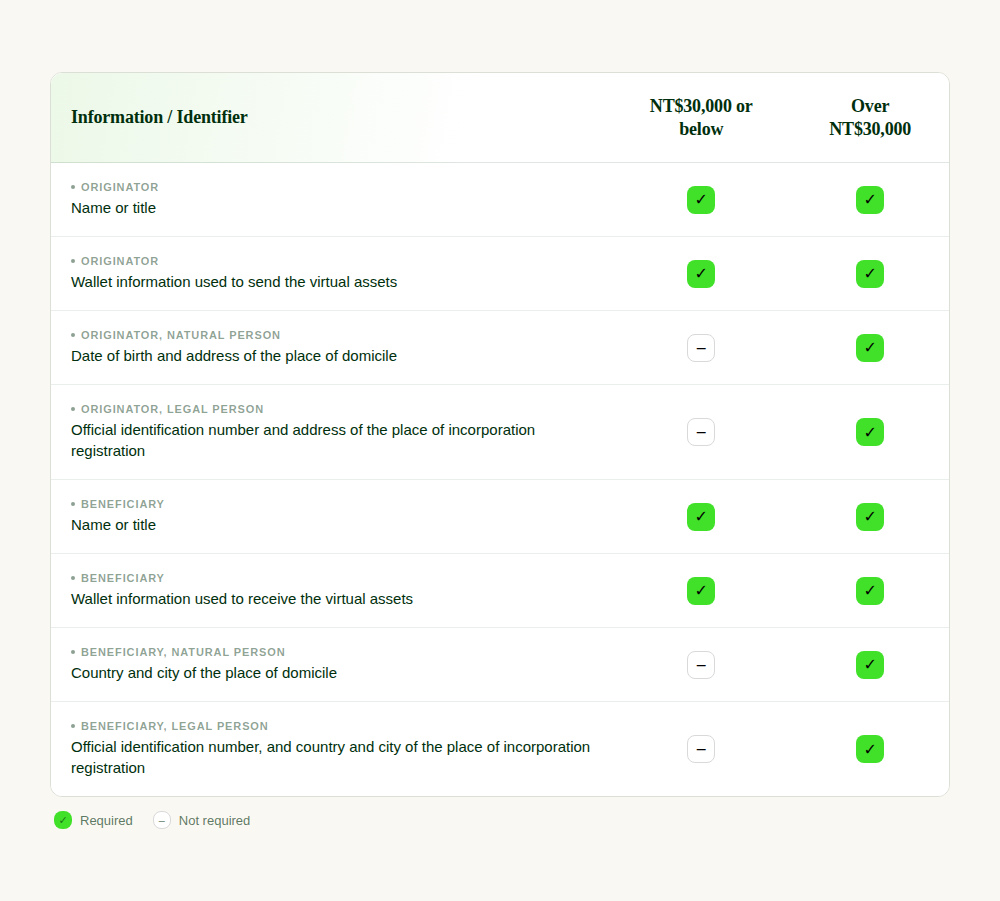
Source: the "Required for all transfers" column reflects the adopted (effective-date-pending) text of Article 7, paragraph 2 of the VASP AML/CFT Regulations [1]. The additional items in the "over NT$30,000" column reflect the enhanced-information mechanism set out in FSC's announced amendment to Article 7 of August 4, 2026, which is planned but not yet enacted [2].
3. What are the obligations of the receiving (beneficiary) VASP in Taiwan?
A VASP acting as the beneficiary party must screen incoming transfers for missing information and decide, on a risk basis, whether to process them. Specifically, it must take reasonable measures to identify transfers that lack the required information, maintain risk-based policies and procedures for determining when to execute, reject, or suspend such transfers and the appropriate follow-up action, and retain the originator and beneficiary information (VASP AML/CFT Regulations, Article 7, paragraph 2).
Beyond receiving and retaining the transmitted data, the FSC's announced amendment adds a beneficiary-side verification step: where the transfer value exceeds NT$30,000, the beneficiary VASP must reconcile the beneficiary information provided by the originating VASP against the customer information it already holds, to strengthen data accuracy and risk control. This reconciliation duty is a check the beneficiary VASP performs against its own records rather than an additional data element transmitted between VASPs [2].
4. What counterparty due diligence must VASPs perform in Taiwan?
Whenever a VASP transfers virtual assets — whether acting as the originating or the beneficiary party — it must verify that its transaction counterparty is subject to and supervised for AML/CFT requirements consistent with the standards set by the FATF (VASP AML/CFT Regulations, Article 7, paragraph 3).
5. Are there differences in customer PII requirements for cross-border transfers versus transfers within Taiwan?
While the information-transmission requirements do not differ between domestic and cross-border transfers, the implementation timeline does. Under the FSC’s announced phased approach, the Travel Rule will first apply to transfers between domestic VASPs, beginning in October 2026, and will subsequently be extended to transfers between domestic and offshore VASPs by the end of 2027 [2].
Regardless of the type of transfer, a VASP must verify, before transferring virtual assets, that its counterparty is subject to AML/CFT supervision consistent with FATF standards (VASP AML/CFT Regulations, Article 7(3)).
6. What are the non-custodial or self-hosted wallet requirements in Taiwan?
To our knowledge, Taiwan has not yet specified the requirements for transactions involving self-hosted wallets.
Why choose Notabene for Crypto Travel Rule Compliance in Taiwan
Notabene Transact is an enterprise-grade transaction authorization platform that lets Taiwanese VASPs verify, authorize, and policy-check every transfer before it settles. Its policy engine applies jurisdiction- and amount-based rules automatically. The platform also supports the receiving-side reconciliation and counterparty checks Article 7 requires. With the largest network of reachable institutions spread across 100+ countries, Transact also readies VASPs for the phased extension to cross-border transfers — where counterparty reachability becomes a revenue issue, not just a compliance one.
[1] FSC | Laws & Regulations Database of the Republic of China (Taiwan) — Regulations Governing Anti-Money Laundering and Countering the Financing of Terrorism for Enterprises or Persons Providing Virtual Asset Services, amended November 26, 2024 (Article 1; Article 2; Article 3, subparagraph 2; Article 7; Article 10; Article 12; Article 17; Article 18).
[2] FSC | Press release, August 4, 2026 — 規劃推動轉帳規則,修正「提供虛擬資產服務之事業或人員防制洗錢及打擊資恐辦法」,及進行法規預告 (Planning to advance the Travel Rule, amend the VASP AML/CFT Regulations, and conduct a draft pre-announcement).
