


US Treasury Focuses on the Travel Rule


How the 2026 Report Reshapes Crypto Compliance
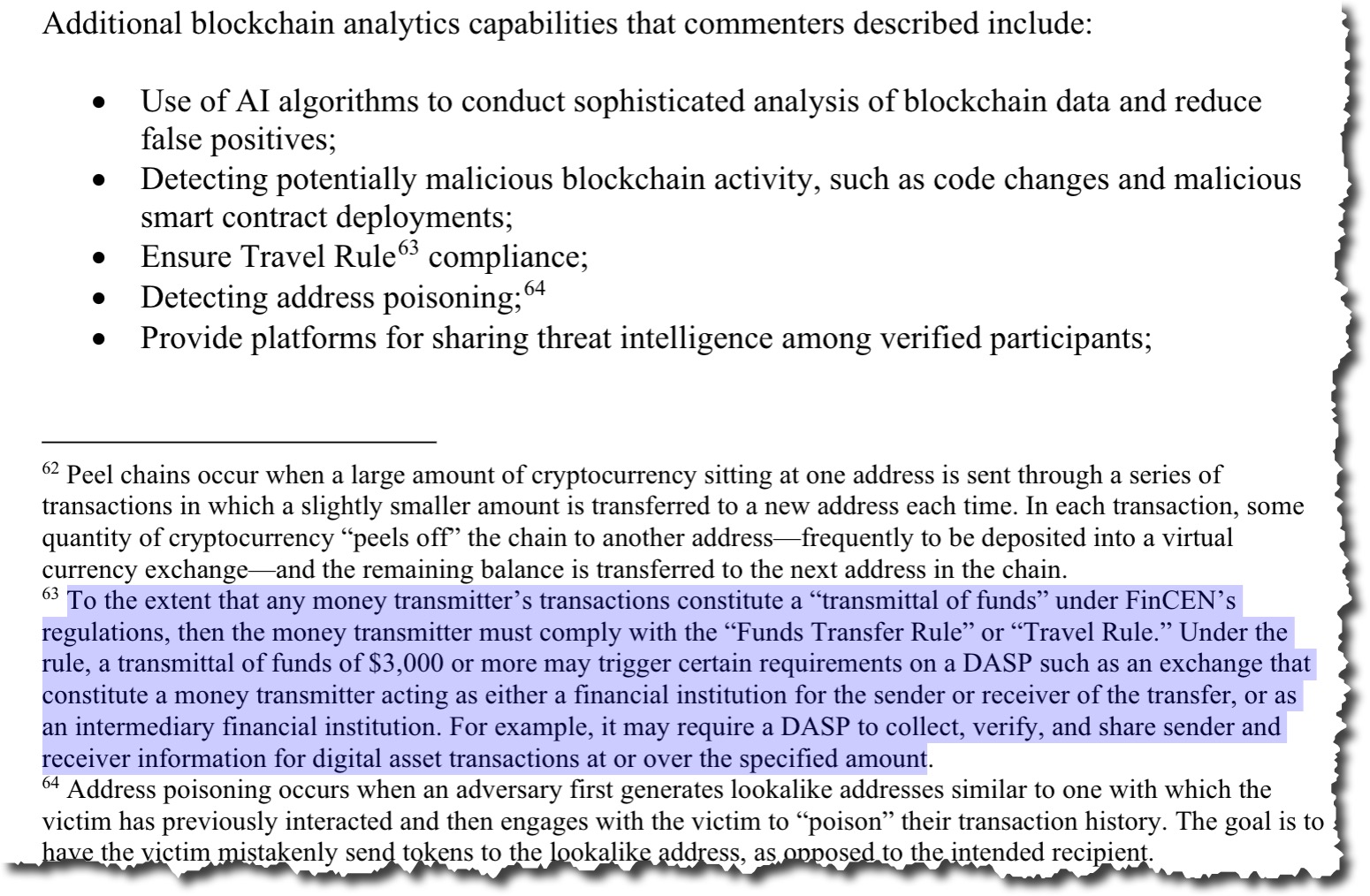
In March 2026, the US Treasury published its report on Innovative Technologies to Counter Illicit Finance Involving Digital Assets. The report frames AI, digital identity, blockchain analytics, and APIs as the four technology pillars for modern financial crime compliance. Inside sits a sharper signal for digital asset firms: Treasury explicitly references the Travel Rule, reaffirming the Funds Transfer Rule applies to crypto transactions over $3,000 and is expected to be operationalized in practice.
While the Travel Rule has long been applicable to the US crypto market, its implementation was frequently viewed more as a policy guideline than a functional necessity. The 2026 report marks a definitive transition from theoretical interpretation to mandatory implementation.
Treasury's Stance on Travel Rule Implementation
Rather than proposing new mandates, the Treasury is reinforcing established regulations. The report reiterates that digital asset transfers fall under the Funds Transfer Rule, maintaining the $3,000 threshold and requiring the collection, verification, and transmission of originator and beneficiary data.
The significance lies in the context: this directive is central to a 2026 report on illicit finance and advanced compliance tools. The industry's focus must now shift from questioning the rule's applicability to ensuring its practical effectiveness.
The Treasury's report is a major federal action signal in addition to the April 8, 2026 joint Notice of Proposed Rulemaking from FinCEN and OFAC detailed AML/CFT requirements for stablecoin issuers under the GENIUS Act. That is in additional to the FATF's March 2026 report identifies Travel Rule data gaps as a primary vulnerability in global crypto AML efforts.
All of these are moving towards the objective of closing the compliance gap.
Monitoring Is Not Travel Rule Execution
Many firms assume blockchain analytics coverage equals Travel Rule coverage. The assumption is wrong.
Blockchain analytics tools identify risk, monitor transactions, and trace flows across wallets and chains. They give institutions visibility into on-chain activity. Analytics tools do not fulfill Travel Rule obligations. They do not send originator and beneficiary data to counterparties. They do not standardize data across institutions. They do not enforce compliance workflows between counterparties.
Insight alone does not meet regulatory requirements. Insight has to be acted on, triggering workflows, exchanging required data, and enforcing decisions across counterparties. This is the distinction Treasury is pointing toward. The difference between monitoring and execution.
Obtaining insight is only the first step toward meeting regulatory mandates. Actionable workflows, data exchange, and cross-counterparty enforcement are necessary to bridge the gap between simple monitoring and true execution.
The Network Nature of Compliance
Because the Travel Rule relies on secure, real-time interactions between institutions, compliance cannot be achieved in isolation. Connectivity is the essential core of the rule.
Digital asset and stablecoin compliance is a network-wide challenge rather than an entity-specific one. While issuer compliance and counterparty controls are foundational, the system remains vulnerable if the broader network fails to exchange data reliably.
Structural exposures caused by network gaps are now a primary target for regulators, as evidenced by the alignment of the FATF offshore VASP report, the April 8 NPRM, and the Treasury Report.
How to Execute Travel Rule Compliance in Practice
This is the gap Notabene was built to solve. Notabene acts as the trust layer enabling institutions to execute Travel Rule compliance. The platform identifies and screens counterparties before a transaction, performs VASP due diligence, securely exchanges required Travel Rule data between institutions, and supports real-time decisions on whether a transaction should proceed. All of this happens before funds move.
Travel Rule compliance depends on reachability. Notabene addresses this through a global network of over 2,100 VASPs and over 260 financial institutions, custodians, and exchanges, spanning more than 100 jurisdictions and supporting 300+ assets and blockchains.
Compliance Infrastructure for the Next Phase of Digital Assets
For years, the Travel Rule was discussed primarily as a regulatory obligation. Treasury’s 2026 report signals a broader shift toward operational maturity, interoperability, and trusted digital asset infrastructure.
The shift is not about entirely new rules. It is about higher expectations for how compliance is embedded into real-time financial systems.
As digital assets and stablecoins become more integrated into global finance, institutions need infrastructure that enables secure connectivity, trusted counterparties, and seamless data exchange across networks. Monitoring and visibility remain important, but scalable growth increasingly depends on the ability to operationalize compliance in a way that supports speed, trust, and cross-border participation.
The opportunity for the industry is significant: institutions that can execute compliance efficiently will be better positioned to expand partnerships, access new markets, and participate confidently in the next generation of financial services.
The question is no longer simply whether firms understand the Travel Rule. It is how they use compliance infrastructure to unlock safer, faster, and more connected digital asset ecosystems.

Notabene is the trust layer for global crypto money movement.
Notabene Flow — the first open stablecoin payments platform for businesses—and Notabene Transact—the world's largest Travel Rule-compliant transaction authorization platform for regulated institutions—are built on the Transaction Authorization Protocol (TAP), an open messaging standard that enables verified entities to transact securely.
The Notabene Network connects thousands of trusted counterparties, facilitating over $1T in transaction volume annually across over 100 jurisdictions.
Subscribe to Notabene Blog
Subscribe to our product updates, news on crypto regulations and more
Request a demo
Notabene offers a demo for you to learn and understand how to use our products
Book demo