

HKMA Stablecoin Licensing Decisions Are Coming in Hong Kong—Are You Ready?


We previously reported on Hong Kong’s new stablecoin issuer regime, which introduced a comprehensive set of Travel Rule obligations for licensed issuers. As the HKMA now moves from reviewing applications to making licensing decisions, issuers that treat Travel Rule as an afterthought risk delaying their go-live—operational readiness on Day 1 will be the real differentiator.
The Stablecoins Ordinance took effect on August 1, 2025, alongside the HKMA’s AML/CFT Guideline for licensed stablecoin issuers. The HKMA made clear that AML/CFT requirements—including Travel Rule compliance—apply to licensed stablecoin issuers.
The Guideline states explicitly in section 1.6 that the minimum AML/CFT criteria
“apply when a licensee is granted a license and continue to apply throughout the licensee’s conduct of licensed stablecoin activities.” HKMA AML/CFT Guideline for Licensed Stablecoin Issuers
In practice, the HKMA expects Travel Rule compliance to be addressed in the AML/CFT policies and procedures submitted as part of the license application. Once a license is granted, stablecoin issuers cannot commence operations until they are able to comply with the Travel Rule—meaning the necessary systems must be fully implemented, tested, and ready to go live before any regulated stablecoin activity begins.
The Ordinance included a transitional regime for entities already conducting regulated stablecoin activities before August 1, 2025, allowing eligible firms to continue operating while their license applications were assessed. This transitional window closes at the end of January 2026, with the HKMA able to grant provisional licenses up to February 1, 2026.
In practice, however, no entity actually benefited from the transitional regime, meaning there are no issuers operating under transitional status while awaiting approval.
The market is now entering the next phase: the HKMA is reviewing the first wave of applications, specifically those submitted by the end of September 2025, and expects to issue licensing decisions early this year.
The market is now entering the next phase: the HKMA is reviewing the first wave of applications, specifically those submitted by the end of September 2025, and expects to issue licensing decisions early this year. For applicants in this first cohort, the priority is to avoid a post-approval scramble—because the fastest route to launch is the one where operational compliance is ready before the license arrives.
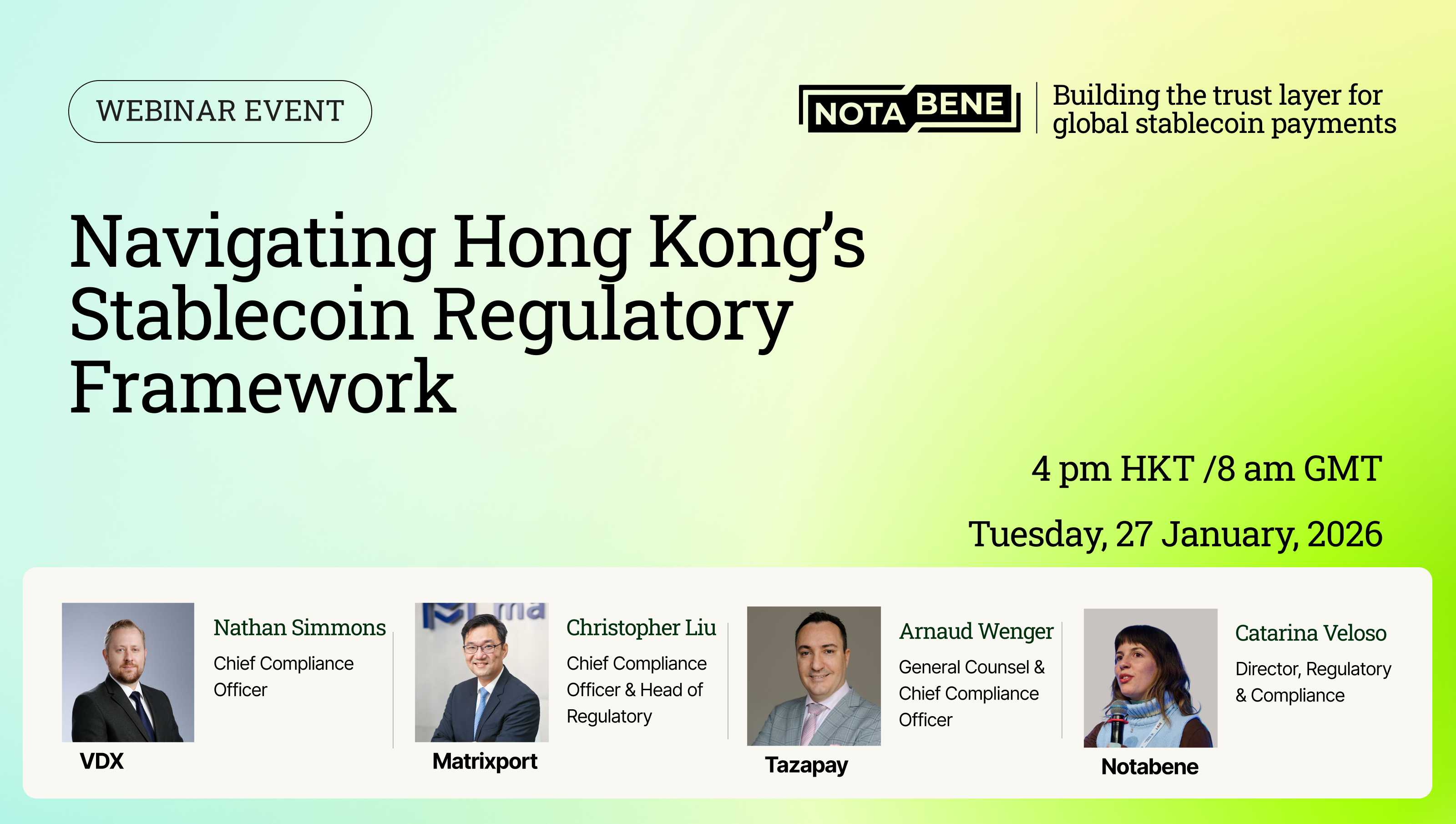
For teams navigating this next phase of approvals and compliance readiness, join our upcoming webinar: HKMA Stablecoin Licensing Decisions Are Coming — Are You Ready?
What issuers should be doing now to protect go-live timelines
- Finalize your Travel Rule solution selection process and complete vendor due diligence
- Map end-to-end stablecoin transfer flows, including self-hosted wallet scenarios
- Approve detailed operating procedures and internal controls for stablecoin transfers
- Assess counterparty readiness, including messaging standards and data availability
- Integrate Travel Rule data into transaction monitoring and sanctions screening
- Produce evidence of testing and operational readiness, so compliance is demonstrable on Day 1
A closer look into Travel Rule obligations for Stablecoin Issuers
Scope of Application
The Guideline on Anti-Money Laundering and Counter-Financing of Terrorism (For Licensed Stablecoin Issuers) applies to stablecoin issuers that hold a license granted under section 15 of the Stablecoins Ordinance.
In the HKMA’s words:
“This Guideline is issued … for a stablecoin issuer which holds a license granted under section 15 of the Stablecoins Ordinance (hereafter referred as ‘licensee’). A licensee is a financial institution as defined in Part 2 of Schedule 1 to the AMLO.”
The HKMA is explicit that compliance with the Guideline is necessary to meet statutory obligations under both the Stablecoins Ordinance and the Anti-Money Laundering and Counter-Terrorist Financing Ordinance (AMLO).
“A licensee should meet these requirements in order to comply with the statutory requirements under the Stablecoins Ordinance and the AMLO.” HKMA AML/CFT Guideline
What that means in practice
- Only licensed stablecoin issuers are directly subject to these guidelines.
- Once licensed, the issuer is treated as an AML/CFT-obliged financial institution under Hong Kong law.
- The obligations apply to:
- the entity itself,
- its officers, senior management, and staff, and
- its licensed stablecoin activities, including issuance, redemption, and stablecoin transfers.
When the obligations apply
Importantly, the guidelines are not just ongoing supervisory expectations. They apply:
“when a licensee is granted a license and continue to apply throughout the licensee’s conduct of licensed stablecoin activities.”
This is why the HKMA expects applicants to demonstrate compliance readiness at the point of licensing, not after.
Who they do not directly apply to
- Unlicensed stablecoin issuers (though they cannot legally operate once licensing is required)
- Wallet providers, VASPs, banks, or intermediaries unless they are also licensed stablecoin issuers
- Overseas group entities, except to the extent group-wide AML/CFT controls are required by the licensed issuer (Chapter 3)
That said, counterparties do feel the impact indirectly, because licensed issuers must assess whether counterparties can meet Travel Rule and data-protection requirements before transacting with them (Chapter 6).
For pre-existing issuers operating under transitional arrangements, January marks the end of the window to continue business without a full license. For new applicants, January is when the HKMA starts deciding who's actually ready versus who's just talking about readiness.
Zero Tolerance for Compliance Gaps
Unlike jurisdictions that set minimum thresholds for Travel Rule compliance, Hong Kong takes a zero-threshold approach. Every stablecoin transfer requires travel rule compliance, regardless of amount. For transfers below $8,000, issuers must still collect and transmit originator and recipient names plus account information. Above $8,000, they need to transmit a broader scope of originator identifying information, as further detailed in our Hong Kong jurisdiction page.
End-to-end Travel Rule processes
Chapter 6 of the Guideline sets out detailed obligations for ordering, intermediary, and beneficiary institutions, in which they need documented procedures for collecting and verifying originator and beneficiary information, transmitting required data immediately and securely, and rejecting or escalating transfers with missing information. For more details, consult our Hong Kong jurisdiction page.
A functioning Travel Rule technology solution
If you rely on a third-party Travel Rule solution, the responsibility still sits with you. The HKMA requires due diligence proving your solution can identify counterparties, transmit data securely in real-time, handle transaction volume, and support sanctions screening.
Counterparty due diligence
Travel Rule compliance depends on who you transact with. The HKMA requires issuers to assess whether counterparties can meet Travel Rule and data-protection obligations before entering into stablecoin transfer relationships.
This is particularly important given the global patchwork of Travel Rule implementation. Issuers must be able to justify why a counterparty is acceptable or restricted.
Integration with monitoring and sanctions screening
Travel Rule data isn’t standalone. The HKMA expects it to feed into transaction monitoring and sanctions screening programs under Chapters 5 and 7 of the Guideline.
That includes screening originators and beneficiaries before executing transfers and using Travel Rule information to detect suspicious activity.
Self-hosted Wallets Get Enhanced Scrutiny
The guidelines take a particularly cautious approach to self-hosted wallet transactions. Stablecoin issuers must:
- Screen wallet addresses against databases of illicit activity
- Implement enhanced monitoring for higher-risk wallets
- Apply transaction limits where appropriate
- Collect originator/recipient information for all transfers to/from unhosted wallets
For more details, consult our Hong Kong jurisdiction page.
Ongoing monitoring
The HKMA recognizes that stablecoin transactions are visible on-chain and that tools like blockchain analytics, wallet screening, blacklists, and freezing mechanisms can help detect and respond to illicit activity. However, the HKMA takes the view that “the effectiveness of these risk mitigating measures is yet to be proven”—especially for peer-to-peer transfers involving self-hosted wallets—the HKMA expects issuers to take a cautious approach. This means that unless an issuer can clearly demonstrate that its risk controls are effective, the HKMA’s default expectation is that the identity of every stablecoin holder should be verified, even where that holder is not a customer of the issuer. In practice, this can create an obligation to verify the identity of third parties, either directly by the issuer or via a supervised financial institution/VASP or another reliable third party.
Operational readiness is your competitive edge
With the HKMA reviewing the first applications, Hong Kong’s stablecoin regime is moving from paper to practice. The framework sets a high bar, and issuers that can translate policies into operational capability will be better positioned to launch quickly once licensed. Travel Rule compliance, in particular, needs to be designed into the operating model from the start—it can’t be treated as a bolt-on—because it shapes everything from customer flows to monitoring, investigations, and SAR reporting. As licensing decisions begin to come through, the first-to-market issuers will be those that can demonstrate readiness and begin operating without delay.
For teams navigating this next phase of approvals and compliance readiness, join our upcoming webinar: HKMA Stablecoin Licensing Decisions Are Coming — Are You Ready?

Notabene is the trust layer for global crypto money movement.
Notabene Flow — the first open stablecoin payments platform for businesses—and Notabene Transact—the world's largest Travel Rule-compliant transaction authorization platform for regulated institutions—are built on the Transaction Authorization Protocol (TAP), an open messaging standard that enables verified entities to transact securely.
The Notabene Network connects thousands of trusted counterparties, facilitating over $1.3T in transaction volume over the past 12 months across over 110 jurisdictions.
Subscribe to Notabene Blog
Subscribe to our product updates, news on crypto regulations and more
Request a demo
Notabene offers a demo for you to learn and understand how to use our products
Book demo